
Last Updated: October 25, 2026
Quick Summary
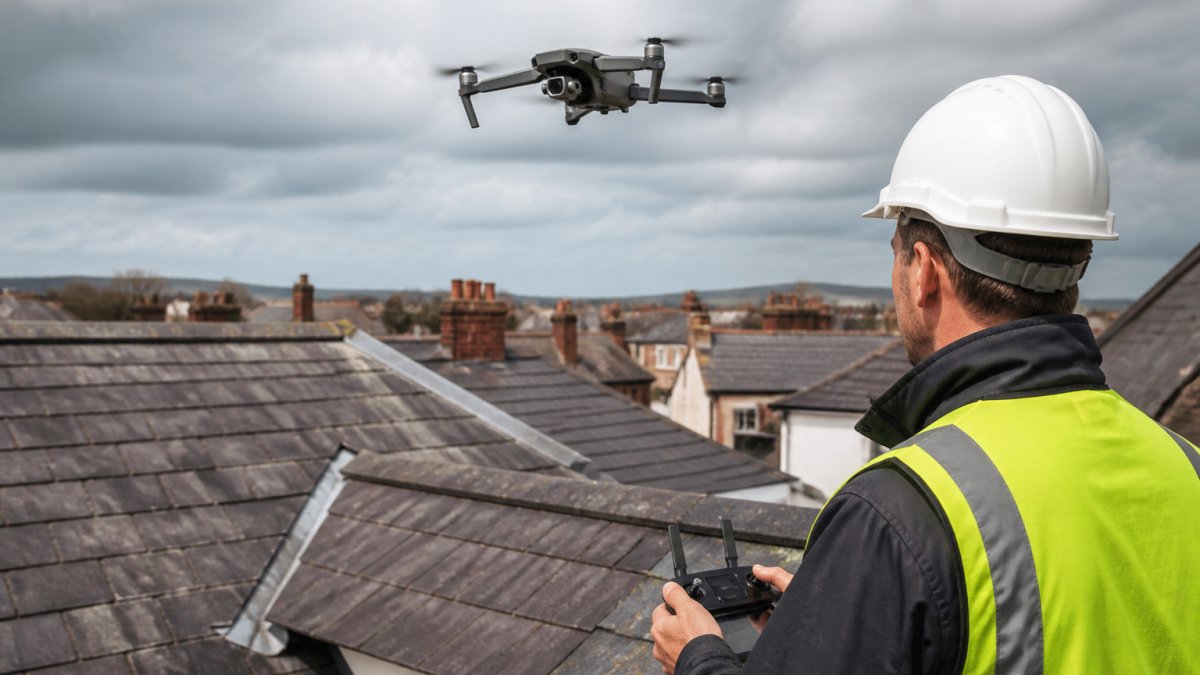
Drone roof inspection safety standards in the UK are set by the Civil Aviation Authority (CAA) under CAP 722, and every commercial flight over a building must follow them. A compliant pilot holds a General Visual Line of Sight Certificate (GVC), carries commercial liability insurance and checks licence, airspace, consent and access before flying.
- A commercial roof inspection pilot must hold a GVC, which requires a theory exam, practical flight assessment and operations manual.
- Impact Aerial holds £5m of commercial liability insurance and pilots are CAA GVC certified.
- Airspace, landowner consent and site access must all be confirmed before the drone leaves its case.
- The risk assessment should name ground hazards, air hazards, weather limits and failure modes for the specific building.
- The most common failure is skipping the wind check at roof height, where ground-level calm means little.
Table of Contents
- What Safety Standards Govern a Drone Roof Inspection
- Drone Roof Survey Permissions: Airspace, Landowner Consent and Site Access
- Building a Drone Roof Inspection Risk Assessment
- Drone Inspection Weather Limits: Wind, Rain and Visibility
- The Pre-Flight Drone Roof Inspection Checklist
- When Drone Inspection Beats Sending Someone Onto the Roof
- Booking a Compliant Drone Roof Inspection
- Frequently Asked Questions
What Safety Standards Govern a Drone Roof Inspection
Drone roof inspection safety standards in the UK are set by the Civil Aviation Authority (CAA), and these drone roof inspection safety standards in the UK apply to every commercial flight over a building. Get them wrong and you are looking at fines, grounded work and a delayed survey. At Impact Aerial, every job we fly starts with those rules, not the camera.
The core principle is simple. A drone over a roof is an aircraft in controlled airspace, and the pilot must hold the right permission for the job. The CAA sets the rules through CAP 722, the CAA’s drone operating guidance, which covers everything from pilot competence to how close you can fly to people and property.
Three things decide whether a flight is legal:
- The pilot’s licence and category of operation
- The airspace around the building
- The consent and access arrangements on site
Miss any one of these and the inspection should not go ahead.
CAA Rules, the GVC and What a Pilot Must Hold
A commercial drone roof inspection needs a pilot holding a General Visual Line of Sight Certificate (GVC). The GVC is the CAA’s licence for flying in the Specific Category, which is where most paid inspection work sits.
The GVC is not a one-off test. It requires a theory exam, a practical flight assessment and an operations manual that the CAA reviews. Pilots then operate under a published set of limits, including staying within visual line of sight and keeping set distances from uninvolved people.
What most guides miss is the insurance side. A compliant operator should carry commercial liability cover, and Impact Aerial holds £5m of it. Ask for the certificate and the insurance schedule before you book. If a pilot cannot produce both, walk away.
For a deeper look at why the licence matters commercially, see why hiring a GVC certified pilot reduces your business risk.
The key facts on what a compliant commercial drone roof inspection requires in the UK.
| Item | Requirement | Note |
|---|---|---|
| Regulator | Civil Aviation Authority (CAA) | Rules set out in CAP 722 |
| Pilot licence | General Visual Line of Sight Certificate (GVC) | Theory exam, practical flight assessment and operations manual |
| Category of operation | Specific Category | Where most paid inspection work sits |
| Insurance | Commercial liability cover | Impact Aerial holds £5m |
| Flight limits | Within visual line of sight | Set distances from uninvolved people |
| Legal checks | Licence, airspace, consent and access | Miss any one and the flight should not go ahead |
Drone Roof Survey Permissions: Airspace, Landowner Consent and Site Access
Permissions for a drone roof survey fall into three buckets: airspace, landowner consent and physical site access. All three need sorting before the drone leaves its case.
Airspace is the first check. Much of the urban and industrial sky sits inside controlled airspace around airports, and flights there need clearance or a specific exemption. A pilot who does not check this is gambling with your schedule.
Landowner consent is the second. The building owner can permit flight over their own roof, but the launch and landing point often sits on someone else’s land. Get that in writing.
Site access is the practical bit. Someone needs to open gates, control the car park and keep staff clear of the operating area. A short site briefing on the day prevents most problems.
Building a Drone Roof Inspection Risk Assessment
A drone roof inspection risk assessment is a written record of what could go wrong on the flight and how the pilot will control it. It is not paperwork for its own sake. It is the document that keeps the job safe and defensible.
The assessment should cover:
- Ground hazards: people, vehicles and overhead cables near the launch point
- Air hazards: other aircraft, birds and nearby tall structures
- Weather: wind, rain and visibility limits on the day
- Failure modes: loss of signal, battery failure and emergency landing zones
In practice, the risk assessment is where a good operator earns their fee. A weak one lists generic hazards. A strong one names the specific building, the specific wind direction and the specific person controlling the site.
Our guide to drone surveys for risk assessments shows how survey data feeds into the wider building risk process.
Drone Inspection Weather Limits: Wind, Rain and Visibility
Drone inspection weather limits are the point where most bookings slip. Wind is the biggest factor. Most enterprise drones have a stated maximum wind resistance, and a sensible pilot flies well inside it, not up to it.
Rain is the second. Most commercial airframes are not waterproof, and moisture on the lens ruins the images you paid for. Light drizzle may be fine. Steady rain is a no.
Visibility matters too. The pilot must keep the drone in sight at all times, and haze or low cloud can end a flight early.
Urban sites add a twist. Wind behaves differently around tall buildings, and vortices can catch a drone on the approach. We cover this in our piece on urban wind effects in drone façade inspections.
The Pre-Flight Drone Roof Inspection Checklist
A drone roof inspection checklist is the short list a pilot runs through before every flight. It turns the risk assessment into actions and catches the mistakes that cause incidents.
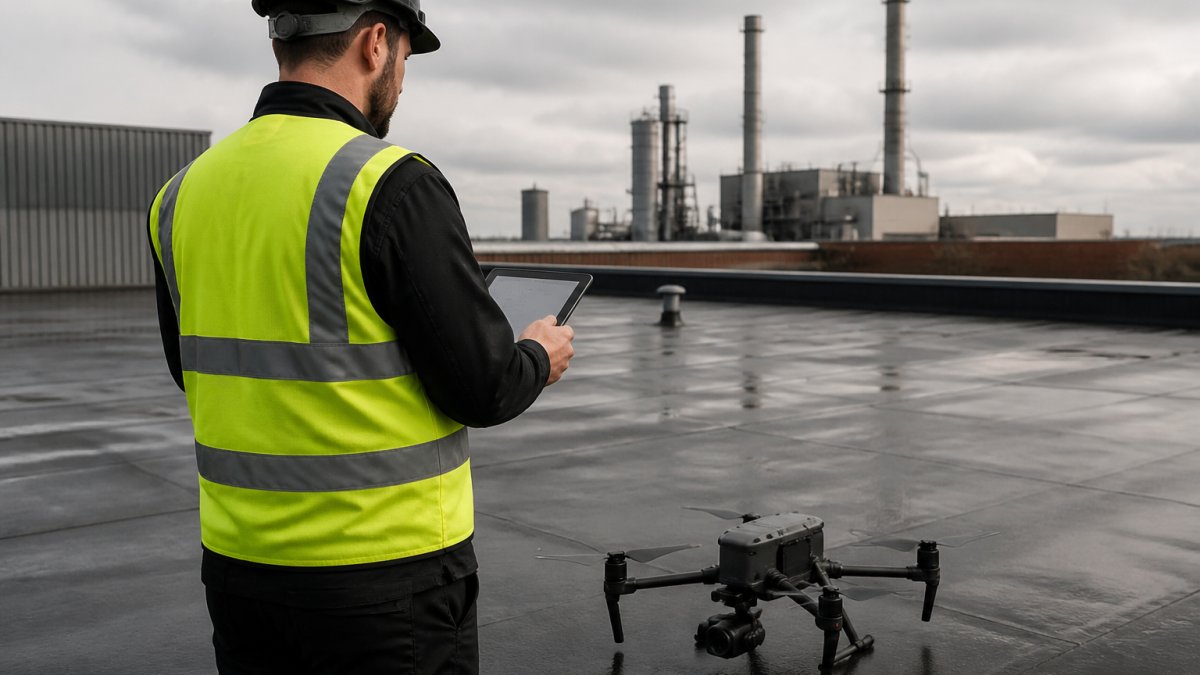
Run through these before take-off:
- CAA permission and GVC certificate on site
- Airspace checked and any clearance confirmed
- Landowner consent and site access agreed
- Weather within limits, wind checked at roof height
- Battery charged and airframe inspected
- Launch and landing zone clear of people
- Emergency landing plan briefed
- Site contact reachable by phone
Watch out: the most common failure is skipping the wind check at roof height. Ground-level calm means little when the roof sits thirty metres up.
When Drone Inspection Beats Sending Someone Onto the Roof
Drone inspection beats manual access when the roof is fragile, high or hard to reach. Sending someone up a ladder or onto a brittle roof carries real risk, and a drone removes most of it.
The case is strongest for:
- Large flat commercial roofs with plant and ductwork
- Pitched or fragile roofs that cannot take weight
- Tall buildings where access equipment is slow to set up
- Repeat inspections where access costs add up fast
Drone imagery is not a full replacement for a close inspection. A surveyor still needs to touch and test certain defects. The honest position is that drones cover the overview and the access, while a specialist handles anything that needs hands on the surface.
Our guide to drone roof surveys sets out where the safety, speed and cost case is strongest.
Booking a Compliant Drone Roof Inspection
Booking a compliant drone roof inspection comes down to checking four things: licence, insurance, permissions and process. Get those confirmed and the flight itself is straightforward.
Ask any operator for:
- Their GVC certificate and CAA operator ID
- A copy of their commercial liability insurance
- How they handle airspace checks and landowner consent
- A sample risk assessment and method statement
At Impact Aerial, our pilots are CAA GVC certified, we carry £5m of commercial liability insurance and we fly a fleet of latest 4K, High Dynamic Range (HDR) DJI Enterprise commercial drones. We handle the permissions and the risk assessment as part of the job.
Pricing depends on the site, the roof size and what you need delivered. For a sense of what drives the figure, see our drone roof survey cost guide.
Frequently Asked Questions
Do you need permission to fly a drone over a building?
Yes. Flying over private land requires the landowner’s or occupier’s consent, and the pilot must also check airspace restrictions such as airport zones, restricted areas and active NOTAMs before take-off. For a commercial drone roof inspection, the operator should hold a CAA General Visual Line of Sight Certificate and appropriate insurance. Permissions also cover site access, marshalling of people below and any temporary restrictions the site imposes, so agree these in writing before the flight date.
Does a drone roof inspection require a risk assessment?
A drone roof inspection risk assessment is standard practice for any commercial flight and should be completed before the drone leaves its case. It records the hazards: people below the flight path, overhead cables, chimney stacks, wind gusts around parapets, and the consequences of a loss of control. It also sets out the mitigations, such as cordoning the area below, keeping the aircraft at a safe stand-off distance and defining abort criteria. Ask to see it; a professional operator will share it without hesitation.
Can a drone inspect a roof in windy or wet weather?
Drone inspection weather limits depend on the aircraft, but most commercial operators will not fly in sustained winds above roughly 10 metres per second, in rain that risks water ingress, or in conditions where visibility or GPS signal is compromised. Gusts around tall buildings and parapets can be significantly stronger than ground-level forecasts suggest, so a pilot should measure on site rather than rely on an app. If conditions are marginal, the flight should be postponed rather than rushed.
When is a drone roof inspection safer than a physical inspection?
A drone roof inspection removes the need for rope access, ladders or scaffolding on fragile surfaces, which is where most roof-related injuries occur. It suits large, complex or hard-to-reach roofs, solar arrays, and buildings where access would disrupt occupants. However, drone imagery complements rather than replaces a close physical inspection where a surveyor needs to touch, probe or test materials. The safest approach combines both: drone capture for coverage and a physical inspection for detailed diagnosis.
Flying a roof safely is a process, not a camera. If you want an inspection that stands up to scrutiny, get the licence, insurance and permissions checked before anything takes off. Impact Aerial brings CAA GVC certified pilots, £5m of commercial liability cover and a full pre-flight process to every job. Get started with Impact Aerial and book a compliant drone roof inspection with confidence.

 2 Norton Drive, Wythall, Birmingham, B47 6HH Company registration number: 11138586. VAT Number: 366 9068 55


