Adjacent Building Wind Vortices: Why Urban Wind Effects Matter in Drone Façade Inspections
Urban drone inspections require more than simply checking the weather forecast. In dense city environments, adjacent buildings can create complex wind vortices, turbulence, downwash, corner acceleration and urban canyon effects that directly affect drone stability, safety and image quality.
For commercial façade inspections, especially in city-centre locations such as London, Birmingham, Manchester and other high-density urban areas, understanding local wind behaviour is critical. A site may appear suitable from a standard weather forecast, yet still present challenging localised airflow conditions once wind interacts with surrounding buildings.
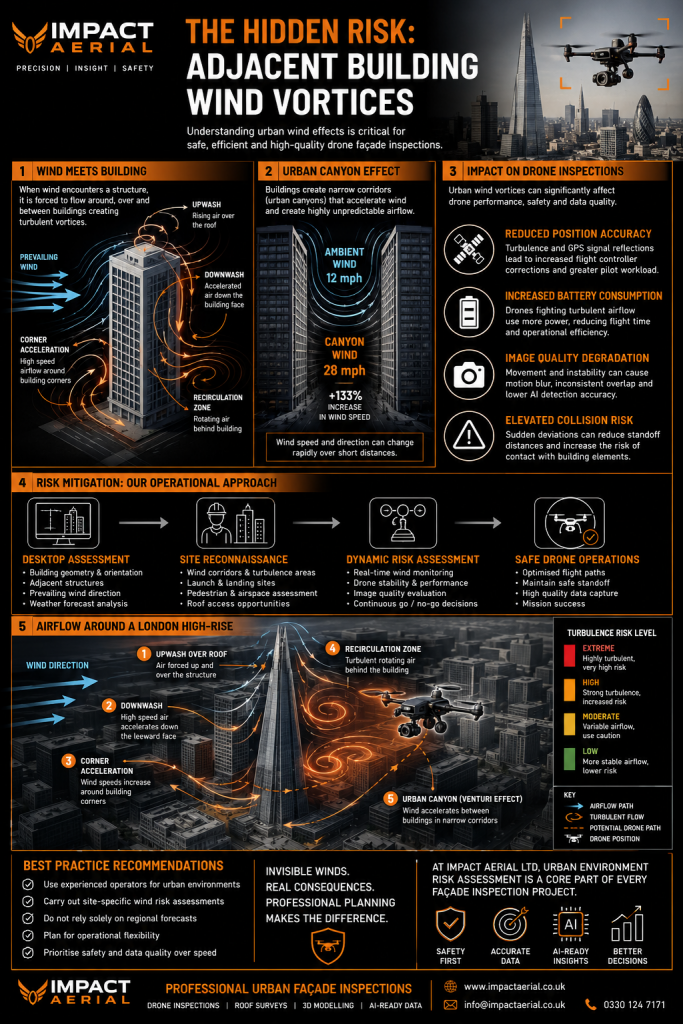
What Are Adjacent Building Wind Vortices?
When wind meets a large building, it is forced around, over and between structures. This creates disturbed airflow patterns that may include upwash, downwash, recirculation zones, corner acceleration and turbulent rotor effects behind buildings.
These effects are often invisible from ground level but can become highly significant when operating a drone close to a building façade.
The Urban Canyon Effect
The urban canyon effect occurs when streets or gaps between tall buildings act like wind corridors. As air is channelled through these spaces, wind speed can increase significantly compared with the general forecasted wind speed.
For example, a forecasted wind speed of 12 mph may result in much stronger localised gusts between buildings, particularly around corners, roof edges and recessed façade areas.
Why This Matters for Drone Inspections
During façade inspection work, drones often operate close to vertical surfaces to capture high-resolution imagery. In these conditions, wind vortices can cause sudden movement, increased pilot workload and reduced image consistency.
1. Reduced Position Accuracy
Urban areas already present GPS challenges due to signal reflection from buildings. When turbulence is added, maintaining accurate positioning becomes more difficult.
2. Increased Battery Consumption
A drone working against turbulent airflow uses more power, reducing flight time and increasing the number of battery changes required on site.
3. Image Quality Degradation
Unstable flight can result in motion blur, inconsistent overlap and reduced inspection quality. This is especially important where imagery is being used for AI-assisted defect detection or detailed condition reporting.
4. Elevated Collision Risk
Sudden gusts, downwash or corner acceleration can reduce safe standoff distance from the building. This increases the risk of contact with façades, balconies, ledges, plant, signage or other protrusions.
How Impact Aerial Manages Urban Wind Risk
Impact Aerial Ltd assesses urban wind conditions as part of its operational planning process for commercial drone façade inspections. This includes reviewing the building geometry, adjacent structures, likely wind direction, launch locations, pedestrian areas and operational constraints.
Our approach includes:
- Desktop assessment of the building and surrounding environment
- Review of prevailing wind direction and forecasted gust conditions
- Site reconnaissance to identify wind corridors and turbulence zones
- Dynamic risk assessment during the flight operation
- Continuous monitoring of drone stability, image quality and safe standoff distance
- Clear go / no-go decision-making based on real site conditions
Why Professional Planning Matters
Urban wind effects can change rapidly over short distances. A launch location may feel calm while the upper levels of a building experience strong downwash or turbulent recirculation. This is why drone façade inspections in complex city environments should be planned and delivered by experienced commercial operators.
Professional planning helps ensure that the inspection can be completed safely, efficiently and with the level of image quality required for surveyors, engineers, architects, property managers and AI inspection platforms.
Conclusion
Adjacent building wind vortices are one of the hidden risks of urban drone operations. They can affect aircraft stability, GPS performance, battery consumption, data quality and collision risk.
For city-centre façade inspections, understanding and managing these effects is essential. At Impact Aerial Ltd, urban environment risk assessment forms a core part of every façade inspection project, helping clients obtain high-quality visual data while maintaining safe and compliant drone operations.
Need a Professional Urban Façade Inspection?
Impact Aerial Ltd provides professional drone façade inspections, roof surveys, 3D modelling and AI-ready image capture services for commercial buildings across the UK.
Website: www.impactaerial.co.uk
 2 Norton Drive, Wythall, Birmingham, B47 6HH Company registration number: 11138586. VAT Number: 366 9068 55