
9 Steps to a Safe Roof Drone Inspection in the UK

Last Updated: November 14, 2026

Quick Summary

A safe roof drone inspection starts with planning, not flying. Check the CAA rules, complete a written risk assessment and a pre-flight checklist, then fly a systematic grid pattern only when weather meets your go/no-go thresholds. Keep the ground clear and confirm full image coverage before packing up.

  • Walking a fragile roof is dangerous, and a drone inspection removes the need for anyone to step onto it.
  • The pilot and operator must meet CAA requirements, including operator registration and pilot competency.
  • Set clear go/no-go weather thresholds before arriving on site, and do not fly outside them.
  • Overlap photographs so every part of the roof appears in at least two images.
  • Drone imagery shows surface condition but cannot always see beneath the covering, so recommend hands-on checks where needed.
Need a safer way to inspect your roof?Impact Aerial flies CAA-qualified drone roof surveys with £5m liability cover.

Book a Roof Survey

Table of Contents

Walking a fragile roof to inspect it is one of the most dangerous jobs in building maintenance, and it is avoidable. A roof drone inspection lets you look at the surface, edges, flashings and gutters from the air, without anyone stepping onto the roof. Safety should be the first decision on every survey, not an afterthought once the drone is in the air.

A roof drone inspection is a planned aerial survey. A remote pilot flies a drone over the roof in a set pattern, captures high-resolution photographs and video, and uses that imagery to find cracks, leaks, loose coverings and damaged edges. The footage becomes a permanent record that the building owner, surveyor or facilities team can review later.

The aim is not just to get pictures. It is to inspect the roof in a way that keeps people and property safe, both on the ground and above it. If you are weighing up whether a drone is the right tool, our [page] guide explains the safer non-access options available for fragile roofs.

Why safety comes first:

  • Fragile roofs can give way under a person’s weight without warning (Fragile surfaces)
  • Work at height is a leading cause of serious injury in the building sector
  • Drones remove the need for anyone to walk or crawl across the roof surface
  • A well-planned flight reduces risk to people working below and nearby

A common mistake is treating the drone flight as the whole job. The planning, risk assessment and weather checks before take-off matter just as much as the footage itself. Skip them, and a quick survey can turn into an incident.

For many roofs, a drone inspection also reduces cost and disruption. Rope access and scaffolding can take days to arrange, while a drone survey can often be completed in a single visit. Compare the options with our [page] guide before you commit to a method.


UK Regulations You Must Follow Before Flying Over a Roof

Any drone flight over a building in the UK must follow the rules set by the Civil Aviation Authority (CAA). Before the first flight, confirm which category of operation applies, what training the pilot holds, and whether the flight needs CAA permission. Operators flying commercially should hold CAA GVC qualifications, and the rules should be checked for every site before flying.

The CAA publishes the rules for flying drones commercially, and these apply whether you hire a specialist or run the drone yourself. You can read the current requirements on the CAA guidance on drone and model aircraft rules page before you plan any flight.

Key areas to check before you fly:

  • Operator registration: the business flying the drone must be registered with the CAA
  • Pilot competency: the remote pilot must hold the right qualification for the operation
  • Flight category: the operation category affects distances, population density and permissions
  • Airspace: restricted areas, airports and controlled airspace need checking and clearance where required
  • Privacy: images of people and private property must be handled within data protection rules

Our research into roof drone inspection workflows found a consistent theme: structured, documented planning reduces risk. A written workflow covering set-up, flight area and photography requirements gives every crew member the same expectations. The TU Wien paper on a standard workflow for drone roof inspections describes the four main stages of such a workflow.

Watch out: flying without the right permissions can lead to fines and delays on site.


Drone Roof Inspection Checklist: Pre-Flight Planning and Site Assessment

A good roof drone inspection starts on the ground, long before the drone leaves its case. Pre-flight planning turns a vague request for “a look at the roof” into a clear, safe job with defined limits.

Work through these steps before every flight:

  • Confirm the inspection goals: leaks, cracks, gutters, or general condition
  • Review the site plan and note obstacles such as masts, aerials and nearby trees
  • Identify people, vehicles and property within the flight area
  • Check the weather forecast for wind speed, rain and visibility
  • Agree the take-off and landing points and a clear exclusion zone

A site assessment should also cover hazards. Look for power lines, skylights, plant equipment and any area where the drone could lose signal. Write these down in a risk assessment and share it with the client and the site team. Plan a contingency too: what happens if the drone loses its GPS link, or if the wind rises during the flight?

What most guides miss is the value of a simple written checklist. Tick off each item, sign it off and keep it with the job file. If something goes wrong later, that record shows the work was planned properly.


Equipment Needed for a Safe Drone Roof Inspection

The right equipment makes a roof survey faster and safer. We fly a fleet of the latest 4K, High Dynamic Range (HDR) DJI Enterprise commercial drones.

At minimum, a roof inspection needs:

  • A suitable drone with a stable camera and a gimbal for smooth footage
  • A high-resolution camera capable of 4K video and detailed still photographs
  • Spare batteries, so a low charge does not end the survey mid-flight
  • A controller with a clear live view of the drone and its position
  • A tablet or screen for checking framing and coverage in the field
  • Safety equipment for the ground crew, including high-visibility clothing

Post-flight checks matter too. Inspect the propellers, body and gimbal for damage after every flight, and log any faults. Store batteries correctly and keep the equipment clean and dry.

Our operators work to strict safety rules. For clients who want to compare the costs of drone and rope access inspections, our [page] guide sets out the main differences.


Flying the Inspection: Flight Patterns, Distances and Weather Go/No-Go Decisions

The flight itself should follow a planned, systematic pattern. A grid pattern covers the roof in consistent passes, so no area is missed. The pilot should keep the drone within visual line of sight (VLOS) at all times, and stay within the altitude and distance limits set in the flight plan.

Weather decides whether the flight goes ahead. Set clear go and no-go thresholds before you arrive on site. High wind, rain, poor visibility and low light can all make a flight unsafe or the images unusable. If conditions fall outside your thresholds, do not fly. Reschedule.

A simple go/no-go check:

  • Go: wind within the drone’s safe limits, good visibility, dry conditions, stable light
  • No-go: gusts above the safe limit, rain or fog, poor light, or any unexpected hazard on site

Keep the ground area clear during take-off and landing. Stop the flight if a person enters the exclusion zone, and land the drone safely before resuming. The most dangerous moments are often the start and end of a flight, so give them full attention.


Drone Roof Inspection Best Practices for Image Capture and Coverage Checks

Good images are the point of the whole survey. Plan the camera settings and framing before the flight, so the pilot captures what the inspector needs without re-flying.

Follow these image capture steps:

  • Shoot stills and video at a consistent height and angle across the roof
  • Overlap photographs so every part of the surface appears in at least two images
  • Capture roof edges, flashings, outlets and gutters as separate close-up shots
  • Check exposure and focus on the live view before each pass
  • Review the footage on site to confirm coverage before the drone is packed away

Coverage checks are essential. Work through a short list: is every roof section captured, are the edges visible, and are any problem areas shown clearly? If not, fly the missing sections again while you are still on site. Returning later costs more time and money.

Drone imagery has limits. It shows surface condition well, but it cannot always see what is under the covering. Be clear with the client about what the survey can and cannot confirm, and recommend a hands-on inspection where the images raise concerns.


Booking Your Next Roof Survey With Impact Aerial

Roof drone inspections are safer, faster and often more cost-effective than walking the roof or erecting scaffolding. The right planning, the right equipment and the right regulations keep people and property protected throughout.

Our team is CAA GVC qualified, we hold £5m commercial liability insurance, and we have over 20 years of experience in aerial photography, videography and data gathering surveys. If you need a roof survey, you can [page] to see what we offer and how we can help your next project.


Frequently Asked Questions

How do you safely inspect a roof with a drone?

Plan the flight before leaving the office: define the flight area, identify obstacles such as aerials and plant, and set a safe height and standoff distance from the roof edge. Use a trained, CAA GVC-qualified pilot, keep the drone within visual line of sight, and avoid flying over people or property. Verify coverage with a checklist of images as the flight progresses, and land only when the surface, edges and hard-to-reach areas have been captured.
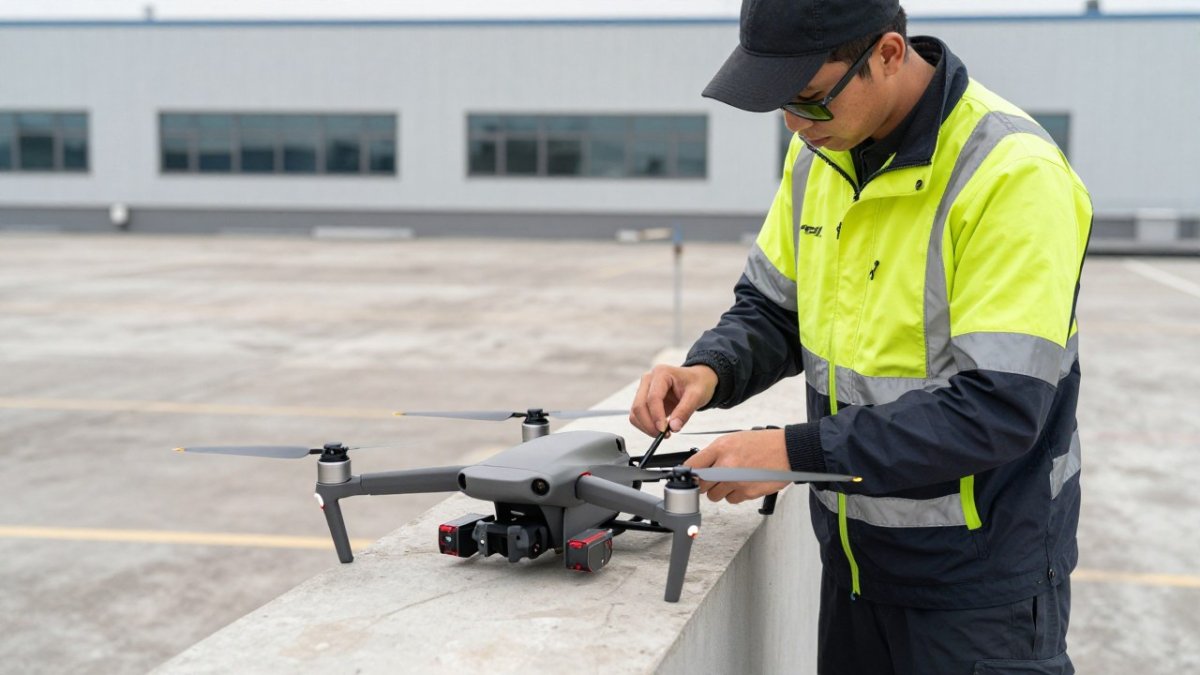
Licensed operator in high-visibility gear preparing equipment for a roof drone inspection on a flat building.

Do you need permission to use a drone for a roof inspection?

Commercial drone operations in the UK are regulated by the Civil Aviation Authority under the Air Navigation Order 2016 and the Department for Transport’s rules for drones. Operators need the appropriate qualification for the type of flight, and they must have permission from the landowner or building owner to fly over the site. Check the airspace before every flight, as controlled airspace and restricted zones may require further permissions.

What weather conditions are suitable for a drone roof inspection?

Flights should be postponed in strong winds, heavy rain, snow, fog or poor visibility. Set a wind speed threshold before the job begins and check gusts as well as average wind, since gusts near a roof edge create turbulence. Daylight and clear visibility are needed to capture usable images of cracks, leaks and surface damage. Make a go/no-go decision at the site before take-off and log the conditions in the flight record.

When should you hire a professional drone roof inspection service?

Hire a professional service when the roof is high, fragile, sloped or difficult to access, when the inspection must meet insurance or maintenance records requirements, or when your in-house team does not hold current CAA qualifications. A professional operator carries commercial liability cover and follows a documented safety procedure. Impact Aerial holds £5m commercial liability insurance; contact us for a quote, as pricing depends on the site, the scope and the delivery timescale.

Are Drone Roof Inspections Safe? UK Standards Explained

Last Updated: October 25, 2026

Quick Summary

Drone roof inspection safety standards in the UK are set by the Civil Aviation Authority (CAA) under CAP 722, and every commercial flight over a building must follow them. A compliant pilot holds a General Visual Line of Sight Certificate (GVC), carries commercial liability insurance and checks licence, airspace, consent and access before flying.

  • A commercial roof inspection pilot must hold a GVC, which requires a theory exam, practical flight assessment and operations manual.
  • Impact Aerial holds £5m of commercial liability insurance and pilots are CAA GVC certified.
  • Airspace, landowner consent and site access must all be confirmed before the drone leaves its case.
  • The risk assessment should name ground hazards, air hazards, weather limits and failure modes for the specific building.
  • The most common failure is skipping the wind check at roof height, where ground-level calm means little.

Table of Contents

What Safety Standards Govern a Drone Roof Inspection

Drone roof inspection safety standards in the UK are set by the Civil Aviation Authority (CAA), and these drone roof inspection safety standards in the UK apply to every commercial flight over a building. Get them wrong and you are looking at fines, grounded work and a delayed survey. At Impact Aerial, every job we fly starts with those rules, not the camera.

The core principle is simple. A drone over a roof is an aircraft in controlled airspace, and the pilot must hold the right permission for the job. The CAA sets the rules through CAP 722, the CAA’s drone operating guidance, which covers everything from pilot competence to how close you can fly to people and property.

Three things decide whether a flight is legal:

  • The pilot’s licence and category of operation
  • The airspace around the building
  • The consent and access arrangements on site

Miss any one of these and the inspection should not go ahead.

CAA Rules, the GVC and What a Pilot Must Hold

A commercial drone roof inspection needs a pilot holding a General Visual Line of Sight Certificate (GVC). The GVC is the CAA’s licence for flying in the Specific Category, which is where most paid inspection work sits.

The GVC is not a one-off test. It requires a theory exam, a practical flight assessment and an operations manual that the CAA reviews. Pilots then operate under a published set of limits, including staying within visual line of sight and keeping set distances from uninvolved people.

What most guides miss is the insurance side. A compliant operator should carry commercial liability cover, and Impact Aerial holds £5m of it. Ask for the certificate and the insurance schedule before you book. If a pilot cannot produce both, walk away.

For a deeper look at why the licence matters commercially, see why hiring a GVC certified pilot reduces your business risk.

The key facts on what a compliant commercial drone roof inspection requires in the UK.

Item Requirement Note
Regulator Civil Aviation Authority (CAA) Rules set out in CAP 722
Pilot licence General Visual Line of Sight Certificate (GVC) Theory exam, practical flight assessment and operations manual
Category of operation Specific Category Where most paid inspection work sits
Insurance Commercial liability cover Impact Aerial holds £5m
Flight limits Within visual line of sight Set distances from uninvolved people
Legal checks Licence, airspace, consent and access Miss any one and the flight should not go ahead

Permissions for a drone roof survey fall into three buckets: airspace, landowner consent and physical site access. All three need sorting before the drone leaves its case.

Airspace is the first check. Much of the urban and industrial sky sits inside controlled airspace around airports, and flights there need clearance or a specific exemption. A pilot who does not check this is gambling with your schedule.

Landowner consent is the second. The building owner can permit flight over their own roof, but the launch and landing point often sits on someone else’s land. Get that in writing.

Site access is the practical bit. Someone needs to open gates, control the car park and keep staff clear of the operating area. A short site briefing on the day prevents most problems.

Building a Drone Roof Inspection Risk Assessment

A drone roof inspection risk assessment is a written record of what could go wrong on the flight and how the pilot will control it. It is not paperwork for its own sake. It is the document that keeps the job safe and defensible.

The assessment should cover:

  • Ground hazards: people, vehicles and overhead cables near the launch point
  • Air hazards: other aircraft, birds and nearby tall structures
  • Weather: wind, rain and visibility limits on the day
  • Failure modes: loss of signal, battery failure and emergency landing zones

In practice, the risk assessment is where a good operator earns their fee. A weak one lists generic hazards. A strong one names the specific building, the specific wind direction and the specific person controlling the site.

Our guide to drone surveys for risk assessments shows how survey data feeds into the wider building risk process.

Drone Inspection Weather Limits: Wind, Rain and Visibility

Drone inspection weather limits are the point where most bookings slip. Wind is the biggest factor. Most enterprise drones have a stated maximum wind resistance, and a sensible pilot flies well inside it, not up to it.

Contact Us →

Rain is the second. Most commercial airframes are not waterproof, and moisture on the lens ruins the images you paid for. Light drizzle may be fine. Steady rain is a no.

Visibility matters too. The pilot must keep the drone in sight at all times, and haze or low cloud can end a flight early.

Urban sites add a twist. Wind behaves differently around tall buildings, and vortices can catch a drone on the approach. We cover this in our piece on urban wind effects in drone façade inspections.

The Pre-Flight Drone Roof Inspection Checklist

A drone roof inspection checklist is the short list a pilot runs through before every flight. It turns the risk assessment into actions and catches the mistakes that cause incidents.

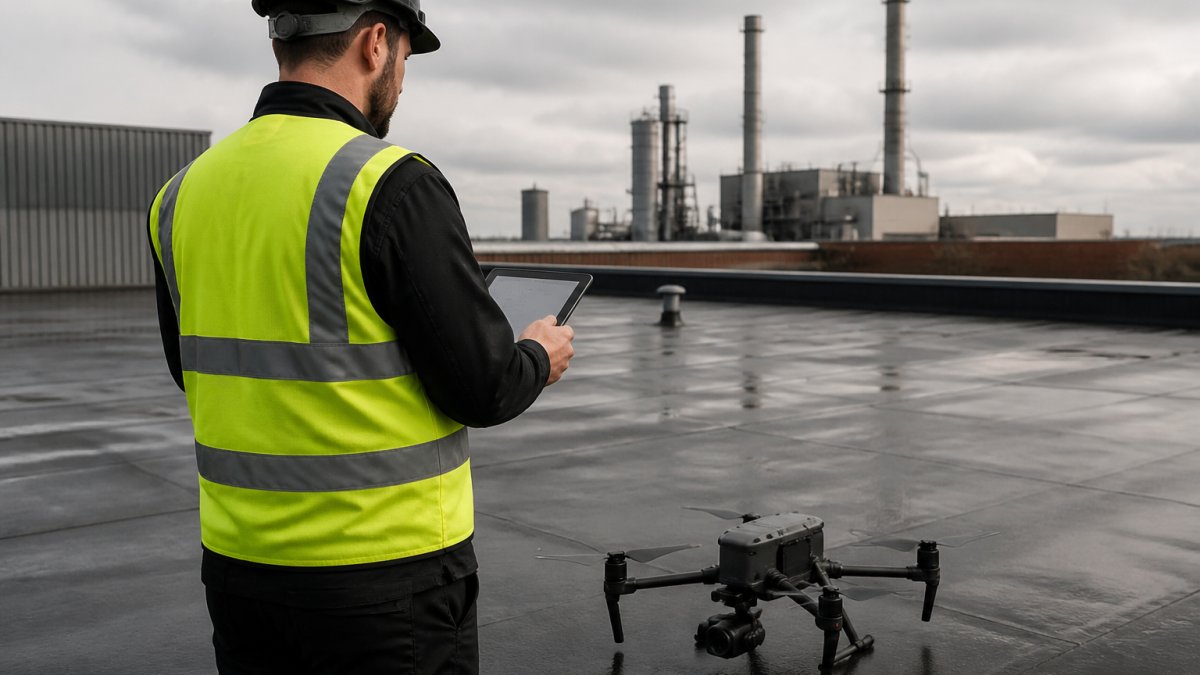
A licensed drone pilot in a high-visibility vest standing beside a commercial quadcopter on a flat commercial rooftop, holding a tablet showing a pre-flight checklist, with industrial plant and parapet walls in the background

Run through these before take-off:

  • CAA permission and GVC certificate on site
  • Airspace checked and any clearance confirmed
  • Landowner consent and site access agreed
  • Weather within limits, wind checked at roof height
  • Battery charged and airframe inspected
  • Launch and landing zone clear of people
  • Emergency landing plan briefed
  • Site contact reachable by phone

Watch out: the most common failure is skipping the wind check at roof height. Ground-level calm means little when the roof sits thirty metres up.

When Drone Inspection Beats Sending Someone Onto the Roof

Drone inspection beats manual access when the roof is fragile, high or hard to reach. Sending someone up a ladder or onto a brittle roof carries real risk, and a drone removes most of it.

The case is strongest for:

  • Large flat commercial roofs with plant and ductwork
  • Pitched or fragile roofs that cannot take weight
  • Tall buildings where access equipment is slow to set up
  • Repeat inspections where access costs add up fast

Drone imagery is not a full replacement for a close inspection. A surveyor still needs to touch and test certain defects. The honest position is that drones cover the overview and the access, while a specialist handles anything that needs hands on the surface.

Our guide to drone roof surveys sets out where the safety, speed and cost case is strongest.

Booking a Compliant Drone Roof Inspection

Booking a compliant drone roof inspection comes down to checking four things: licence, insurance, permissions and process. Get those confirmed and the flight itself is straightforward.

Ask any operator for:

  • Their GVC certificate and CAA operator ID
  • A copy of their commercial liability insurance
  • How they handle airspace checks and landowner consent
  • A sample risk assessment and method statement

At Impact Aerial, our pilots are CAA GVC certified, we carry £5m of commercial liability insurance and we fly a fleet of latest 4K, High Dynamic Range (HDR) DJI Enterprise commercial drones. We handle the permissions and the risk assessment as part of the job.

Pricing depends on the site, the roof size and what you need delivered. For a sense of what drives the figure, see our drone roof survey cost guide.

Frequently Asked Questions

Do you need permission to fly a drone over a building?

Yes. Flying over private land requires the landowner’s or occupier’s consent, and the pilot must also check airspace restrictions such as airport zones, restricted areas and active NOTAMs before take-off. For a commercial drone roof inspection, the operator should hold a CAA General Visual Line of Sight Certificate and appropriate insurance. Permissions also cover site access, marshalling of people below and any temporary restrictions the site imposes, so agree these in writing before the flight date.

Does a drone roof inspection require a risk assessment?

A drone roof inspection risk assessment is standard practice for any commercial flight and should be completed before the drone leaves its case. It records the hazards: people below the flight path, overhead cables, chimney stacks, wind gusts around parapets, and the consequences of a loss of control. It also sets out the mitigations, such as cordoning the area below, keeping the aircraft at a safe stand-off distance and defining abort criteria. Ask to see it; a professional operator will share it without hesitation.

Can a drone inspect a roof in windy or wet weather?

Drone inspection weather limits depend on the aircraft, but most commercial operators will not fly in sustained winds above roughly 10 metres per second, in rain that risks water ingress, or in conditions where visibility or GPS signal is compromised. Gusts around tall buildings and parapets can be significantly stronger than ground-level forecasts suggest, so a pilot should measure on site rather than rely on an app. If conditions are marginal, the flight should be postponed rather than rushed.

When is a drone roof inspection safer than a physical inspection?

A drone roof inspection removes the need for rope access, ladders or scaffolding on fragile surfaces, which is where most roof-related injuries occur. It suits large, complex or hard-to-reach roofs, solar arrays, and buildings where access would disrupt occupants. However, drone imagery complements rather than replaces a close physical inspection where a surveyor needs to touch, probe or test materials. The safest approach combines both: drone capture for coverage and a physical inspection for detailed diagnosis.


Flying a roof safely is a process, not a camera. If you want an inspection that stands up to scrutiny, get the licence, insurance and permissions checked before anything takes off. Impact Aerial brings CAA GVC certified pilots, £5m of commercial liability cover and a full pre-flight process to every job. Get started with Impact Aerial and book a compliant drone roof inspection with confidence.