Virtual Tour for Conference Centres: A Buyer’s Guide

What makes the best virtual tour for conference centres? It answers practical questions before it tries to impress. Event planners need more than a glimpse of an attractive room. They need to understand layouts, atmosphere and how spaces might work for their event, even when they can’t visit in person.

Choosing a provider can be difficult when terms such as interactive, immersive and high quality don’t explain exactly what you’ll receive. This guide helps you compare tour options against clear requirements, define the experience your venue needs and prepare a focused brief for a professional provider.

We’ll look at how to present key rooms and configurations, what to check about navigation, mobile performance, hosting and final deliverables, and which technical details need separate confirmation. You’ll also learn how to plan capture around venue operations, agree access and approvals, and address safety before filming begins. The result is a more informed way to commission a tour that gives remote prospects a clearer view of your venue and your team a defined scope to work from.

Key Takeaways

  • A virtual tour for conference centres should help remote planners assess spaces, atmosphere and how venue areas connect.
  • Separate essential venue information from optional tour features, and confirm available formats and functions with each provider.
  • Compare suppliers using a written brief that sets out your audience, intended use, priority spaces and required deliverables.
  • Prepare a space inventory, access plan and list of areas to exclude so capture can be coordinated with venue operations and safety requirements.
  • Assess whether a provider’s relevant experience, project process and post-production scope fit your venue’s needs, then agree approvals before work begins.

Why a Virtual Tour for a Conference Centre Should Support Venue Decisions

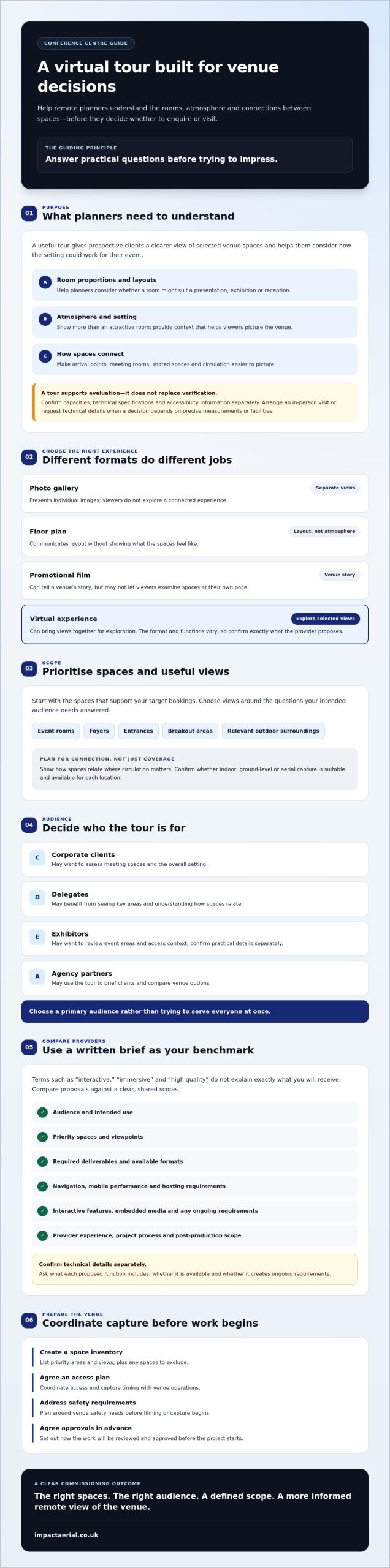
A virtual tour for conference centres gives prospective clients a digital way to explore selected venue spaces before making an enquiry. Its purpose is practical as well as presentational: help event planners picture the rooms, understand how spaces connect and judge whether the setting could suit their event. A useful tour does more than show attractive rooms. It gives viewers a clearer sense of the venue they may be considering.

A tour differs from a photo gallery, which presents separate views, and a floor plan, which communicates layout without showing atmosphere. A promotional film can tell a venue’s story, but may not let viewers examine spaces at their own pace. A virtual experience can bring selected views together for exploration, but it isn’t a live site visit. The broader virtual tour format can use different media, so confirm what a provider’s proposed experience includes.

For a visual example of a conference-centre walkthrough, watch this video:

What event planners need to understand from a virtual venue tour

Room proportions and layouts help planners consider whether a space might work for a presentation, exhibition or reception. Views of connected areas can also make circulation easier to picture, from arrival points to meeting rooms and shared spaces. Images alone can’t verify every requirement, however. Planners may still need confirmed capacities, technical specifications and clear accessibility information. Treat the tour as an evaluation aid, then arrange an in-person visit or request technical details when a decision depends on precise measurements or facilities.

Which conference-centre audiences benefit from a tour?

Organisers comparing venues remotely can use a tour to form an initial shortlist and identify questions for the sales team. Other audiences may need different views, so decide who the tour is intended to help rather than trying to serve everyone at once:

  • Corporate clients may want to assess meeting spaces and the overall setting.
  • Delegates may benefit from seeing key areas and understanding how spaces relate.
  • Exhibitors may want to review event areas and access context, with practical details confirmed separately.
  • Agency partners may use the tour to brief clients and compare venue options.

A well-planned tour supports informed conversations. It helps each intended audience assess suitability and event flow, while leaving technical verification and final decisions to the appropriate checks.

What a Conference Centre Virtual Tour Can Include

A virtual tour for conference centres should be scoped around the information prospective clients need, not a long list of features that may add little value. Core content usually includes clear views of priority rooms, how spaces connect and enough context to understand arrival and the venue’s surroundings. Optional elements, such as interactive navigation, embedded media or hosted access, depend on the provider and project. Ask what each proposed feature does, whether it is included and whether it creates ongoing requirements.

Different audiences may need different details. An organiser comparing venues may prioritise room layouts and adjoining spaces, while an exhibitor may want to understand event-area access. The Professional Convention Management Association discusses how planners use digital tools for site visits; apply that principle by deciding which views and supporting information will help your own audience assess the venue.

Which spaces and viewpoints should the tour present?

Start with spaces that support the venue’s target bookings. Depending on the brief, these could include event rooms, foyers, entrances, breakout areas and relevant outdoor surroundings. Show connections between spaces where circulation matters, rather than treating every room as an isolated view. Confirm whether indoor, ground-level or aerial capture is suitable and available for each location. An aerial view may help communicate the venue’s wider setting, but it won’t replace a useful view inside an event room.

How to judge image quality and supporting information

Check whether the imagery conveys a room’s character and practical layout without making it difficult to judge scale. Ask the provider to specify the capture approach, expected image quality, post-production scope and final file delivery. Agree who supplies and checks room names, captions, labels and venue details, including capacity or technical information. Establish how those details can be corrected when they change, so outdated information does not remain in circulation.

Before approving a proposal, separate core content from features that need further discussion. Check the scope against a simple list:

  • Spaces: Which rooms, entrances and surrounding areas are included or excluded?
  • Information: Who provides and verifies labels, captions and supporting venue details?
  • Functionality: Are interactive navigation, embedded media, hosting and accessibility features included, and on what terms?
  • Delivery: What files will the venue receive, and what post-production or update responsibilities are defined?

For venues considering aerial footage as part of the visual presentation, Impact Aerial’s virtual-tour creation can be discussed as a project option. Confirm the proposed viewpoints, deliverables and any indoor or interactive elements directly with the provider before agreeing the scope.
Virtual Tour for Conference Centres: A Buyer’s Guide

How to Compare Conference Centre Virtual Tour Providers

Compare proposals against the same written brief, not broad claims such as “immersive” or “high quality”. Set out the intended audience, where the tour will be used, priority spaces and expected deliverables. This makes it easier to see whether a provider understands the venue’s objectives and to compare like with like.

Ask for examples of comparable work, then discuss what each example demonstrates. Does it show a similar type of venue, a clear approach to presenting connected spaces or effective post-production? Request details about who plans and captures the project, who edits the content, how you’ll review it and how revisions and approvals are managed. The technology-enabled event experience can involve more than visuals, so judge proposed features by whether they help your intended audience make a decision.

Get the full scope in writing. Don’t assume that hosting, analytics, future updates or particular interactive functions are included. Confirm what the venue receives, where the tour can be published, who controls access and whether ongoing platform arrangements apply.

Which production credentials and processes should buyers check?

For drone capture, ask who will operate the aircraft and verify relevant pilot qualifications, insurance and proposed operating arrangements. Confirm how access, permissions, the presence of staff or visitors, privacy and safety will be addressed at your site. These checks should reflect the location and planned capture, rather than rely on general assurances. Impact Aerial states that its pilots are CAA GVC certified and that it holds £5m commercial liability insurance. Buyers can also consult this guide to professional drone services in the UK when assessing drone-related supplier credentials.

Will a virtual tour replace an in-person venue visit?

No. A virtual tour for conference centres can help planners evaluate a venue early and prepare focused questions, but it can’t confirm every operational detail. Event-specific needs may require a direct discussion with the venue team or a physical visit, particularly when technical arrangements, access, room configuration or logistics need checking. Use the tour to inform those next steps, not as a substitute for verification.

A practical comparison comes down to fit and clarity. Choose a provider whose process, relevant evidence and written deliverables align with your brief, and make sure any drone work has a suitable, clearly explained operational plan.

How to Brief and Prepare a Conference Centre Virtual Tour

A clear brief helps a provider plan the right capture and helps your team review the result against agreed objectives. For a virtual tour for conference centres, begin by defining its primary purpose, such as supporting initial venue enquiries or presenting spaces to agency partners. Identify the intended audiences, priority booking types and publication channels, such as your venue website or sales materials.

Agree the project boundaries before production starts. Record the deliverables, revision process, approval contacts, ownership arrangements, hosting responsibility and how future updates will be handled. These details clarify what the venue will receive and who is responsible for each stage after capture.

Build a practical production brief

List each requested room and viewpoint, and note the question it should answer. An event-room view might help planners judge layout options, while a foyer view could show how guests move between spaces. Supply current room names, layouts, specifications, approved copy and brand assets. Appoint a lead reviewer and final decision-maker, then agree review dates and how consolidated feedback will be returned.

A space inventory makes the scope easier to check. Include:

  • Priority areas: Rooms and views required, plus areas excluded from capture.
  • Access: Entry points, staff contacts, restricted locations and any escort arrangements.
  • Operational constraints: Venue operating hours, event schedules, setup or reset periods, and times when filming would interrupt activity.
  • Approvals: Who checks room details, supporting copy, privacy-sensitive content and the final experience.

Prepare the venue and coordinate production safely

Before capture, confirm how staff, visitors, signage and confidential material will be managed. Identify busy routes and agree how the team will avoid disrupting venue operations. Document permissions and clarify who is responsible for site access, safety coordination and any required approvals. If the project includes aerial filming, discuss suitable viewpoints and operating arrangements with the provider. This guide to professional aerial filming offers further context for planning that part of a project.

Keep the brief and decisions in one shared record, including changes made during review. That gives the venue and provider a consistent reference from planning through post-production, helping prevent misunderstandings about scope or sign-off.

If you’re preparing a project brief, discuss virtual-tour creation with Impact Aerial and outline the spaces, intended use and capture requirements you want considered.

Choosing Impact Aerial for a Conference Centre Virtual Tour

Impact Aerial creates virtual tours using drone-captured content, with project support from initial consultation through post-production. For a conference centre, aerial imagery may help present the venue’s wider setting where suitable. The tour scope should still be based on your priority spaces and intended audience. Confirm indoor, ground-level, interactive, hosting and accessibility features for the specific project rather than assuming they are included.

Supplier credentials are one part of the assessment. Impact Aerial’s pilots are CAA GVC certified, its commercial-grade drones have 4K HDR cameras, and the company holds £5m commercial liability insurance. Consider these details alongside the proposed capture plan, deliverables and how the finished content will be used.

What to discuss with a virtual-tour production provider

Share which audiences the tour should serve, the booking types you want to support and the spaces that matter most. Explain whether the content is intended for your website, sales materials or another channel. Then ask which capture methods and deliverables suit the venue, and identify requested features that need separate confirmation.

Discuss practical arrangements before production is agreed. Confirm access and permissions, safety responsibilities, production stages, review points and final delivery. If aerial views are part of the brief, clarify which viewpoints are suitable and how the provider will plan capture around venue operations. If you’re considering complementary imagery, Impact Aerial’s guide to professional drone photography offers further context on aerial visual content.

Turn your venue requirements into a project enquiry

There isn’t one fixed scope for every conference-centre project. The content and production plan depend on the venue, requested spaces, capture methods and agreed deliverables. Providing a concise outline of your goals, priority areas, access considerations and intended use gives a provider a sound basis to discuss suitability and scope.

Share your venue requirements with Impact Aerial to discuss whether its virtual-tour creation and post-production services fit your project. You can discuss your conference centre project without assuming specific features or formats before they’ve been confirmed.

Make Your Venue Easier to Assess Remotely

A well-planned virtual tour for conference centres should help event planners understand the spaces, how they connect and whether the venue merits a closer look. Define the intended audience and priority areas first, then compare providers using a written brief that sets out capture methods, deliverables, approvals and hosting responsibilities.

Preparation matters too. A clear space inventory, agreed access arrangements and a defined review process help keep production coordinated with venue operations. A tour can support early evaluation, while technical requirements and event-specific details may still need direct confirmation.

Impact Aerial creates virtual tours using drone-captured content and provides post-production support. Its stated credentials include CAA GVC certified pilots, commercial-grade drones with 4K HDR cameras and £5m commercial liability insurance. Share your venue’s goals and requirements to discuss what may suit your project.

Discuss your conference centre virtual tour with Impact Aerial and take the next step towards presenting your venue clearly and confidently.

Frequently Asked Questions

Can a virtual tour replace a site visit to a conference centre?

No, a virtual tour can support early evaluation, but it can’t confirm every detail of an event. Use it to assess how rooms look and connect, then verify event-specific requirements directly with the venue. A site visit or technical discussion may still be needed to check room configuration, access, equipment and operational arrangements. Treat the tour as a way to make those next conversations more focused, not as a substitute for them.

What should a conference centre virtual tour include?

A useful tour should present priority event spaces clearly and help viewers understand their layout, atmosphere and connections to nearby areas. Depending on the venue’s goals, it may also show entrances, foyers, breakout spaces or the surrounding setting. Supporting details such as room names and capacities should be checked for accuracy. Confirm in writing whether navigation, embedded media, hosting and accessibility features are included, as these depend on the provider and project.

How much does a virtual tour for a conference centre cost?

The cost depends on the project scope, including the number and type of spaces, capture methods, post-production and agreed deliverables. Hosting or other platform arrangements may involve separate ongoing terms, so ask whether these are included and who is responsible for them. Request a written proposal that sets out the work, final files, revision process and any continuing charges. This lets your team compare supplier quotes against the same requirements.

How long does it take to create a conference centre virtual tour?

There isn’t a single timeline that applies to every venue. Timing depends on the spaces involved, access arrangements, capture requirements, post-production and how quickly reviews and approvals are completed. Ask each provider to outline the project stages, identify what they need from your team and give a schedule for capture, draft review and final delivery. Confirm how changes to the brief or approval process could affect the agreed schedule.

Can a virtual tour show both indoor event spaces and the venue exterior?

It may be possible to present both, but the capture methods and deliverables need to be agreed for the specific project. Discuss which indoor rooms matter most and whether exterior or wider-setting views would help your intended audience. Ask the provider to confirm what they can capture, how the views will be incorporated and whether requested interactive or accessibility functions are available. Don’t assume one capture method covers every space.

What should I ask a virtual tour provider before commissioning a project?

Ask for examples of comparable work and clarify who plans the capture, completes post-production and manages approvals. Request a written scope covering priority spaces, capture methods, deliverables, revisions, ownership and hosting responsibility. If drone work is proposed, check pilot qualifications, insurance, permissions, access and safety arrangements. Also confirm which features are included rather than assumed, such as analytics, updates, interactive navigation or accessibility options, and who will verify supporting venue information.

Can drone footage be used in a conference centre virtual tour?

Yes, drone-captured content may contribute to a tour, particularly when an aerial view can help communicate the venue’s setting. Its suitability depends on the site, intended viewpoint and project arrangements, so confirm the proposed capture and permissions with the provider. Impact Aerial creates virtual tours using drone-captured content. Its pilots are CAA GVC certified, and the company holds £5m commercial liability insurance.
Virtual Tours for Restaurants: 2026 Marketing Guide

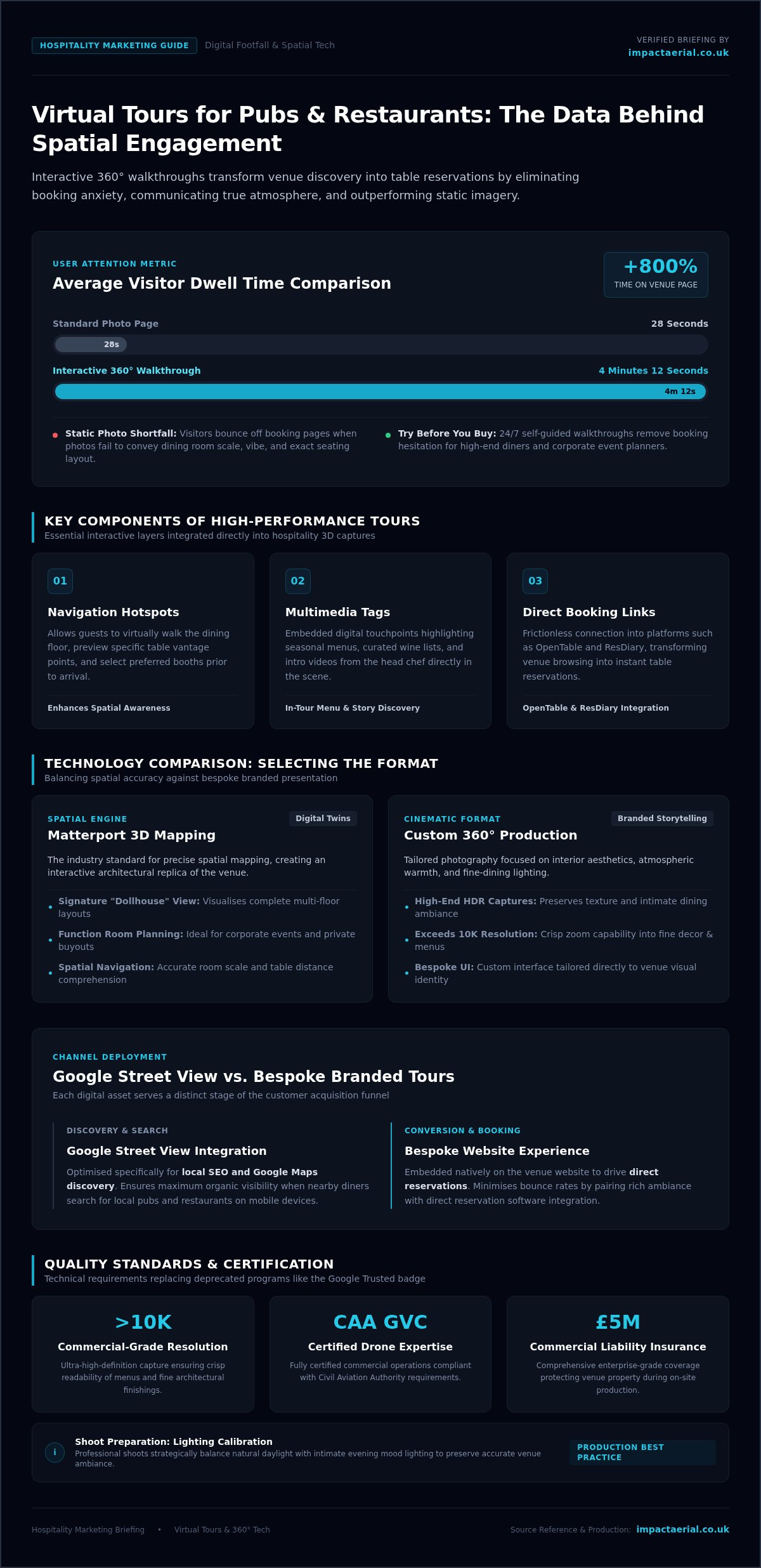
Did you know that website visitors spend an average of four minutes and 12 seconds exploring a venue with an interactive walkthrough, compared to just 28 seconds on a standard photo page? This 800% increase in dwell time represents a massive opportunity that many UK hospitality businesses are currently missing. You likely feel the frustration when static photos fail to capture the true vibe of your dining room or when potential guests bounce off your booking page because they can’t see the layout. A professional virtual tour for restaurants and pubs acts as a bridge between digital discovery and physical footfall, turning casual browsers into confirmed guests.

In this 2026 marketing guide, you’ll discover how interactive 360° technology can transform your venue’s online presence, increase direct bookings, and showcase your atmosphere to a global audience. We’ll examine the latest technical standards, from why the discontinued Google Trusted badge has been replaced by more robust certifications to how high-end HDR captures can solve the problem of static imagery. We will outline how to leverage professional digital assets, backed by CAA GVC certified expertise and £5m commercial liability insurance, to ensure your venue stands out on Google Maps and social media for years to come.

Key Takeaways

  • Evaluate the technical advantages of Matterport’s 3D spatial mapping versus the high-end cinematic flexibility of custom 360° tours for your hospitality branding.
  • Learn to distinguish between Google Street View for local SEO visibility and bespoke branded tours designed specifically to increase direct website reservations.
  • Master the essential preparation techniques for a professional shoot, including lighting strategies that balance natural light with the intimate evening ambiance of your venue.
  • Understand why a high-quality virtual tour for restaurants and pubs must be supported by CAA GVC certified pilots and comprehensive £5m commercial liability insurance.
  • Discover the proven impact of interactive walkthroughs on customer engagement and how these digital assets can drastically reduce bounce rates on your booking pages.

What is a Virtual Tour for Restaurants and Pubs?

A virtual tour for restaurants and pubs is a sophisticated, interactive digital walkthrough that offers prospective guests a comprehensive view of your hospitality space. Unlike a standard 360-degree photograph, which remains a static point in space, a fully navigated 3D experience allows users to move through the venue as if they were physically present. It provides a seamless transition from the entrance to the bar area and eventually to specific dining tables, providing a level of spatial awareness that traditional photography cannot achieve.

To better understand how these immersive environments are captured and built, watch this helpful video:

By digitising your venue, you bridge the gap between online discovery and physical footfall. Static imagery often fails to capture the specific “vibe” or atmosphere that defines a gastropub or fine-dining establishment. A virtual tour communicates the scale of the room, the intimacy of the lighting, and the precise layout of the seating. These are critical factors for customers deciding where to spend their evening, especially when they are looking for a specific ambiance for a special occasion.

The Evolution of Hospitality Marketing in 2026

User expectations have shifted significantly as we move through 2026. Modern diners now prefer to “try before they buy” by exploring a venue’s interior before committing to a reservation. This transparency is vital for reducing “booking anxiety,” particularly for high-end diners or corporate event planners who need to verify table spacing and accessibility. Your virtual tour acts as a 24/7 open house that showcases your venue’s premium standards without requiring a physical site visit.

Key Components of a High-Quality Tour

To maintain a professional digital presence, the technical output must meet industry-leading standards. High-resolution imagery, often exceeding 10K, ensures that guests can zoom into menu details or appreciate the texture of your interior design. This level of precision requires commercial-grade hardware and meticulous post-production services to ensure the final asset is both reliable and visually striking.

  • Navigation Hotspots: These allow guests to “walk” through the venue, selecting their preferred booth or viewing the vantage point from a specific table.
  • Integrated Multimedia Tags: Interactive elements can be embedded directly into the tour, showcasing seasonal menus, wine lists, or introductory videos from the head chef.
  • Booking Platform Integration: Modern tours link directly to platforms like OpenTable or ResDiary, allowing a guest to move from exploration to reservation in a single click.

When these assets are produced by experts and supported by £5m commercial liability insurance, they become a permanent, professional asset for your business. This technical approach ensures that your venue is represented with the accuracy and quality that discerning UK customers expect.

Comparing Virtual Tour Technologies: Matterport vs. Custom 360°

Selecting the right technology for a virtual tour for restaurants and pubs depends on the specific marketing objectives of the establishment. While some venues require high-precision spatial mapping for event planning, others prioritise a cinematic, branded experience that aligns with their interior design. The choice between Matterport and custom 360-degree photography involves balancing technical accuracy with visual storytelling. Each method offers distinct advantages for hospitality operators looking to digitise their physical assets.

Matterport: The Gold Standard for Layout

Matterport is the industry standard for creating “digital twins” of physical spaces. Its most recognisable feature is the “dollhouse” view. This allows users to see the entire venue as a 3D model, which is particularly beneficial for large, multi-floor pubs or restaurants with dedicated function rooms. For event planners organising wedding receptions or corporate hires, the spatial data provided by Matterport is invaluable for planning seating charts and equipment placement. However, Matterport operates within a closed ecosystem, which can limit bespoke branding and custom interface elements compared to bespoke options.

The Impact of Aerial Integration

A significant gap in standard hospitality marketing is the “arrival experience.” Most tours start at the front door, ignoring the geographic context of the venue. By integrating a drone-captured 360-degree panorama, establishments can showcase their beer gardens, outdoor terraces, and parking facilities from an elevated perspective. This provides essential context for guests arriving by car or those looking for specific outdoor amenities. High-quality drone photography is a prerequisite for this level of venue context, ensuring a seamless transition from the street to the table.

FPV drone footage further enhances this transition. It creates a single, cinematic movement that flies through the entrance and into the dining area. This approach provides a high-end feel that static 360 photos cannot match. When choosing a technology, consider how it affects loading speeds and mobile responsiveness. Custom 360 tours often allow for better optimisation of assets, ensuring that guests on mobile devices don’t experience lag when exploring a virtual tour for restaurants and pubs. This technical reliability is essential for maintaining engagement and preventing potential customers from bouncing off your booking page.

For venues looking to establish a professional digital presence, investing in a tailored virtual tour solution ensures that technical precision and brand identity are perfectly aligned. This methodical approach to technology selection guarantees a high-end output that remains a valuable digital asset for years.

Virtual Tours for Restaurants: 2026 Marketing Guide

Google Street View vs. Bespoke Branded Tours: Which Is Best?

Choosing between Google Street View and a bespoke branded tour is not a binary decision; it is about understanding the different stages of the customer journey. Google Street View is the premier tool for local discovery, while a bespoke tour serves as your primary conversion engine. For a virtual tour for restaurants and pubs to be effective, it must address both the “find” and “book” phases of the digital experience. A hybrid approach often yields the best results, ensuring your venue is visible in search results while providing a premium, branded environment on your own website.

Maximising Local SEO with Google Virtual Tours

Google Street View remains a critical component of local search strategy. By uploading high-quality 360-degree imagery to your Google Business Profile, you significantly increase your “quality score” in the eyes of search algorithms. This data-driven approach correlates directly with higher rankings in the Google Maps “3-pack,” which is the block of three local business listings that appear at the top of search results. The impact on physical footfall is immediate; data shows that 50% of Google Maps searches result in a physical visit within 24 hours. While Google retired its “Trusted Photographer” badge program in late 2024, professional operators now utilise authorised third-party APIs to ensure panoramas are correctly stitched and geolocated for maximum impact.

To further enhance your venue’s visibility beyond map listings, a strategic press release distributed by the Newswire Now Media Group can help secure coverage in local news and hospitality blogs, driving even more traffic to your new interactive tour.

Bespoke Tours: Your Interactive Booking Engine

Once a guest moves from Google Maps to your official website, the focus shifts from discovery to conversion. Bespoke branded tours offer a level of functionality that Google Street View cannot match. These tours act as an interactive booking engine where the environment is fully controlled. You can customise the user interface to align with your restaurant’s specific colour palette and typography, maintaining brand consistency throughout the digital walkthrough. Unlike the generic Google interface, bespoke tours allow for “Book a Table” buttons to exist directly within the virtual environment.

  • Interactive Hotspots: Use Mattertags or custom hotspots to link directly to seasonal menu PDFs, wine lists, or reservation forms.
  • Sensory Enhancement: Integrate subtle background audio, such as ambient restaurant noise or acoustic music, to build a sensory connection with the viewer.
  • Direct Integration: Seamlessly connect the tour to booking platforms like OpenTable or ResDiary, allowing guests to select a specific booth or area and reserve it instantly.

High-end venues often prefer this bespoke route because it allows for storytelling. You can embed chef interviews or “behind the scenes” video content into the tour, providing a layer of transparency that builds trust. When these assets are produced using commercial-grade hardware and supported by £5m commercial liability insurance, they provide a reliable, professional asset that protects your brand’s reputation while driving measurable increases in direct bookings.

Preparing Your Venue for a Professional 360° Shoot

Preparation is the most critical phase of creating a virtual tour for restaurants and pubs. Unlike traditional photography, where a photographer can hide equipment or clutter behind the lens, a 360-degree camera captures every angle simultaneously. This means there is no “off-camera” space. You essentially have one opportunity to capture the scene in its optimal state. Meticulous staging ensures that the final digital asset remains professional and relevant for several years, providing a high-quality perspective that builds immediate trust with potential guests.

Staging and Aesthetics

The primary objective during staging is the removal of visual clutter. Items that are functional during service, such as high chairs, POS terminals, cleaning equipment, or unsightly cables, must be cleared from the floor. These small details can break the immersion of a virtual walkthrough and detract from the premium feel of your establishment. You should also verify that every light bulb in the venue is functioning correctly and set to the precise dimming level that represents your evening or midday ambiance.

A common debate in hospitality marketing is the inclusion of staff or “ghost” figures. For maximum longevity, we typically recommend a clean, minimalist approach without people in the frame. Movement during a 360-degree rotation can cause technical blur artifacts or “ghosting” that requires extensive post-production to fix. If you choose to include staff, they must remain perfectly stationary during the capture process to ensure the high-resolution output remains sharp and professional.

Logistics and Timing

Timing is a technical necessity rather than a preference. Early morning shoots or sessions during “Golden Hour” are preferred because they allow for better control over natural light. We utilise multi-bracket HDR techniques to balance the bright light from windows with the intimate, moody interior of a pub. This prevents “blown-out” windows and ensures that guests can see both your interior design and your exterior views clearly.

Staff coordination is essential for maintaining a safe and efficient shooting environment. Every team member on-site must be briefed to ensure they don’t accidentally enter the frame during a rotation. When capturing the exterior of your venue, we adhere to strict safety protocols. This is particularly important when deploying professional drone services in the UK, where CAA GVC certified pilots must manage the flight path to avoid public interference. Our £5m commercial liability insurance provides the necessary reassurance that all operations are conducted with a safety-first approach.

To ensure your venue is captured with the precision and technical expertise it deserves, contact Impact Aerial for your virtual tour capture. Our methodical process guarantees a professional result that enhances your online presence and drives direct bookings.

Why Professional Certification Matters for Hospitality Shoots

Hiring a provider for a virtual tour for restaurants and pubs involves more than just selecting a creative partner; it’s a decision regarding legal compliance and risk management. Public-facing venues like gastropubs and high-end restaurants operate in high-traffic urban environments where safety is paramount. Utilizing unlicensed operators, particularly when capturing aerial context, exposes your business to significant regulatory and financial risks. A professional approach ensures that your digital assets are built on a foundation of technical competence and official certification.

Safety and Compliance in Public Spaces

A professional operator must demonstrate a deep understanding of current UK aviation regulations. This includes ensuring the pilot holds a valid drone license and CAA GVC certification for commercial operations. These credentials are not optional; they’re required for managing complex risk assessments when flying over urban restaurant terraces or busy high streets. We manage the technical transition between high-altitude aerial panoramas and ground-level 360-degree captures, ensuring a cohesive and legally compliant digital asset.

At Impact Aerial, we prioritise client security through strict adherence to safety protocols and the maintenance of £5m commercial liability insurance. This level of coverage is essential for protecting your business against unforeseen incidents during the data collection process. Furthermore, privacy and GDPR compliance are critical considerations for permanent virtual environments. Managing the “Right to be Forgotten” requires a methodical approach to post-production, including the blurring of identifiable faces or license plates if they inadvertently appear in the frame. This meticulous attention to detail ensures your tour remains a professional asset rather than a legal liability.

The Impact Aerial Advantage

The difference between a basic “tech demo” and a powerful marketing asset lies in the quality of post-production. Our bespoke editing process includes advanced colour grading designed to make food, beverages, and interiors look as appetising and inviting as possible. We don’t just deliver a file; we provide technical consultancy on how to embed the tour to ensure maximum website performance and mobile responsiveness. This ensures that your virtual tour for restaurants and pubs functions as a high-performing booking engine that doesn’t slow down your page load speeds.

This data-centric approach ensures your venue is represented with industry-leading quality. By combining technical precision with authoritative industry standards, we provide hospitality owners with the psychological comfort that their venue is in safe, expert hands. To elevate your venue’s online presence with a compliant, high-end digital twin, contact Impact Aerial to discuss your venue’s virtual tour project. Our team operates nationwide from our Birmingham base, providing the expertise required for professional results.

Future-Proofing Your Venue’s Digital Presence

Implementing a virtual tour for restaurants and pubs is no longer a luxury; it’s a strategic requirement for venues looking to thrive in the 2026 hospitality market. By bridging the gap between digital discovery and physical footfall, you reduce booking anxiety and provide guests with the transparency they demand. Whether you prioritise spatial precision or a bespoke branded interface, the goal remains the same: transforming casual website visitors into confirmed table reservations through immersive storytelling.

Ensuring your project is handled by specialists is critical for maintaining professional standards and legal compliance. Impact Aerial provides a methodical approach to venue digitisation, combining ground-level walkthroughs with advanced aerial filming drone technology for a complete arrival experience. With CAA GVC Certified Pilots and £5m Commercial Liability Insurance, we guarantee that your venue is in safe, expert hands throughout the capture process.

Don’t let static photography limit your venue’s potential. Request a bespoke Virtual Tour quote from Impact Aerial today and start showcasing your unique atmosphere to a global audience with the precision it deserves. It’s time to give your guests the immersive experience they’ve been looking for.

Frequently Asked Questions

How much does a virtual tour for a restaurant cost?

Total investment is determined by the square footage of your venue and the number of scan points required to create a seamless walkthrough. While basic setups cover the main dining floor, more comprehensive projects include private rooms, bars, and outdoor terraces. Professional post-production and the integration of interactive booking links also influence the final cost. Every project is unique, so a tailored consultation is necessary to define the technical scope for your specific venue.

How long does it take to film a 360° tour of a pub?

A typical capture session for a standard UK pub or restaurant usually takes between two and four hours. The duration depends heavily on the complexity of the layout and the level of staging required. We spend a significant portion of this time ensuring the lighting is balanced and the space is free from visual clutter. Larger venues with multiple floors or extensive outdoor seating areas naturally require more time to ensure every angle is perfectly captured.

Will the virtual tour work on my customers’ mobile phones?

Yes, every virtual tour for restaurants and pubs we create is fully responsive and optimised for mobile devices. Most users now explore hospitality venues on their smartphones before making a booking. Our tours use HTML5 technology to ensure smooth navigation across iOS and Android platforms without requiring additional apps. This mobile-first approach is essential for maintaining high engagement rates and ensuring your interactive booking engine is accessible to all potential guests.

Do I need to close my restaurant during the virtual tour shoot?

You don’t necessarily need to close for the entire day, but we strongly recommend filming while the venue is empty of patrons. Shooting during off-hours or before opening prevents privacy complications and ensures compliance with UK GDPR regarding the capture of identifiable faces. It also allows our team to move equipment freely without disrupting your service. An empty venue ensures that every 360-degree rotation is clear and free from motion blur artifacts.

Can I update the tour if I change my menu or interior decor?

Updating your virtual tour is a straightforward process that doesn’t always require a full reshoot. If you update your seasonal menu or wine list, we can simply edit the interactive multimedia tags within the existing environment. For significant changes to interior decor or structural layouts, we can reshoot specific rooms or areas and stitch them into the original tour. This modular approach ensures your digital asset remains an accurate representation of your establishment.

How do I add the virtual tour to my Google Business Profile?

Adding your 360-degree imagery to your Google Business Profile is managed through authorised third-party APIs or the Google Street View Studio. While the official Trusted Photographer badge was discontinued on December 31, 2024, we still use professional tools to upload and geolocate your panoramas. This process ensures your venue appears in the See Inside section of Google Maps, which is a proven method for increasing local search visibility and driving physical footfall.

What is the difference between a virtual tour and a promotional video?

No special plugins are required to host a professional virtual tour on your website. We provide a simple iframe embed code that works similarly to a YouTube video. This code is compatible with all major website builders and content management systems, including WordPress and Squarespace. Because the tour is hosted on secure, high-speed servers, it doesn’t slow down your website’s performance or require your customers to download any external software to view it.

360 Virtual Tour for Venues: The Ultimate Guide to Immersive Marketing

A 2024 study by Google reveals that 67% of users want more virtual tours on business listings, yet 58% of UK event spaces still lose significant traffic to outdated, static galleries. You’ve likely felt the drain of hosting three physical site visits in a single afternoon only for none of them to progress to a contract. It’s a common frustration. Venue managers need to showcase their space effectively without disrupting daily operations or staff schedules. This guide explains how a professional 360 virtual tour for venues creates a high-quality, 24/7 digital “open house” that filters out non-serious enquiries and builds immediate trust.

We’ll detail the technical precision required for these immersive experiences, covering everything from CAA-regulated aerial integration to the specific ways interactive media provides a competitive edge in the £70 billion UK events industry. You’ll learn how to transform your digital presence into a reliable, high-performing lead generation tool that offers potential clients total peace of mind before they even step through your doors.

Key Takeaways

  • Understand how a 360 virtual tour for venues acts as a 24/7 digital twin, significantly increasing “time on page” and boosting your site’s SEO performance.
  • Compare the benefits of Matterport 3D scanning versus high-altitude aerial panoramas to determine the most effective technology for your specific property type.
  • Learn how to qualify leads more efficiently and reduce unproductive “tyre-kicker” site visits by providing prospective clients with a transparent, immersive walk-through experience.
  • Discover the critical safety requirements and CAA-certified procedures necessary for conducting professional drone surveys within indoor spaces and public venues.
  • Master the hybrid marketing approach that combines cinematic aerial views with technical precision to showcase large UK estates and multi-building venues with total clarity.

What is a 360 Virtual Tour for Venues and Why Does it Matter?

A 360 virtual tour for venues is a photorealistic digital environment that allows users to control their perspective and movement. This technology creates an interactive, navigable digital twin of a physical space, allowing prospective clients to explore every corner of a property from their own device. By 2026, the UK hospitality and events industry will have fully transitioned from static photography to these immersive walk-through experiences to meet rising consumer expectations. Professional venues must adapt to this shift to maintain their market position and provide the transparency that modern clients demand.

Understanding What is a 360 Virtual Tour is essential for any business owner looking to remain competitive in a digital-first market. It serves as a 24/7 open house, removing the geographical barriers that often limit venue bookings. A study from 2023 showed that 67% of site visitors want more virtual tours on business listings, as it provides peace of mind and allows for a more informed decision-making process. This level of accessibility builds immediate trust and accelerates the booking cycle by providing a reliable representation of the site.

To better understand how these tours function in practice, watch this helpful video:

The primary advantage of a 360 virtual tour for venues is the ability to offer global reach. Whether you manage a heritage site in the West Midlands or a modern conference centre in London, international planners can verify your facilities without the carbon footprint or cost of travel. This technology ensures that the property is always “showroom ready,” regardless of what is happening on-site during a physical visit. It is a meticulous, high-quality solution that provides tangible benefits to a client’s business by increasing engagement and reducing wasted site visits.

The Evolution of Venue Marketing

User behaviour has shifted significantly toward self-service viewing. Data suggests that 75% of event planners prefer to conduct their initial research and site viewing before they ever contact a sales team. We use high-definition 4K HDR imagery to establish a sense of luxury and quality that standard photography cannot match. While traditional video provides a curated, passive view, it often fails where a 360 virtual tour for venues succeeds. Interactive tours allow the user to judge distances and room scales for themselves, providing the essential spatial context required for planning complex events or large-scale conferences.

Key Industries Benefiting from Virtual Tours

  • Wedding and event spaces: Couples use these tours to visualise their “big day” layout from home. This often leads to a 30% increase in conversion rates for venues that provide immersive digital twins.
  • Educational institutions and schools: Providing safe, remote campus tours for prospective parents is now a standard requirement. These tours allow for exploration while maintaining strict safeguarding protocols on-site.
  • Commercial and construction sites: Stakeholders use these environments for monitoring progress and showcasing completed developments. Using high-resolution sensors and photogrammetry, we provide a level of detail that aids in both marketing and technical site inspections.

Matterport vs. Aerial 360: Choosing the Right Technology

Ground-based 3D scanning, typically powered by Matterport technology, provides an exceptional level of detail for interior walkthroughs. It uses infrared sensors or LiDAR to create a “dollhouse” view of a room, allowing users to navigate through spaces with millimetre precision. This is a vital component of a 360 virtual tour for venues where the layout of a ballroom or conference suite is the primary selling point. Aerial 360 panoramas, captured from altitudes between 50 and 120 metres, offer a completely different perspective. They showcase the venue’s setting, parking capacity, and surrounding grounds. A 2023 survey of event planners found that 72% prioritised understanding the total site layout before they would even consider booking a physical viewing.

A hybrid approach is the gold standard for large estates or multi-building venues. By linking ground-level 3D scans with high-altitude panoramas, you provide a seamless transition from the front gates to the bridal suite. This context is vital for sites where guests need to understand the walking distance between a ceremony hall and overnight accommodation. We utilise 4K HDR resolution to ensure every architectural detail remains crisp. High Dynamic Range is particularly important for venues with large windows; it prevents the bright outdoor light from washing out the interior details, a common flaw in lower-quality amateur photography. Our advanced aerial imaging equipment captures 12-bit colour depth, ensuring that the textures of stone, wood, and fabric are rendered with lifelike accuracy.

Interactive “Hotspots” transform a static tour into a functional sales tool. These digital tags allow users to click on a fireplace to see a video of it lit, or tap a dining table to view a £75-per-head wedding menu. You can even embed direct booking links to your reservation system. For those looking to integrate these features, our professional aerial imaging services offer bespoke hotspot customisation tailored to your specific business goals. This interactivity keeps users on your page for 5 times longer than static image galleries, directly influencing your site’s search engine ranking.

The Power of Interior Drone Videography

We use specialised “cinewhoop” drones to create cinematic fly-throughs that ground cameras cannot achieve. These drones are small, encased in protective guards, and flown by CAA GVC certified pilots. They can glide through a 1.5-metre wide doorway and soar up to a 10-metre high vaulted ceiling in a single shot. This provides a “sense of place” that static cameras miss. Our professional aerial equipment captures high-dynamic-range data, ensuring that shadows in a grand hall don’t lose their texture or depth.

Technical Data and Photogrammetry

A 360 virtual tour for venues offers more than just a marketing boost. By employing photogrammetry, we convert aerial imagery into accurate 3D models with 20-millimetre spatial accuracy. This data is invaluable for venue managers planning a £250,000 renovation or needing Building Information Modelling (BIM) data for structural surveys. Professional data collection ensures that every measurement is precise; it simplifies maintenance schedules and provides a digital twin for future architectural planning or insurance valuations.

Calculating the ROI of a Virtual Venue Tour

Investing in a 360 virtual tour for venues isn’t just a creative choice; it’s a strategic financial decision. For venue managers in the UK, the most immediate return on investment comes from lead qualification. Statistics from industry leaders like Matterport indicate that immersive listings can reduce “tyre-kicker” site visits by up to 40%. When a potential client explores every corner of your space online, they’ve already performed a mental walkthrough. This means by the time they request a physical viewing, they’re already 70% of the way toward a booking. You’re no longer wasting staff hours on tours for people whose requirements don’t match your physical layout.

Search engine performance provides another measurable boost to your bottom line. Google’s algorithm prioritises user engagement metrics, specifically “dwell time.” A standard gallery of static images might hold a user’s attention for 30 seconds. In contrast, data shows that users spend 5 to 10 times longer on pages containing interactive 360-degree content. This increased time on page signals to Google that your website is a high-value resource, which helps improve your organic search rankings for local event hire terms. It’s a self-sustaining cycle of visibility and engagement.

Transparency builds immediate credibility. In a market where wide-angle photography can sometimes be misleading, a 360 virtual tour provides a “source of truth.” It shows the proximity of the bar to the dance floor, the exact height of the ceilings, and the location of fire exits. For corporate event planners, this level of detail is essential. They often work on tight deadlines and need to confirm logistics without multiple site visits. Providing this data upfront can reduce the traditional sales cycle by 20%, allowing your team to close bookings faster and move on to the next lead.

Direct Bookings and Conversion Rates

A 2022 study by TIG revealed that venues utilising immersive media saw a 30% increase in direct enquiries compared to those using traditional photography alone. We recommend integrating “Book Now” or “Enquire Today” buttons directly into the virtual environment. This allows a planner to click a hotspot while standing in the middle of your ballroom and jump straight to the booking form. There’s a powerful psychological element at play here called “mental ownership.” When a client navigates the space themselves, they begin to mentally place their guests and decorations, making them far more likely to commit to the venue.

Cost vs. Value: Long-term Marketing Assets

While a professional 360 virtual tour requires an initial investment, it’s vital to compare this to ongoing costs. A high-quality shoot typically starts from £500 to £1,500 for most UK venues, which is a one-off fee for an asset that lasts for years. Compare this to a monthly Google Ads or social media spend of £300 to £500 that stops delivering results the moment you stop paying. A professional tour is a multi-channel asset that you can use in email signatures, social media posts, and digital brochures. We strongly advise against low-quality DIY tours. Poorly stitched images or grainy resolution can actively damage a luxury brand’s reputation, suggesting a lack of professionalism that might reflect on your event management standards. High-quality, precise imagery is the only way to provide true peace of mind to your high-value clients.

Planning and Safety: The Professional Drone Approach

Creating a high-quality 360 virtual tour for venues requires more than just a camera and a drone. It demands a structured, five-step methodology to ensure the final product delivers a return on investment while maintaining site safety. We don’t believe in guesswork. Our process is designed to be transparent and efficient, allowing venue managers to focus on their guests while we handle the technical complexities.

  • Step 1: Initial Consultation. We identify your “hero” shots, such as the grand ballroom or a panoramic terrace view. We map out the navigation paths to ensure the user experience is intuitive and leads directly to your booking enquiry page.
  • Step 2: Site Survey and Risk Assessment. Safety is our priority. We conduct a detailed survey to identify hazards, particularly for indoor drone flight where ceiling heights and signal interference are factors. This is vital for public spaces where footfall must be managed.
  • Step 3: The Shoot Day. Our professional crew works with precision. A typical shoot takes between 4 and 7 hours, depending on the venue size. We coordinate with your team to ensure we don’t disrupt your daily operations or guest experiences.
  • Step 4: Post-Production. This is where the magic happens. We use 4K, High Dynamic Range (HDR) processing and meticulous colour grading to ensure every frame looks breath-taking. We also integrate interactive hotspots, allowing users to view menus or check availability within the tour.
  • Step 5: Delivery and Hosting. We provide the final assets for seamless embedding on your website. We also handle the integration with Google Street View, which can increase click-through rates from search results by 16% according to recent industry data.

Execution is everything. A 360 virtual tour for venues must be polished and professional to reflect the quality of your brand. We use the latest DJI Enterprise commercial drones to capture data with a level of detail that consumer-grade equipment simply cannot match.

The Importance of CAA GVC Certification

Hiring a CAA GVC certified pilot is a legal requirement for commercial drone work in the UK. Since the regulation changes in December 2020, the General Visual Line of Sight Certificate (GVC) has become the industry standard for operating drones in congested areas or near people. This certification isn’t just a piece of paper; it proves the operator has undergone rigorous flight examinations and understands complex UK air law. It ensures your venue isn’t exposed to the legal risks and potential fines associated with unauthorised or hobbyist flights.

Insurance and Peace of Mind

We carry £5 million in commercial liability insurance as a standard for every project. This level of cover is essential for protecting your venue’s assets and the general public during the filming process. Professional insurance is a hallmark of a vetted, reliable operator. For added peace of mind, we provide all documentation before we arrive on-site, ensuring your health and safety department is fully satisfied. We take the operational rigour of our work as seriously as the final visual result.

Ready to showcase your space from a new perspective? Contact Impact Aerial today to discuss your professional 360 virtual tour requirements.

Impact Aerial: Bespoke 360 Tours for UK Venues

Impact Aerial operates from a central Birmingham hub, providing a strategic advantage for national UK coverage. We aren’t just photographers; we’re technical drone specialists who understand the intricate balance between aesthetic appeal and operational safety. Our team delivers a high-end 360 virtual tour for venues by leveraging DJI Enterprise technology. These aren’t consumer-grade gadgets. Our fleet utilizes 4K High Dynamic Range (HDR) sensors that capture 20-megapixel stills and 10-bit D-Log M video, ensuring every architectural detail of your property is rendered with absolute clarity.

The “Aerial-to-Interior” transition is our signature capability. We bridge the gap between a sweeping 400ft bird’s-eye view and the intimate details of a banquet hall or conference suite. This creates a single, fluid journey for the viewer. Instead of clicking through disjointed galleries, a potential client starts at the venue gates and “flies” directly into the heart of the building. This continuity builds a spatial understanding that standard photography simply cannot replicate. We manage the entire lifecycle of the project, from initial Civil Aviation Authority (CAA) compliant flight planning to the final post-production stitch.

Our workflow is built on a foundation of data-gathering precision. Every flight is preceded by a site-specific risk assessment and a review of UK NATS airspace restrictions. This meticulous approach ensures that even complex urban venues in city centres can be captured safely and legally. We handle the technical heavy lifting, allowing venue managers to focus on their core operations while we build a digital asset that works 24/7 to secure bookings.

Why Choose a Technical Specialist?

The distinction between a creative agency and a technical drone survey specialist is significant. While many can take a “nice photo,” Impact Aerial brings a meticulous, safety-first mindset to every project. We hold full CAA GVC Certification, which is the current UK standard for professional remote pilots. This provides essential peace of mind for venue owners. Our Birmingham roots allow us to serve the West Midlands with local expertise, yet our infrastructure supports large-scale deployments across the UK with consistent, top-quality results.

Safety protocols aren’t a hurdle for us; they’re a core service. We carry £5 million in commercial drone liability insurance as standard, ensuring your property and guests are protected. This technical rigour extends to our post-production, where we use advanced photogrammetry and stitching software to eliminate the “warping” often seen in amateur 360-degree content. You receive a polished, professional tool that reflects your venue’s prestige.

Start Your Venue Transformation Today

Securing a 360 virtual tour for venues starts with a consultation to assess your site’s specific layout. We don’t believe in “one size fits all” pricing. We provide tailored quotes based on the number of transition points and the complexity of the airspace. Once you book, the typical timeline from the initial site visit to the final tour going live is just 10 to 14 working days. This rapid turnaround ensures you can start seeing a return on investment almost immediately. Our team handles the hosting and provides a simple embed code for your website, making the integration process seamless.

Ready to elevate your digital presence? Contact Impact Aerial to discuss your 360 virtual tour project and discover how our technical expertise can drive your venue’s growth.

Elevate Your Venue Booking Potential Today

Implementing a 360 virtual tour for venues is no longer a luxury; it’s a fundamental requirement for modern marketing. By combining interior Matterport scans with our 4K HDR DJI Enterprise aerial technology, you provide potential clients with a comprehensive view that static photography simply can’t match. This level of transparency builds trust and significantly increases ROI by filtering for high-intent leads before they even step foot on your property.

Safety and compliance remain at the heart of our operations. Impact Aerial provides professional services across Birmingham and the West Midlands, led by CAA GVC Certified pilots. We operate with £5m commercial liability insurance to ensure every project is delivered with total precision and legal adherence. You don’t just get high-quality imagery; you get the peace of mind that comes from working with a vetted, industry-leading specialist.

Your venue deserves to be seen from its best angles, whether that’s a sweeping 360-degree panorama of the grounds or a detailed walkthrough of your main hall. Take the first step toward a more immersive digital presence. Request a bespoke quote for your venue virtual tour and let’s showcase your space with the technical excellence it requires.

Frequently Asked Questions

How much does a 360 virtual tour for a venue cost in the UK?

A 360 virtual tour for venues typically starts from £450 for a small space and can reach £3,500 for large estates. Costs depend on the total square footage and the number of scan points required to cover the area. A standard 2,500 square foot function room usually averages £750. This fee covers the site visit, professional equipment hire, and all post-production work.

Will the drone filming disrupt my venue’s daily operations or events?

Drone filming doesn’t disrupt your daily operations because we typically schedule flights during “golden hour” or before your opening times. We coordinate with your site manager to ensure a 30 minute window for aerial captures. Our pilots are trained to operate efficiently; a standard exterior shoot takes 45 minutes. This ensures your guests and staff aren’t disturbed while we capture top-quality footage.

How long does it take to film and produce a full 360 virtual tour?

A full 360 virtual tour for venues usually takes 4 to 6 hours to film on-site. The post-production phase, including stitching and data-gathering, takes 3 to 5 business days. For a 10,000 square foot venue, you can expect the final delivery within 7 days of the initial shoot. We prioritise precision to ensure the end results are breath-taking and accurate.

Can I embed the virtual tour on my website and social media channels?

You can easily embed the virtual tour on your website using a simple iframe code. We provide direct links for social media platforms like Facebook and LinkedIn to help you reach more clients. These tours integrate with Google Street View in 95% of cases, which helps boost your local search rankings. Most clients see a 40% increase in website engagement after adding a tour.

Do I need special insurance or permits for a drone tour of my venue?

You don’t need to provide insurance because we carry £5 million in commercial liability insurance for every project. As CAA GVC Certified operators, we handle all flight permissions and risk assessments ourselves. We follow the UK Civil Aviation Authority’s CAP 722 regulations strictly to ensure total safety. For added peace of mind, we provide a full safety brief 48 hours before the flight.

What is the difference between a Matterport tour and a 360 video tour?

A Matterport tour is an interactive 3D dollhouse model that lets users walk through a space at their own pace. In contrast, a 360 video tour is a linear film where the viewer looks around while the camera moves on a set path. 82% of venue owners prefer Matterport for its measurement tools and navigation. Both formats provide high-quality visuals for your digital marketing suite.

Can you update the virtual tour if I renovate or change the venue layout?

We can update specific sections of your virtual tour without reshooting the entire venue. If you renovate a single 500 square foot room, we only need to scan that specific area again. We then stitch the new data into the existing model seamlessly. This modular approach saves you 60% of the cost compared to starting a completely new tour from scratch.

Is a 360 tour compatible with mobile devices and VR headsets?

Every 360 virtual tour for venues we produce is 100% compatible with mobile devices and VR headsets. The interface automatically scales for iOS and Android, which accounts for 65% of all web traffic today. Users can also toggle “VR Mode” to view the space through Meta Quest or Google Cardboard. This immersive experience helps potential clients feel they’re already standing at your location.