Virtual Tour for Conference Centres: A Buyer’s Guide

What makes the best virtual tour for conference centres? It answers practical questions before it tries to impress. Event planners need more than a glimpse of an attractive room. They need to understand layouts, atmosphere and how spaces might work for their event, even when they can’t visit in person.

Choosing a provider can be difficult when terms such as interactive, immersive and high quality don’t explain exactly what you’ll receive. This guide helps you compare tour options against clear requirements, define the experience your venue needs and prepare a focused brief for a professional provider.

We’ll look at how to present key rooms and configurations, what to check about navigation, mobile performance, hosting and final deliverables, and which technical details need separate confirmation. You’ll also learn how to plan capture around venue operations, agree access and approvals, and address safety before filming begins. The result is a more informed way to commission a tour that gives remote prospects a clearer view of your venue and your team a defined scope to work from.

Key Takeaways

  • A virtual tour for conference centres should help remote planners assess spaces, atmosphere and how venue areas connect.
  • Separate essential venue information from optional tour features, and confirm available formats and functions with each provider.
  • Compare suppliers using a written brief that sets out your audience, intended use, priority spaces and required deliverables.
  • Prepare a space inventory, access plan and list of areas to exclude so capture can be coordinated with venue operations and safety requirements.
  • Assess whether a provider’s relevant experience, project process and post-production scope fit your venue’s needs, then agree approvals before work begins.

Why a Virtual Tour for a Conference Centre Should Support Venue Decisions

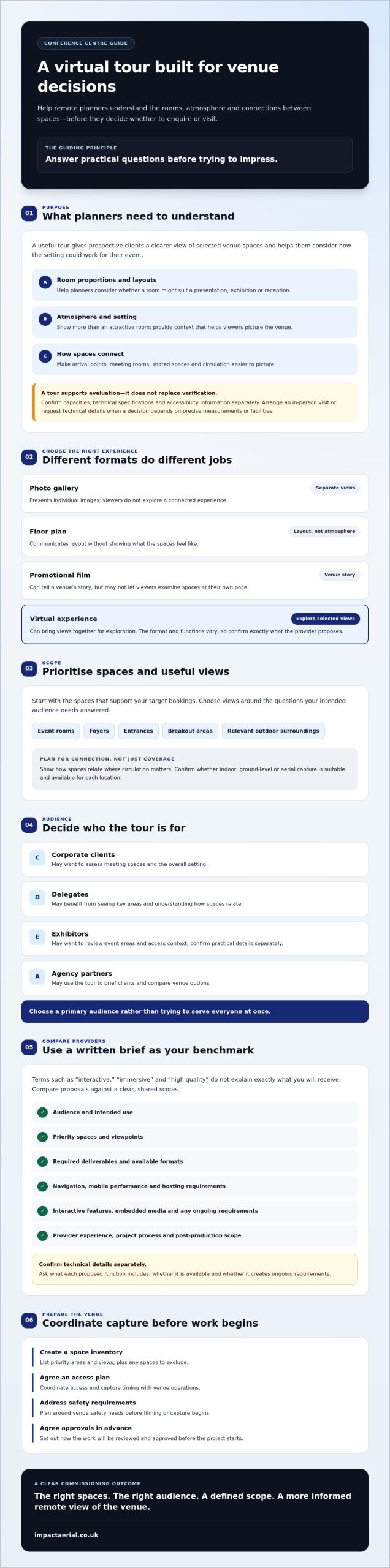
A virtual tour for conference centres gives prospective clients a digital way to explore selected venue spaces before making an enquiry. Its purpose is practical as well as presentational: help event planners picture the rooms, understand how spaces connect and judge whether the setting could suit their event. A useful tour does more than show attractive rooms. It gives viewers a clearer sense of the venue they may be considering.

A tour differs from a photo gallery, which presents separate views, and a floor plan, which communicates layout without showing atmosphere. A promotional film can tell a venue’s story, but may not let viewers examine spaces at their own pace. A virtual experience can bring selected views together for exploration, but it isn’t a live site visit. The broader virtual tour format can use different media, so confirm what a provider’s proposed experience includes.

For a visual example of a conference-centre walkthrough, watch this video:

What event planners need to understand from a virtual venue tour

Room proportions and layouts help planners consider whether a space might work for a presentation, exhibition or reception. Views of connected areas can also make circulation easier to picture, from arrival points to meeting rooms and shared spaces. Images alone can’t verify every requirement, however. Planners may still need confirmed capacities, technical specifications and clear accessibility information. Treat the tour as an evaluation aid, then arrange an in-person visit or request technical details when a decision depends on precise measurements or facilities.

Which conference-centre audiences benefit from a tour?

Organisers comparing venues remotely can use a tour to form an initial shortlist and identify questions for the sales team. Other audiences may need different views, so decide who the tour is intended to help rather than trying to serve everyone at once:

  • Corporate clients may want to assess meeting spaces and the overall setting.
  • Delegates may benefit from seeing key areas and understanding how spaces relate.
  • Exhibitors may want to review event areas and access context, with practical details confirmed separately.
  • Agency partners may use the tour to brief clients and compare venue options.

A well-planned tour supports informed conversations. It helps each intended audience assess suitability and event flow, while leaving technical verification and final decisions to the appropriate checks.

What a Conference Centre Virtual Tour Can Include

A virtual tour for conference centres should be scoped around the information prospective clients need, not a long list of features that may add little value. Core content usually includes clear views of priority rooms, how spaces connect and enough context to understand arrival and the venue’s surroundings. Optional elements, such as interactive navigation, embedded media or hosted access, depend on the provider and project. Ask what each proposed feature does, whether it is included and whether it creates ongoing requirements.

Different audiences may need different details. An organiser comparing venues may prioritise room layouts and adjoining spaces, while an exhibitor may want to understand event-area access. The Professional Convention Management Association discusses how planners use digital tools for site visits; apply that principle by deciding which views and supporting information will help your own audience assess the venue.

Which spaces and viewpoints should the tour present?

Start with spaces that support the venue’s target bookings. Depending on the brief, these could include event rooms, foyers, entrances, breakout areas and relevant outdoor surroundings. Show connections between spaces where circulation matters, rather than treating every room as an isolated view. Confirm whether indoor, ground-level or aerial capture is suitable and available for each location. An aerial view may help communicate the venue’s wider setting, but it won’t replace a useful view inside an event room.

How to judge image quality and supporting information

Check whether the imagery conveys a room’s character and practical layout without making it difficult to judge scale. Ask the provider to specify the capture approach, expected image quality, post-production scope and final file delivery. Agree who supplies and checks room names, captions, labels and venue details, including capacity or technical information. Establish how those details can be corrected when they change, so outdated information does not remain in circulation.

Before approving a proposal, separate core content from features that need further discussion. Check the scope against a simple list:

  • Spaces: Which rooms, entrances and surrounding areas are included or excluded?
  • Information: Who provides and verifies labels, captions and supporting venue details?
  • Functionality: Are interactive navigation, embedded media, hosting and accessibility features included, and on what terms?
  • Delivery: What files will the venue receive, and what post-production or update responsibilities are defined?

For venues considering aerial footage as part of the visual presentation, Impact Aerial’s virtual-tour creation can be discussed as a project option. Confirm the proposed viewpoints, deliverables and any indoor or interactive elements directly with the provider before agreeing the scope.
Virtual Tour for Conference Centres: A Buyer’s Guide

How to Compare Conference Centre Virtual Tour Providers

Compare proposals against the same written brief, not broad claims such as “immersive” or “high quality”. Set out the intended audience, where the tour will be used, priority spaces and expected deliverables. This makes it easier to see whether a provider understands the venue’s objectives and to compare like with like.

Ask for examples of comparable work, then discuss what each example demonstrates. Does it show a similar type of venue, a clear approach to presenting connected spaces or effective post-production? Request details about who plans and captures the project, who edits the content, how you’ll review it and how revisions and approvals are managed. The technology-enabled event experience can involve more than visuals, so judge proposed features by whether they help your intended audience make a decision.

Get the full scope in writing. Don’t assume that hosting, analytics, future updates or particular interactive functions are included. Confirm what the venue receives, where the tour can be published, who controls access and whether ongoing platform arrangements apply.

Which production credentials and processes should buyers check?

For drone capture, ask who will operate the aircraft and verify relevant pilot qualifications, insurance and proposed operating arrangements. Confirm how access, permissions, the presence of staff or visitors, privacy and safety will be addressed at your site. These checks should reflect the location and planned capture, rather than rely on general assurances. Impact Aerial states that its pilots are CAA GVC certified and that it holds £5m commercial liability insurance. Buyers can also consult this guide to professional drone services in the UK when assessing drone-related supplier credentials.

Will a virtual tour replace an in-person venue visit?

No. A virtual tour for conference centres can help planners evaluate a venue early and prepare focused questions, but it can’t confirm every operational detail. Event-specific needs may require a direct discussion with the venue team or a physical visit, particularly when technical arrangements, access, room configuration or logistics need checking. Use the tour to inform those next steps, not as a substitute for verification.

A practical comparison comes down to fit and clarity. Choose a provider whose process, relevant evidence and written deliverables align with your brief, and make sure any drone work has a suitable, clearly explained operational plan.

How to Brief and Prepare a Conference Centre Virtual Tour

A clear brief helps a provider plan the right capture and helps your team review the result against agreed objectives. For a virtual tour for conference centres, begin by defining its primary purpose, such as supporting initial venue enquiries or presenting spaces to agency partners. Identify the intended audiences, priority booking types and publication channels, such as your venue website or sales materials.

Agree the project boundaries before production starts. Record the deliverables, revision process, approval contacts, ownership arrangements, hosting responsibility and how future updates will be handled. These details clarify what the venue will receive and who is responsible for each stage after capture.

Build a practical production brief

List each requested room and viewpoint, and note the question it should answer. An event-room view might help planners judge layout options, while a foyer view could show how guests move between spaces. Supply current room names, layouts, specifications, approved copy and brand assets. Appoint a lead reviewer and final decision-maker, then agree review dates and how consolidated feedback will be returned.

A space inventory makes the scope easier to check. Include:

  • Priority areas: Rooms and views required, plus areas excluded from capture.
  • Access: Entry points, staff contacts, restricted locations and any escort arrangements.
  • Operational constraints: Venue operating hours, event schedules, setup or reset periods, and times when filming would interrupt activity.
  • Approvals: Who checks room details, supporting copy, privacy-sensitive content and the final experience.

Prepare the venue and coordinate production safely

Before capture, confirm how staff, visitors, signage and confidential material will be managed. Identify busy routes and agree how the team will avoid disrupting venue operations. Document permissions and clarify who is responsible for site access, safety coordination and any required approvals. If the project includes aerial filming, discuss suitable viewpoints and operating arrangements with the provider. This guide to professional aerial filming offers further context for planning that part of a project.

Keep the brief and decisions in one shared record, including changes made during review. That gives the venue and provider a consistent reference from planning through post-production, helping prevent misunderstandings about scope or sign-off.

If you’re preparing a project brief, discuss virtual-tour creation with Impact Aerial and outline the spaces, intended use and capture requirements you want considered.

Choosing Impact Aerial for a Conference Centre Virtual Tour

Impact Aerial creates virtual tours using drone-captured content, with project support from initial consultation through post-production. For a conference centre, aerial imagery may help present the venue’s wider setting where suitable. The tour scope should still be based on your priority spaces and intended audience. Confirm indoor, ground-level, interactive, hosting and accessibility features for the specific project rather than assuming they are included.

Supplier credentials are one part of the assessment. Impact Aerial’s pilots are CAA GVC certified, its commercial-grade drones have 4K HDR cameras, and the company holds £5m commercial liability insurance. Consider these details alongside the proposed capture plan, deliverables and how the finished content will be used.

What to discuss with a virtual-tour production provider

Share which audiences the tour should serve, the booking types you want to support and the spaces that matter most. Explain whether the content is intended for your website, sales materials or another channel. Then ask which capture methods and deliverables suit the venue, and identify requested features that need separate confirmation.

Discuss practical arrangements before production is agreed. Confirm access and permissions, safety responsibilities, production stages, review points and final delivery. If aerial views are part of the brief, clarify which viewpoints are suitable and how the provider will plan capture around venue operations. If you’re considering complementary imagery, Impact Aerial’s guide to professional drone photography offers further context on aerial visual content.

Turn your venue requirements into a project enquiry

There isn’t one fixed scope for every conference-centre project. The content and production plan depend on the venue, requested spaces, capture methods and agreed deliverables. Providing a concise outline of your goals, priority areas, access considerations and intended use gives a provider a sound basis to discuss suitability and scope.

Share your venue requirements with Impact Aerial to discuss whether its virtual-tour creation and post-production services fit your project. You can discuss your conference centre project without assuming specific features or formats before they’ve been confirmed.

Make Your Venue Easier to Assess Remotely

A well-planned virtual tour for conference centres should help event planners understand the spaces, how they connect and whether the venue merits a closer look. Define the intended audience and priority areas first, then compare providers using a written brief that sets out capture methods, deliverables, approvals and hosting responsibilities.

Preparation matters too. A clear space inventory, agreed access arrangements and a defined review process help keep production coordinated with venue operations. A tour can support early evaluation, while technical requirements and event-specific details may still need direct confirmation.

Impact Aerial creates virtual tours using drone-captured content and provides post-production support. Its stated credentials include CAA GVC certified pilots, commercial-grade drones with 4K HDR cameras and £5m commercial liability insurance. Share your venue’s goals and requirements to discuss what may suit your project.

Discuss your conference centre virtual tour with Impact Aerial and take the next step towards presenting your venue clearly and confidently.

Frequently Asked Questions

Can a virtual tour replace a site visit to a conference centre?

No, a virtual tour can support early evaluation, but it can’t confirm every detail of an event. Use it to assess how rooms look and connect, then verify event-specific requirements directly with the venue. A site visit or technical discussion may still be needed to check room configuration, access, equipment and operational arrangements. Treat the tour as a way to make those next conversations more focused, not as a substitute for them.

What should a conference centre virtual tour include?

A useful tour should present priority event spaces clearly and help viewers understand their layout, atmosphere and connections to nearby areas. Depending on the venue’s goals, it may also show entrances, foyers, breakout spaces or the surrounding setting. Supporting details such as room names and capacities should be checked for accuracy. Confirm in writing whether navigation, embedded media, hosting and accessibility features are included, as these depend on the provider and project.

How much does a virtual tour for a conference centre cost?

The cost depends on the project scope, including the number and type of spaces, capture methods, post-production and agreed deliverables. Hosting or other platform arrangements may involve separate ongoing terms, so ask whether these are included and who is responsible for them. Request a written proposal that sets out the work, final files, revision process and any continuing charges. This lets your team compare supplier quotes against the same requirements.

How long does it take to create a conference centre virtual tour?

There isn’t a single timeline that applies to every venue. Timing depends on the spaces involved, access arrangements, capture requirements, post-production and how quickly reviews and approvals are completed. Ask each provider to outline the project stages, identify what they need from your team and give a schedule for capture, draft review and final delivery. Confirm how changes to the brief or approval process could affect the agreed schedule.

Can a virtual tour show both indoor event spaces and the venue exterior?

It may be possible to present both, but the capture methods and deliverables need to be agreed for the specific project. Discuss which indoor rooms matter most and whether exterior or wider-setting views would help your intended audience. Ask the provider to confirm what they can capture, how the views will be incorporated and whether requested interactive or accessibility functions are available. Don’t assume one capture method covers every space.

What should I ask a virtual tour provider before commissioning a project?

Ask for examples of comparable work and clarify who plans the capture, completes post-production and manages approvals. Request a written scope covering priority spaces, capture methods, deliverables, revisions, ownership and hosting responsibility. If drone work is proposed, check pilot qualifications, insurance, permissions, access and safety arrangements. Also confirm which features are included rather than assumed, such as analytics, updates, interactive navigation or accessibility options, and who will verify supporting venue information.

Can drone footage be used in a conference centre virtual tour?

Yes, drone-captured content may contribute to a tour, particularly when an aerial view can help communicate the venue’s setting. Its suitability depends on the site, intended viewpoint and project arrangements, so confirm the proposed capture and permissions with the provider. Impact Aerial creates virtual tours using drone-captured content. Its pilots are CAA GVC certified, and the company holds £5m commercial liability insurance.
Virtual Tour for Co-Working Spaces: The 2026 Buying Guide

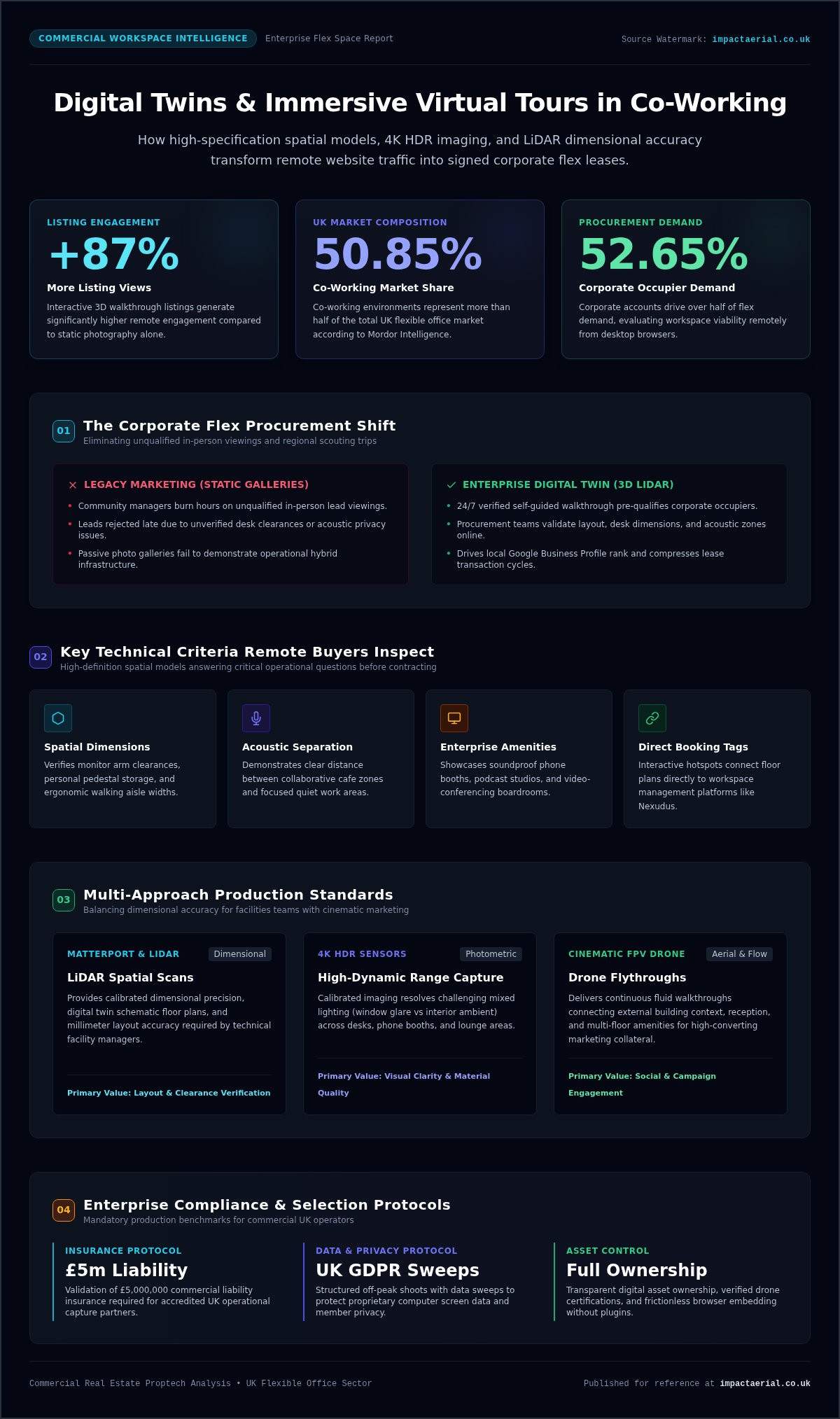
Commercial workspace listings featuring interactive 3D walkthroughs generate 87% more views than static photography alone, yet many operators still rely on flat photo galleries to sell premium flex space. Commissioning a high-specification virtual tour for co-working spaces bridges that costly gap, turning remote website traffic into signed desk memberships before prospective tenants ever visit in person.

Your community team shouldn’t have to burn valuable hours hosting physical tours for unqualified leads, especially when remote corporate occupiers simply need to verify acoustic phone booths, ergonomic desk dimensions, and infrastructure details. In this guide, you’ll discover how commercial digital twins accelerate dedicated hot desk and private office pre-leasing, how to evaluate crucial technical features like LiDAR dimensional accuracy, and how to select an accredited, fully insured UK production partner. Below, we break down the operational standards, compliance protocols, and technical features required to deploy an immersive workspace walkthrough that consistently converts.

Key Takeaways

  • Deploying a high-specification virtual tour for co-working spaces enables remote corporate teams to validate layouts and book memberships online, eliminating unqualified in-person viewings.
  • Integrating interactive data hotspots with 4K HDR imaging transforms a passive visual walkthrough into an active sales channel with live desk availability and direct booking links.
  • Balancing dimensional LiDAR scans with cinematic FPV drone flythroughs allows operators to satisfy technical facility managers while generating engaging marketing collateral.
  • Conducting off-peak shoots with structured data sweeps protects proprietary screen data and member privacy in strict compliance with UK GDPR standards.
  • Selecting an enterprise-ready UK capture partner hinges on validating £5m commercial liability insurance, certified drone credentials for aerial context, and transparent digital asset ownership.

Why Co-Working Spaces Need Immersive Virtual Tours in 2026

The UK flexible office sector has evolved into an enterprise-first marketplace. Mordor Intelligence reports that co-working environments represent 50.85% of the UK flexible office market, with corporate occupiers accounting for 52.65% of overall demand. These commercial clients rarely dispatch facilities managers on regional scouting trips to view private office suites or dedicated desks. Instead, procurement teams evaluate operational readiness from desktop browsers, making an interactive digital twin a mandatory asset rather than a marketing novelty.

Deploying an enterprise-grade virtual tour for co-working spaces fundamentally transforms your sales pipeline. Unqualified in-person viewings waste hours of community manager time on leads who ultimately reject a space due to inflexible desk layouts or insufficient call privacy. By adopting modern virtual tour technology, operators deliver a verified 24/7 walkthrough that pre-qualifies incoming enquiries, boosts Google Business Profile local search rank, and shortens the lease transaction cycle.

To understand the hardware options and capture workflows required to digitise commercial office layouts, watch this practical overview:

Qualifying Leads and Accelerating Membership Sales

Self-guided 3D tours allow prospective members to inspect hot desks, dedicated workstations, and private team suites on their own schedule. High-definition spatial models answer practical operational questions before a contract is sent:

  • Spatial dimensions: Confirms monitor arm clearances, personal pedestal storage, and walking aisle widths.
  • Acoustic separation: Demonstrates the clear distance between buzzing collaborative cafe zones and focused quiet areas.
  • Campaign integration: Embeds directly into paid LinkedIn and Google Ads campaigns, driving remote prospects straight to digital reservation flows.

Showcasing Amenities and Hybrid Work Culture

Static galleries fail to convey how a dynamic flexible workspace actually functions. A commercial virtual tour for co-working spaces documents critical member amenities, from soundproof phone booths and podcast production suites to boardroom video-conferencing technology. This precise visual record proves your space offers professional-grade infrastructure, distinguishing your location from uninspiring serviced offices while validating ergonomic design for health-conscious enterprise clients.

Essential Features of an Enterprise Co-Working Virtual Tour

A basic 360 panoramic walkthrough is no longer sufficient to close corporate flex leases. As flexible inventory expands, facility managers and remote operations leaders expect interactive functionality that bridges the gap between passive viewing and active space procurement. Commercial-grade virtual tour for co-working spaces must combine calibrated 4K HDR sensors with operational data points, ensuring visual clarity under challenging mixed lighting while giving prospective tenants the exact technical specifications they need to sign agreements.

Research into proptech innovations transforming commercial real estate highlights that interactive space management tools dramatically compress leasing cycles. Embedding live data directly inside the 3D model transforms a promotional digital asset into a practical, self-service transactional environment accessible across all standard web browsers without third-party plugins.

Interactive Multimedia Tags and Booking Integrations

Modern flex operators turn virtual spaces into revenue drivers by embedding interactive tags throughout the floor plan. These digital anchor points provide immediate context and streamline the customer journey:

  • Management software links: Connect hot desks and meeting spaces directly to platforms like Nexudus or OfficeRnD so prospective members can complete checkout immediately.
  • Welcome video introductions: Position brief onboarding clips from on-site community managers inside the reception foyer to establish personal rapport.
  • Technical specifications: Attach downloadable PDFs covering boardroom AV compatibility, dual-gigabit backup internet connectivity, and network firewall protocols.

Measurement Tools and Accurate Spatial Digital Twins

Enterprise procurement teams cannot commit to private suites without precise dimensional confirmation. True LiDAR spatial capture provides millimetre-accurate measurement tools directly within the interface, allowing clients to confirm whether custom executive desks, server racks, or storage cabinets will fit before signing contracts. Operators can partner with visual specialists offering professional virtual tour creation to ensure these digital assets reflect rigorous architectural fidelity.

Dimensional precision also guarantees compliance verification. Corporate occupiers must confirm wheelchair turning radii, corridor clearances, and accessible doorway widths to satisfy internal inclusion policies. Accurate schematic 2D and 3D floor plans generated from the capture eliminate spatial misunderstandings, giving corporate real estate directors the absolute confidence to approve remote agreements.

Virtual Tour for Co-Working Spaces: The 2026 Buying Guide

Comparing Production Approaches: Matterport, 360 Video, and Drone FPV

Selecting the right capture technology determines how effectively your visual marketing converts online traffic into signed agreements. While some workspace operators default to standard 360 panoramic video, high-performing hubs deploy distinct visual formats matched to specific sales channels. A comprehensive virtual tour for co-working spaces often blends structured spatial models with continuous video capture, addressing both analytical corporate occupiers and lifestyle-driven hybrid freelancers.

Static panoramic video offers low capture overhead, but it lacks spatial depth and interactive metadata. Operators looking to lead their regional flex market choose between dimensional LiDAR digital twins, dynamic indoor FPV (First-Person View) flythroughs, and exterior aerial context to engage prospective tenants.

Navigable 3D Lidar Scanning for Self-Paced Tours

Structured LiDAR scanning creates an exact architectural digital twin of your property. By capturing dimensional geometry alongside HDR photography, this approach generates the familiar dollhouse perspective and floor-plan views that facility managers rely on. Prospects navigate freely between quiet zones, hot-desk banks, and kitchen areas at their own speed. The spatial data embeds directly onto your website without third-party viewing applications, maintaining fast load speeds across both mobile and desktop browsers.

First-Person-View (FPV) Drones for Cinematic Brand Experience

Lightweight, ducted cinewhoop drones provide a dynamic walkthrough that static scans cannot replicate. Flying smoothly through communal cafe lounges, skimming over meeting tables, and banking up open mezzanine staircases delivers an immediate, energetic sense of brand atmosphere. High-tempo video walkthroughs captured using specialised aerial filming drone systems excel on LinkedIn, Instagram, and paid display channels, capturing remote decision-makers during their initial research phase.

Exterior Aerial Context for Commuter and Location Marketing

Workspace decisions rarely stop at the front door. Commuting logistics, parking availability, and local conveniences heavily influence where corporate occupiers position their teams. Incorporating external aerial perspectives lets you showcase transport infrastructure in a single frame:

  • Transit connections: Highlight proximity to mainline railway stations, tram stops, and key arterial roads.
  • Commuter infrastructure: Document secure on-site parking facilities, dedicated EV charging bays, and covered cycle storage.
  • Neighbourhood amenities: Showcase walkable high-street cafes, green parks, and lunchtime dining spots.

Commissioning experienced operators who deliver comprehensive drone services ensures seamless site storytelling. Crucially, when outdoor flights transition into the public realm, pilots must adhere strictly to UK Civil Aviation Authority drone regulations to maintain legal airspace compliance and enterprise risk mitigation.

Preparing Your Co-Working Space for Virtual Tour Capture

Executing an enterprise visual capture requires meticulous operational preparation. While casual photography accommodates quick staging adjustments on the fly, 360-degree panoramic sensors document every angle simultaneously. Cluttered cable trays, uneven task lighting, or stray whiteboard notes become permanent digital fixtures if not managed before the production team arrives on site. Executing a structured pre-capture audit guarantees that your commercial virtual tour for co-working spaces reflects an organised, premium flexible workplace.

Timing remains the most critical operational variable. High-resolution spatial scanning demands static environments without moving foot traffic, as passersby create visual artefacts and distorted point clouds. Conducting capture sessions during off-peak weekend windows or early morning hours prevents member disruption while giving technicians clear floor plates to execute uniform scans.

Staging Workstations, Boardrooms, and Communal Zones

Visual consistency signals operational discipline to enterprise occupiers. Before camera sensors begin documenting your floor plates, enforce a strict visual checklist across every functional zone:

  • Workstations and quiet pods: Tuck trailing power leads into under-desk cable baskets, align task chairs uniformly, and remove individual mugs or peripheral clutter from open-plan desks.
  • Executive boardrooms: Power on central audiovisual displays to show clean corporate standby screens, dress conference tables with branded notebooks and clean glassware, and align conference chairs flush to table perimeters.
  • Lighting and ambiance: Turn on all perimeter and architectural accent lights, replace any flickering fluorescent bulbs, and adjust window blinds to uniform heights to prevent harsh sunlight glare across wide-angle lenses.

Managing Member Privacy, GDPR, and Intellectual Property

Capturing active co-working environments carries legal compliance obligations under the UK General Data Protection Regulation (UK GDPR) and the Data Protection Act 2018. Commercial lenses easily pick up private member credentials, open financial spreadsheets, and proprietary architectural sketches left on whiteboards. Unlawful processing of identifiable data can expose operators to severe Information Commissioner’s Office (ICO) regulatory penalties, reaching up to £17.5 million or 4% of annual global turnover.

Mitigating these risks requires transparent operational safeguards. Notify private office tenants at least five business days before capture, requesting that whiteboards be wiped clean and physical client files locked away. When digitising your space, operators must ensure that technical technicians apply automated blurring across incidental computer monitors, identifiable individual faces, and vehicle registration marks. You can protect your workspace reputation and member privacy by commissioning professional post-production services that guarantee comprehensive compliance sweeps prior to public launch.

Selecting the Right Commercial Virtual Tour Provider in the UK

Choosing an agency to capture your property requires looking beyond aesthetic showreels. Commercial real estate directors and workspace operators must treat visual capture as an operational project where health and safety compliance, data governance, and technical precision are paramount. An inferior production leaves you with distorted floor plans, recurring hosting markups, and serious legal liabilities. When evaluating partners to commission a virtual tour for co-working spaces, use a structured vetting process that prioritises accredited credentials and operational transparency.

Aviation Licensing, Safety Compliance, and Commercial Insurance

If your project combines interior walkthroughs with exterior context, verify that the agency’s drone operators hold formal UK Civil Aviation Authority (CAA) qualifications. Professional pilots operating commercial drones must hold a valid General Visual Line of Sight Certificate (GVC) and conduct structured pre-flight risk assessments. Commercial building landlords also require proof of comprehensive coverage; verify your partner holds at least £5m commercial liability insurance compliant with Retained Regulation (EC) No. 785/2004.

A vetted specialist applies the same rigorous methodology to visual capture that surveyors apply during a commercial drone survey. This disciplined approach ensures all indoor operations, outdoor flights, and data-gathering activities remain completely safe and compliant with UK property regulations.

Delivery Formats, Hosting Terms, and Turnaround Expectations

Asset ownership and technical delivery can create unexpected overheads if terms aren’t clarified upfront. Before signing an agreement, establish clear expectations across several key operational areas:

  • Digital asset ownership: Confirm whether the 3D model can be transferred directly into your company’s own hosting account or if the supplier charges recurring annual hosting fees.
  • Export deliverables: Ensure your agreement includes high-resolution schematic floor plans, print-ready 4K HDR stills, and uncompressed video assets for social promotion.
  • Turnaround windows: Agree on explicit milestones for initial scan processing, interactive tag integration, and post-production compliance sweeps.

Investing in an enterprise-grade virtual tour for co-working spaces provides a lasting commercial asset that drives pre-leasing velocity for years to come. Ready to elevate your workspace marketing with fully certified visual capture? Request a consultation with Impact Aerial to discuss your location’s requirements.

Maximise Your Co-Working Occupancy with Certified Visual Capture

Deploying a high-precision virtual tour for co-working spaces bridges the gap between passive online interest and signed flex memberships. Combining dimensional LiDAR models with dynamic FPV video walkthroughs eliminates unproductive in-person viewings, allowing corporate occupiers and remote workers to inspect desk ergonomics, acoustic zoning, and transit connections with complete confidence. When supported by structured off-peak staging and rigorous post-production data sweeps, your digital space becomes a secure, high-performing 24/7 sales engine.

Securing these commercial outcomes requires a capture partner committed to regulatory compliance and technical precision. Backed by CAA GVC certified remote pilots, £5m commercial liability insurance, and advanced 4K HDR imaging technology, Impact Aerial delivers end-to-end capture solutions across the West Midlands and nationwide. Take control of your leasing pipeline and present your facilities with total architectural fidelity. Commission your commercial workspace virtual tour with Impact Aerial to elevate your property’s competitive edge today.

Frequently Asked Questions

How much does a commercial virtual tour for a co-working space cost?

Commercial pricing depends on total square footage, the density of scan positions, and required multimedia integrations. Rather than a flat fee, operators price projects based on floor plate complexity, whether private offices require individual scans, and whether external aerial filming is included. Third-party hosting subscriptions and schematic floor plan generation also influence total investment. Most suppliers evaluate architectural floor plans to deliver bespoke commercial quotes matching specific site requirements.

How long does it take to capture a complete co-working facility?

A typical 10,000 to 20,000 square foot co-working hub generally takes between three and six hours to scan thoroughly. Capture speed hinges on spatial layout; open-plan hot-desking zones scan rapidly, whereas numerous partitioned phone booths and executive meeting suites require individual scan placements. Scheduling sessions during off-peak windows or weekends ensures scanning technicians work without interruption, preserving operational continuity for your community team and members.

Can we embed our desk booking software directly inside the virtual tour?

Yes, modern virtual tours support deep interactive linking directly within the 3D model. Technical tags can host live links to flex management platforms such as Nexudus or OfficeRnD. This allows a remote prospect exploring a dedicated desk or hot-desk bank to click a tag, view real-time availability, and complete checkout immediately. It effectively turns a virtual tour for co-working spaces into a direct, automated sales portal.

What happens if our co-working office layout changes after scanning?

Modular workspaces change frequently, but minor furniture shifts rarely necessitate a complete rescan. For major layout reconfigurations, private suite refits, or expanded amenities, technicians can conduct targeted partial rescans. Modern digital twin software aligns new scan points with the existing model, updating specific rooms while preserving your existing embed code and analytics. This keeps digital maintenance costs manageable and ensures your published model remains accurate over time.

Can we film while co-working members are actively using the building?

Commercial filming while members are actively working is strongly discouraged due to compliance and visual quality risks. Moving people create ghosting artefacts in LiDAR scans and continuous 360 photography. Incidental capture of open laptop monitors, sensitive paperwork, or member faces also triggers severe UK GDPR liabilities. Conducting capture sessions during early mornings, evenings, or weekends guarantees uncompromised visual fidelity while protecting member confidentiality.

Is an exterior drone flight necessary for an indoor virtual tour?

While not mandatory, combining exterior aerial footage with an interior virtual tour for co-working spaces significantly enhances commuter marketing. High-resolution aerial perspectives showcase critical location assets that interior walkthroughs cannot convey, such as on-site parking, EV charge points, and nearby rail stations. If an aerial package is selected, ensure the flight is conducted by CAA GVC certified pilots operating under comprehensive commercial liability insurance.

How do virtual tours integrate with our Google Business Profile and local maps?

Panoramic 360-degree imagery can be published directly to your Google Business Profile via Google Street View integration. When prospective hybrid workers search for flexible workspaces or hot desks in your locality, Google surfaces interactive indoor walkthroughs alongside standard search results. This verified visual footprint improves local map rankings, increases user dwell time on your listing, and drives qualified inbound traffic to your booking engine.

Virtual Tour for Retail Spaces: The Ultimate Guide to Immersive Commercial Experiences in 2026

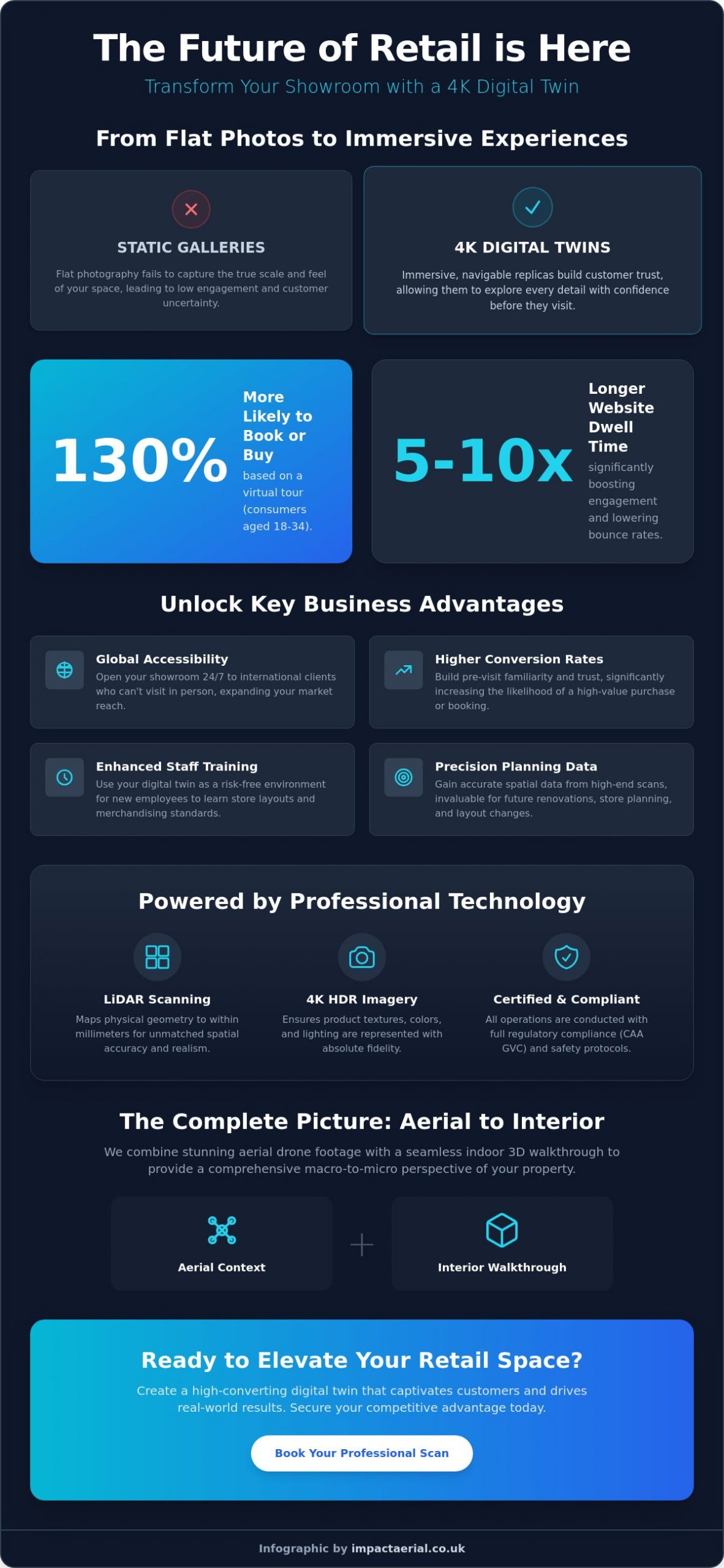
Did you know that consumers aged 18 to 34 are 130% more likely to book or visit a business if they can first engage with an immersive online experience? In a market where digital presence dictates physical success, a professional virtual tour for retail spaces has become the benchmark for commercial credibility. You probably recognize the difficulty of showcasing the true scale of a premium showroom through flat photography, especially when low footfall threatens your bottom line. It’s frustrating to invest in a high-end physical space that your online audience cannot fully appreciate or navigate with ease.

This guide provides a clear roadmap to transforming your retail environment into a high-converting 4K digital twin. We will examine how technical precision, aerial integration, and professional post-production create a seamless journey that increases website dwell time. By following these industry-leading standards, you can secure a significant competitive advantage and ensure your commercial space thrives in the 2026 retail landscape.

Key Takeaways

  • Transition from static online galleries to immersive 4K digital twins to significantly increase user dwell time and customer trust.
  • Learn how a virtual tour for retail spaces leverages advanced hardware like the Matterport Pro3 to provide high-resolution product clarity and spatial accuracy.
  • Understand the critical importance of professional certifications, such as CAA GVC, to ensure your digital scan is conducted with full regulatory compliance and safety.
  • Follow a practical planning checklist that prioritizes “Hero Product” placement and optimized lighting to create a high-converting customer path.
  • Discover how integrating aerial perspectives with 3D walkthroughs creates a comprehensive digital ecosystem for your commercial property.

What is a Virtual Tour for Retail Spaces and Why Does it Matter?

A virtual tour for retail spaces is no longer just a series of stitched-together photos. It’s a high-resolution, 360-degree digital replica of your physical environment. By 2026, the technology has evolved from grainier “street view” clones into immersive 4K HDR digital twins. These sophisticated models allow customers to navigate a store with the same fluidity they’d experience in person. If you’re wondering What is a Virtual Tour? in a commercial context, it’s a data-rich environment where every product shelf and architectural detail is rendered with mathematical precision.

To better understand how these experiences come to life, watch this helpful video:

The Evolution of Retail Visuals in 2026

Traditional photography often fails to capture the scale of modern commercial properties. Static images don’t tell the full story. In 2026, leading brands use an aerial filming drone to establish the geographic context and impressive scale of a flagship site before transitioning into an indoor 3D walkthrough. This provides a macro to micro perspective that photography simply cannot match. Beyond marketing, 3D mapping serves as a vital tool for internal staff training; it allows new employees to learn store layouts and merchandising standards in a risk-free digital environment.

Key Benefits for Retailers and Showrooms

The commercial impact is measurable and immediate. Data suggests that websites featuring virtual tours are viewed 5 to 10 times longer than those without. This increased dwell time directly correlates with lower bounce rates and higher enquiry volumes. The meticulous nature of a 4K scan ensures your brand is perceived as a leader in your sector.

  • Global Accessibility: Your London or Birmingham showroom is open 24/7 to international clients who can’t visit in person.
  • Sustainability: By offering a qualified virtual visit, you reduce unnecessary travel for clients who only need to confirm specific details before purchasing.
  • Conversion: Prospects aged 18 to 34 are 130% more likely to book or buy based on a virtual experience.
  • Precision: High-end digital twins provide accurate spatial data, which is useful for future renovations or store planning.

The Technology Behind High-Conversion Virtual Experiences

High-conversion digital twins aren’t created with consumer-grade cameras. To achieve professional results, we utilize LiDAR-based systems like the Matterport Pro3. This hardware doesn’t just take pictures; it maps the physical geometry of a room to within millimeters. While custom 360 photography has its uses, it often lacks the spatial depth required for a truly navigable virtual tour for retail spaces. Research into The Technology Behind Virtual Experiences confirms that high-fidelity rendering and interactive elements are critical for maintaining customer engagement in a digital retail environment.

Visual clarity is non-negotiable for premium brands. We use 4K HDR imagery to ensure that product textures and colors are represented with absolute accuracy. This precision is vital for showrooms where material quality is a primary selling point. To drive actual sales, we integrate interactive “Mattertags”. These digital hotspots allow you to embed product videos, direct purchasing links, or booking forms directly into the 3D environment. If you want to see how these elements function in a live environment, you can explore our professional virtual tour creation services.

Indoor Immersive Walkthroughs

A successful tour must be intuitive for the end-user. We generate a “Dollhouse View”, which provides a 3D cutaway of the entire building. This is particularly effective for multi-floor department stores, as it allows customers to understand the layout instantly. Our technicians prioritize the strategic placement of information points near high-margin product lines. We also focus on smooth navigation. By carefully calculating the distance between scan points, we prevent the “digital motion sickness” that poorly executed tours often cause. This technical attention to detail ensures the user remains focused on your products rather than the interface.

Aerial Context and External Mapping

Indoor scans only tell half the story of a physical location. To provide a complete commercial perspective, we integrate high-resolution drone photography to capture building exteriors and car parks. This establishes the physical accessibility and prominence of your site. Using professional-grade commercial drones, we can create cinematic “fly-through” sequences. These start high above the retail park and transition smoothly into the indoor 3D display. For large-scale developments, the addition of drone survey data provides prospective tenants or buyers with precise site measurements and structural context that standard marketing materials lack.

Virtual Tour for Retail Spaces: The Ultimate Guide to Immersive Commercial Experiences in 2026

Professional Standards: Safety, Insurance, and Compliance

Engaging a hobbyist for a virtual tour for retail spaces represents a significant operational risk that high-street brands simply cannot afford. The legal and reputational fallout of an uninsured accident or a regulatory breach far outweighs any perceived cost savings. Professional operators prioritize compliance with the same rigor they apply to image quality. For instance, operating drones in congested retail environments requires a specific level of competence. We hold the CAA GVC (General Visual Line of Sight Certificate), which is the industry standard for pilots working in complex urban settings. This certification ensures every flight is conducted within a strict safety framework, protecting both the public and your property.

Insurance is another non-negotiable factor in the commercial sector. A standard drone policy is rarely sufficient for high-traffic retail environments. We maintain £5m in commercial liability insurance, providing the necessary financial protection and peace of mind for our clients. During the filming process, our team implements rigorous risk mitigation strategies. We manage foot traffic and coordinate closely with store managers to ensure the scanning process doesn’t compromise public safety or the customer experience. This methodical approach is what separates a professional digital twin from a low-quality amateur attempt.

Navigating UK Drone Regulations in 2026

Understanding the current drone license requirements is essential for any business commissioning aerial content. In 2026, flight planning for busy urban retail centers involves more than just launching a craft. It requires detailed site surveys, weather monitoring, and often specific permissions from local authorities. Privacy is equally critical. To remain compliant with GDPR, we utilize advanced post-production techniques to blur faces and vehicle number plates. This ensures your virtual tour for retail spaces respects the privacy of the public while showcasing your brand in the best possible light.

Professional Accreditations and Reliability

Professional body memberships, such as ARPAS-UK, serve as a hallmark of quality and technical competence. These affiliations demonstrate a commitment to industry best practices and continuous professional development. At Impact Aerial, our approach is defined by meticulous planning and technical precision. By choosing accredited drone services, you protect your brand reputation from the pitfalls of amateur execution. We provide a structured, methodical workflow that ensures your project is delivered on time and in full compliance with all national safety standards.

Planning Your Retail Virtual Tour: A Practical Checklist

Successful execution of a virtual tour for retail spaces depends on meticulous preparation. You shouldn’t treat the scan as a casual photography session. Instead, view it as a high-stakes digital grand opening. Every detail captured by a 4K LiDAR sensor remains accessible to your customers indefinitely. Proper planning ensures that your digital twin reflects your brand’s highest standards while maximizing the technical capabilities of the hardware. To achieve a seamless result, follow this structured approach to site readiness.

  • Step 1: Identify Hero Products. Determine which high-margin items or exclusive collections should act as the focal points of the tour. These areas will receive the highest density of interactive tags and links.
  • Step 2: Master the Lighting. Contrary to traditional photography, natural light is often a hindrance in 3D scanning. Moving shadows and changing sun positions can cause “stitching errors” in the final model. We recommend consistent, high-quality artificial lighting for uniform results.
  • Step 3: The Grand Opening Standard. Declutter every aisle. Remove temporary signage, cleaning equipment, or personal items. If it shouldn’t be there on your busiest Saturday, it shouldn’t be there for the camera.
  • Step 4: Strategic Scheduling. We typically conduct shoots during “off-peak” hours. This minimizes disruption to your operations and ensures a clean, people-free environment for the most professional output.
  • Step 5: Post-Production Audit. Once the scan is complete, we review the digital twin to ensure all embedded links, booking forms, and product tags are accurate and functional.

Staging Your Store for the 3D Camera

LiDAR sensors use light pulses to measure distance. Highly reflective surfaces, such as floor-to-ceiling mirrors or large glass partitions, can confuse these sensors and create “ghost rooms” or spatial distortions. We advise cleaning these surfaces thoroughly but also identifying potential problem areas during our pre-shoot site survey. Brand consistency is also vital. Ensure all visible signage is current and aligned with your 2026 marketing strategy. If you plan to include staff for “lifestyle” shots, they must be briefed on their positioning to avoid motion blur during the rotation of the 360-degree lens.

Technical Integration Post-Shoot

The value of your tour increases when it’s integrated into your wider digital ecosystem. Embedding the experience directly onto your website’s homepage or key product landing pages provides a significant SEO advantage by increasing user dwell time. You should also share the tour link across social media and your Google Business Profile to capture local search traffic. Success is measured through data. By tracking “walkthrough” paths and tag click-through rates, you gain valuable insights into customer behavior and showroom navigation. If you’re ready to begin the planning process, you can book your virtual tour consultation with our technical team today.

Why Choose Impact Aerial for Your Retail Space?

Impact Aerial provides a specialized service that integrates sophisticated indoor 3D mapping with cinematic aerial context. While many agencies offer basic scans, our Birmingham-based team delivers a comprehensive virtual tour for retail spaces that meets the exacting standards of luxury commercial brands. We operate across the UK, bringing nationwide delivery capabilities to retailers who require a consistent, high-tier digital presence for their entire portfolio. Our approach focuses on 4K HDR output, ensuring that the visual quality of your digital twin matches the prestige of your physical showroom.

Our technical advantage lies in our dual-certification. We aren’t just Matterport specialists; we’re also CAA-certified drone pilots. This means we manage the entire project from 100 feet in the air down to the finest product detail on your shelves. By handling end-to-end project management, from the initial consultation to final post-production editing, we ensure a cohesive narrative that guides your customers seamlessly from the street into your store. This level of professional integration is rarely found in the standard “walkthrough-only” market.

Our Meticulous Approach to Retail Projects

Safety is the cornerstone of our operational workflow. We conduct detailed pre-flight and pre-shoot surveys for every project to ensure a zero-incident delivery, even in busy urban environments. We utilize advanced, professional-tier drone platforms to achieve unparalleled visual clarity for building exteriors, which provides the necessary context for your virtual tour for retail spaces. Beyond the raw imagery, we offer customized multimedia overlays. These are tailored to your specific retail goals, whether that involves highlighting seasonal promotions or embedding direct links to your e-commerce platform.

Driving ROI for UK Retailers

Investing in a digital twin is a strategic move to turn digital views into physical visits. Our case studies demonstrate how high-fidelity tours increase customer confidence, leading to more “qualified” footfall from visitors who’ve already explored your layout online. We value long-term partnerships, offering efficient store refreshes and seasonal updates to keep your virtual presence current as your inventory evolves. This commitment to technical excellence and brand protection makes us the trusted choice for commercial property marketing in 2026.

Our goal is to provide a seamless, data-centric experience that drives tangible results for your business. If you’re ready to elevate your showroom’s digital profile, Enquire about a virtual tour for your retail space today and speak with our technical consultants.

Future-Proofing Your Commercial Presence

The shift toward immersive digital twins is no longer a luxury for flagship stores; it’s a commercial necessity. By combining high-resolution indoor scans with cinematic aerial context, you provide a level of transparency that builds immediate consumer trust. We have established that a professional virtual tour for retail spaces relies on three fundamental pillars: technical precision, strategic planning, and rigorous safety standards. Implementing these elements ensures your digital presence works as hard as your physical showroom to drive conversions and increase dwell time.

Impact Aerial provides the technical expertise and regulatory compliance required for high-stakes commercial projects. Our team of CAA GVC Certified Pilots uses 4K HDR commercial-grade equipment to deliver unparalleled visual clarity. With £5m in commercial liability insurance, we offer the reassurance that your brand and property are in expert hands. It’s time to bridge the gap between your online audience and your physical retail environment. You can Request a bespoke quote for your retail virtual tour to begin your transformation. We look forward to helping you lead the market in 2026.

Frequently Asked Questions

How long does it take to film a virtual tour for a retail store?

Most professional scans take between 2 and 6 hours depending on the total square footage and the complexity of the layout. A standard retail unit under 2,000 square feet can typically be completed in a single morning session. Larger showrooms or multi-floor department stores require a full day to ensure every LiDAR scan point is captured with the precision needed for a high-quality 4K output.

Do I need to close my shop during the virtual tour shoot?

We recommend scheduling the shoot during off-peak hours or while the store is closed to ensure a clean, unobstructed digital twin. While it’s technically possible to scan with people present, moving figures often cause “ghosting” artifacts in the 3D model. Most clients choose to book sessions before opening or after closing to maintain professional visual standards without disrupting their daily trade.

Can I update the products or tags in the virtual tour later?

You can update interactive Mattertags, product descriptions, and embedded links at any time without needing a new site visit. This flexibility allows you to refresh pricing, promotional videos, or direct booking links as your inventory changes. However, if you physically move walls or rearrange the entire store layout, a re-scan of those specific areas is necessary to maintain spatial accuracy.

Are virtual tours for retail spaces compatible with mobile devices?

Every virtual tour for retail spaces we produce is fully responsive and optimized for mobile, tablet, and desktop viewing. Modern 3D walkthroughs use WebGL technology to ensure smooth, lag-free navigation within all standard mobile browsers. This is essential because a significant portion of modern consumers use smartphones to research local showrooms and flagship stores before committing to a physical visit.

What is the difference between a 360 photo and a Matterport 3D tour?

A 360 photo is a static image from a single fixed point, whereas a Matterport 3D tour uses LiDAR data to create a navigable spatial model. This “digital twin” allows users to walk through the space and view it from any angle, including the specialized “Dollhouse” perspective. Matterport provides a much more immersive experience that accurately represents the true depth and scale of a commercial environment.

How much does a virtual tour for a commercial space cost in the UK?

Professional costs vary based on the square footage of the property and the complexity of the interactive elements required for the project. Industry rates typically reflect the level of technical expertise, the quality of 4K hardware used, and the inclusion of necessary commercial liability insurance. We provide bespoke quotes tailored to the specific dimensions and marketing goals of your unique retail environment.

Can you integrate drone footage into an indoor virtual tour?

We specialize in integrating high-resolution aerial perspectives with indoor walkthroughs to create a comprehensive digital ecosystem. Using DJI Enterprise drones, we capture the exterior context and site accessibility, which we then link directly to the 3D indoor scan. This macro-to-micro journey helps customers understand the location and scale of your site before they transition into the immersive indoor experience.

Is a virtual tour good for my website’s SEO?

Implementing a virtual tour for retail spaces significantly improves SEO by increasing user dwell time, which is a critical ranking signal for search engines. When visitors spend more time exploring your 3D showroom, it signals to Google that your content is highly relevant and engaging. Additionally, embedding these tours on your Google Business Profile can increase visibility in local search results and improve overall click-through rates.