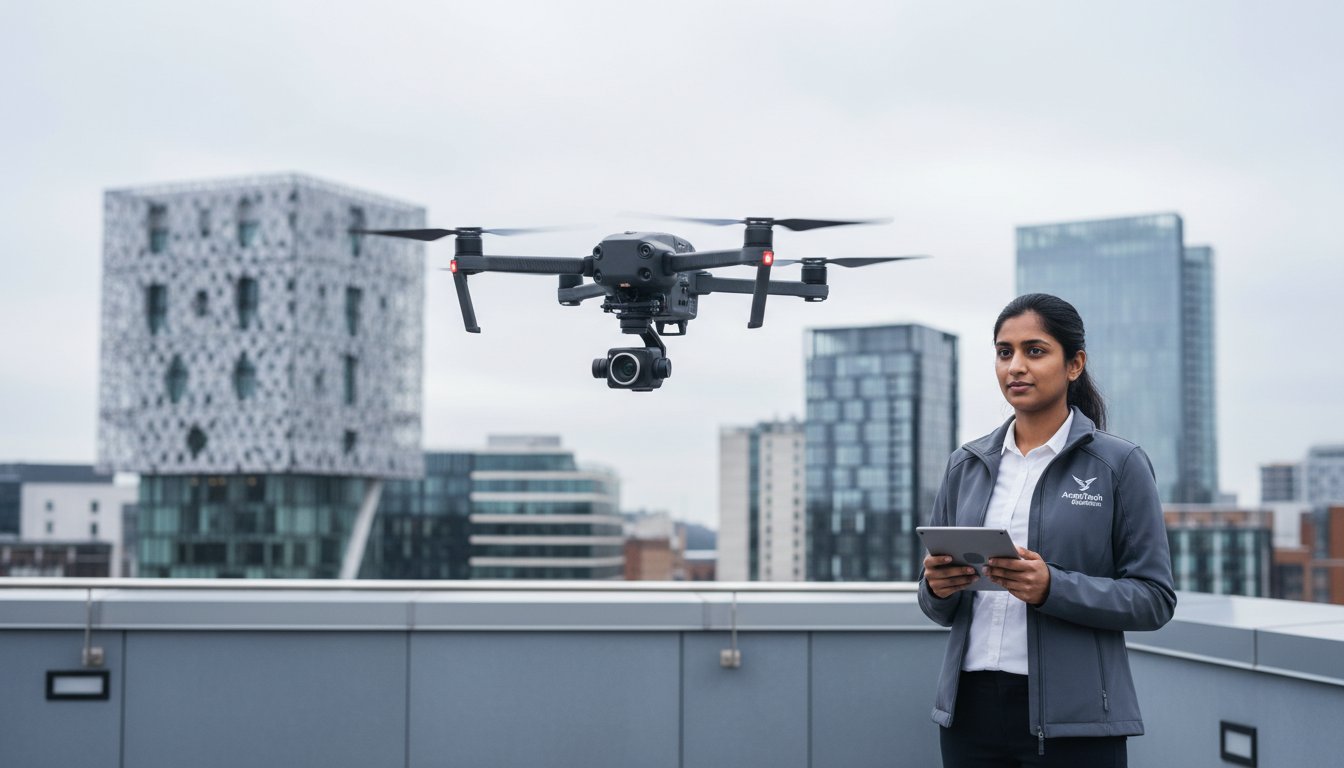
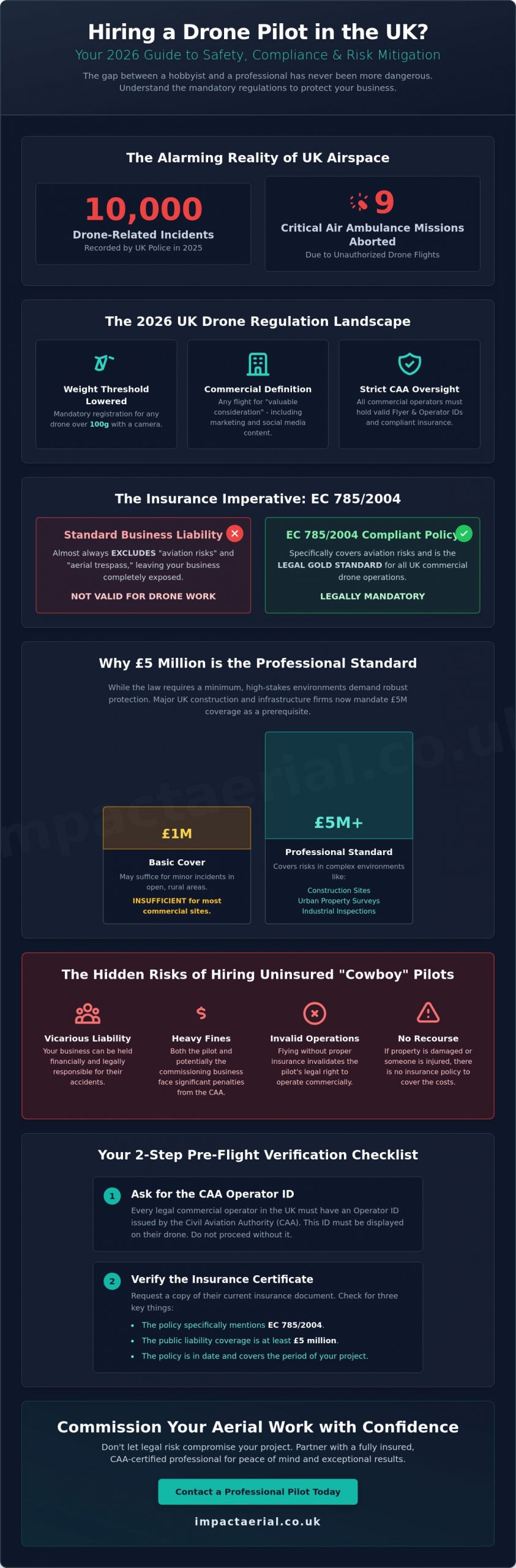
In 2025, UK police recorded nearly 10,000 drone-related incidents, including nine critical air ambulance missions that were forced to abort due to unauthorized flights. These figures highlight a stark reality for any business commissioning aerial work; the gap between a hobbyist and a professional has never been more dangerous. Understanding why you need an insured drone pilot is no longer just a best practice. It’s a fundamental requirement to shield your organization from the severe legal and financial fallout of non-compliance under the latest aviation standards.
You likely appreciate the precision that professional aerial photography or thermal solar surveys provide, yet the complexity of the new 2026 UK drone regulations often creates unnecessary uncertainty. We believe that professional-grade results should never come with a side of legal risk. This guide explains the mandatory EC 785/2004 insurance standards and the new UK class marking system that now governs every flight. You’ll learn exactly how to verify a pilot’s Flyer ID and insurance documents so you can commission your next construction site monitor or property survey with absolute confidence in its legality and safety.
Key Takeaways
- Understand the mandatory EC 785/2004 insurance requirements that define legal commercial drone operations under the 2026 UK regulatory framework.
- Discover why you need an insured drone pilot to mitigate vicarious liability, ensuring your business isn’t held responsible for operational accidents or third-party damages.
- Learn why £5 million public liability coverage has become the professional standard for complex environments like construction sites and urban property surveys.
- Master a simple two-step verification process to validate a pilot’s CAA Operator ID and professional qualifications before any flight commences.
- Identify how specialized enterprise-grade hardware and meticulous safety protocols provide the technical reliability required for high-stakes aerial data collection.
The Legal Landscape of UK Drone Operations in 2026
The regulatory framework for unmanned aircraft underwent a significant transformation on January 1, 2026. These updates moved the industry toward a high-accountability model, lowering the mandatory registration threshold to just 100g for any drone equipped with a camera. This means almost every modern aircraft used for professional data collection now falls under strict Civil Aviation Authority (CAA) oversight. This legal framework is precisely why you need an insured drone pilot who understands the nuances of the 2026 mandate and maintains the necessary Flyer and Operator IDs for every mission.
To better understand the professional requirements for modern drone operations, watch this helpful video:
Operating a drone for any form of “valuable consideration” is legally classified as a commercial flight. The current UK drone regulations stipulate that any pilot performing paid work must hold third-party liability insurance that meets specific statutory requirements. For businesses commissioning aerial filming or PV solar farm thermal surveys, confirming this insurance is the first step in professional due diligence. Flying without it doesn’t just risk a fine; it invalidates the pilot’s legal right to operate in commercial airspace.
Commercial vs. Recreational: The Legal Divide
The CAA defines a commercial operation as any flight performed “in the pursuit of business.” This definition is broader than many realize. It includes not only direct payment for services like construction site monitoring but also “indirect” benefits. If a pilot flies to create content for their own marketing or to promote a third-party brand on social media, the law views this as a commercial venture. Understanding why you need an insured drone pilot becomes clear when you realize that recreational policies explicitly exclude any activity that generates value for a business. Pilots found operating commercially under a hobbyist policy face heavy penalties, and the businesses hiring them may find themselves entangled in the legal fallout.
Understanding EC 785/2004 Compliance
The European-retained regulation EC 785/2004 sets the specific insurance requirements for all aircraft operators within the UK. Standard business public liability insurance almost always excludes “aviation risks” or “aerial trespass,” leaving a massive gap in coverage if an incident occurs. A compliant policy must specifically mention EC 785/2004 to be valid for drone work. This regulation ensures that there’s a guaranteed minimum level of cover for third-party property damage and personal injury. EC 785/2004 is the gold standard for UAV insurance, providing the legal and financial security required for high-stakes commercial property surveys and aerial data collection.
Why £5m Commercial Liability Insurance is the Professional Standard
While the law mandates a baseline of cover, professional environments in 2026 demand significantly more. A £1 million policy might suffice for a minor incident in an open field, but it quickly evaporates in a high-stakes commercial setting. Major UK construction and infrastructure firms now mandate a £5 million minimum as a prerequisite for site access. This requirement isn’t arbitrary. It reflects the actual costs associated with structural repairs, business interruption, and personal injury in densely populated urban zones or sensitive industrial sites.
Meeting the official CAA insurance requirements is the legal floor, but the professional ceiling is much higher. High-limit insurance provides the financial depth required to manage the complex risks inherent in modern aerial work. It ensures that if an unforeseen event occurs, the financial burden doesn’t fall back onto your business through vicarious liability claims.
The Financial Reality of a Drone Incident
The true cost of an accident goes beyond the physical replacement of a drone. If an aircraft strikes a specialized glass atrium during a drone commercial property survey, the repair bill is only the start. You must consider the potential for massive business interruption claims, legal fees, and specialized cleanup costs. In sensitive environments like PV solar farms, a collision with high-voltage equipment can trigger a “total loss” scenario for critical infrastructure components. Professional commercial policies also provide essential coverage for data breaches or accidental privacy invasion, providing a safety net that hobbyist insurance simply doesn’t offer.
Insurance as a Proxy for Professionalism
High-limit insurance acts as a vital filter for quality. Insurers typically only grant £5 million policies to pilots who hold advanced qualifications, such as the General Visual Line of Sight Certificate (GVC). This underwriting process requires the operator to prove they use meticulous risk assessment protocols and commercial-grade hardware, such as DJI Enterprise models. This rigorous vetting process is a primary reason why you need an insured drone pilot for complex projects. It guarantees that the operator has the technical maturity to handle high-value assets and the discipline to follow strict safety workflows. For projects requiring this level of technical precision and security, many firms look to professional aerial photography services that treat these high-limit standards as a baseline rather than an optional extra.
The Hidden Risks of Hiring Uninsured “Cowboy” Pilots
Hiring an uninsured “cowboy” pilot might seem like a cost-saving measure, but the financial exposure for your business is immense. Many organizations mistakenly believe that if a drone crashes, the liability remains solely with the operator. This is a dangerous misconception. In the eyes of the law, the entity that commissions the flight often shares the burden of the outcome. This regulatory and financial minefield is a primary reason why you need an insured drone pilot to manage your aerial data requirements.
The technical reliability of the aircraft is another major concern. Professional insurance providers require pilots to maintain detailed maintenance logs and use enterprise-grade hardware. Uninsured operators often fly unmaintained consumer drones that lack the mandatory 2026 Remote ID broadcasting capabilities. These “legacy” systems are significantly more prone to “fly-away” incidents, where the aircraft stops responding to pilot commands and becomes a kinetic hazard to the public. When an incident occurs with an uninsured operator, there is no financial safety net to catch the falling debris or the resulting legal claims.
Vicarious Liability: Your Business on the Hook
UK courts frequently apply the principle of vicarious liability when assessing damages. If a contractor performs a task for your benefit and causes harm, your business can be held legally responsible for their actions. Imagine a scenario on a busy Birmingham street where a drone loses power during a commercial property survey. If that aircraft strikes a pedestrian or a vehicle, and the pilot has no assets or insurance, the legal focus shifts directly to the firm that hired them. Your own general business insurance likely contains an “aviation exclusion” clause, meaning it won’t cover drone-related accidents. You could be left to settle six-figure claims for personal injury or property damage out of your own capital reserves.
Data and Privacy Complications
In 2026, data security is as critical as physical safety. Uninsured operators rarely have the robust, GDPR-compliant workflows needed for tasks like construction site monitoring or virtual tour creation. If they accidentally capture sensitive data or breach privacy boundaries, professional indemnity insurance is the often the only thing protecting your business from an Information Commissioner’s Office (ICO) fine. Furthermore, footage captured during an illegal, uninsured flight may be deemed inadmissible for planning applications or legal evidence. This renders the entire mission a waste of time and money, while simultaneously damaging your corporate reputation. Working with a vetted, insured professional ensures that every byte of data is captured legally and protected by a comprehensive indemnity policy.
How to Verify a Drone Pilot’s Insurance and Credentials
Verification is the only way to turn the theoretical safety of a professional operator into a practical reality for your project. While the 2026 regulations have formalized many industry standards, the burden of due diligence still rests with the hiring business. This is why you need an insured drone pilot who proactively provides a transparent paper trail of their operational maturity. Follow these five steps to ensure your contractor is compliant before they arrive on-site.
- Step 1: Verify the CAA Operator ID. Every commercial drone over 100g must be linked to a valid Operator ID. Request this number and check it against the official CAA register to ensure it’s active and belongs to the entity you’re hiring.
- Step 2: Review Qualifications. A professional should hold either an A2 Certificate of Competency (A2 CofC) or a General Visual Line of Sight Certificate (GVC). The latter is typically required for more complex industrial work.
- Step 3: Examine the Insurance Schedule. Don’t just look for a “certificate of insurance.” You must see the specific schedule that confirms compliance with EC 785/2004. If this regulation isn’t cited, the policy is likely a hobbyist version that won’t cover commercial site monitoring or photography.
- Step 4: Request a Site-Specific RAMS. A professional operator will provide a Risk Assessment and Method Statement (RAMS) tailored to your specific location. This document should detail how they’ll manage local hazards like power lines, public footpaths, or nearby airports.
- Step 5: Check Expiration Dates. Regulatory certificates and insurance policies often expire on different dates. Ensure every document is valid for the entire duration of your scheduled flight operations.
Red Flags to Watch Out For
Be wary of operators who use vague language like “fully licensed” or “certified” without providing a specific CAA number or insurance schedule. If an operator claims their hobbyist insurance covers “occasional business use,” it’s a major red flag. These policies almost never meet the EC 785/2004 standards required for paid work. Another warning sign is a pilot who arrives on-site without having performed a pre-flight survey. Professionalism starts long before the propellers spin; meticulous planning is the hallmark of a vetted specialist.
The Importance of GVC Certification
Being CAA GVC certified represents a significant step up from basic competency. While an A2 CofC allows for limited operations, the GVC is the professional standard for high-stakes work in complex environments. It demonstrates that the pilot has undergone rigorous practical and theoretical training, specifically focused on operating safely in high-risk or congested areas. This level of certification is often a prerequisite for obtaining the £5 million liability policies discussed earlier. It provides the technical assurance you need for projects like construction site monitoring or industrial inspections. If you require a pilot who meets these stringent professional standards, contact our team for a compliant drone service quote.
Impact Aerial: Safety-First Drone Services in the West Midlands
Impact Aerial provides a specialized solution for businesses across Birmingham and the wider West Midlands region. We understand that the regional landscape, from dense urban centers to complex infrastructure projects, requires more than just basic flight skills. This is exactly why you need an insured drone pilot who treats safety as a technical discipline rather than a simple checkbox. We maintain £5 million in commercial liability insurance as our standard baseline. This ensures every client has the financial security needed for high-stakes operations in high-value environments.
Our fleet consists exclusively of DJI Enterprise hardware. Unlike consumer-grade alternatives, these systems feature advanced obstacle avoidance, redundant power systems, and integrated Remote ID broadcasting to meet the latest 2026 compliance standards. This hardware reliability is paired with the expertise of our GVC certified pilots. We manage the entire project lifecycle with meticulous care. From the initial site-specific Risk Assessment and Method Statement (RAMS) to the final post-production delivery, our methodical approach guarantees both safety and precision.
Specialised Surveys and Filming
Precision is the cornerstone of our drone survey capabilities. We provide construction site monitoring and commercial property surveys that transform raw aerial footage into actionable, data-centric reports. For creative projects, our aerial filming drone workflows utilize strict safety protocols to operate in complex urban environments. Our deep local knowledge of Birmingham’s controlled airspace and West Midlands geography allows us to identify potential hazards early. This regional expertise ensures that your project remains fully compliant with national aviation laws while delivering high-tier visual output.
Your Trusted Partner for UK Drone Services
Choosing a specialist provider means more than just hiring a pilot; it means securing a technical consultant for your business. Our guide to professional drone services explains how we integrate regulatory compliance into every aspect of our work. We invite every potential client to request our full compliance pack, including our insurance schedule and CAA certifications, before any flight is booked. This transparency is a primary reason why you need an insured drone pilot with a proven track record. Contact Impact Aerial for a compliant, insured drone quote today and ensure your 2026 operations are built on a foundation of safety and professional excellence.
Secure Your Operational Future in 2026
The 2026 UK aviation landscape leaves no room for ambiguity. Between mandatory class markings and strict EC 785/2004 insurance requirements, the line between professionals and hobbyists is now a firm legal boundary. Choosing a vetted specialist protects your business from vicarious liability and ensures data is captured with enterprise-grade precision. This fundamental security is exactly why you need an insured drone pilot for every commercial property survey or construction site monitoring mission.
Impact Aerial bridges the gap between complex CAA regulations and your project’s specific requirements. We combine CAA GVC Certified Pilots with £5m Commercial Liability Insurance as a baseline for every project. Our status as DJI Enterprise Hardware Specialists ensures that every mission utilizes the most reliable technology available today. You don’t have to manage these regulatory risks alone.
Get a Quote from our GVC Certified and £5m Insured Pilots. We look forward to providing the professional results and legal peace of mind your business deserves.
Frequently Asked Questions
Is it illegal to hire a drone pilot who doesn’t have insurance?
It is illegal to commission any commercial drone flight in the UK if the operator lacks valid third-party liability insurance. The Civil Aviation Authority (CAA) mandates that all paid aerial work, including aerial filming and photography, must comply with EC 785/2004 standards. Hiring an uninsured operator puts your business in direct breach of these aviation laws and can lead to significant legal penalties for both parties.
What is the minimum insurance required for commercial drone pilots in the UK?
Commercial drone pilots must maintain third-party liability insurance that meets the specific requirements of Regulation (EC) 785/2004. While the legal minimum is often cited as £1 million, this figure represents the absolute floor for low-risk operations. Most professional operators maintain significantly higher limits to ensure they can manage the financial risks associated with complex urban projects or industrial site monitoring.
Can I be sued if a drone pilot I hired crashes?
You can be held legally responsible for a drone crash through the principle of vicarious liability. If an uninsured pilot causes property damage or personal injury while working on your behalf, the claimant’s legal team will likely target your business for compensation. This financial exposure is a primary reason why you need an insured drone pilot with a high-limit policy to act as a protective buffer.
How do I know if a drone pilot’s insurance is actually valid?
You should request a copy of the pilot’s insurance schedule and verify that it explicitly mentions compliance with EC 785/2004. Check that the policy is currently active and that the insured entity matches the name on the pilot’s CAA Operator ID. A professional will always provide these documents as part of their standard compliance pack before any flight takes place on your site.
Does standard business public liability insurance cover drone flights?
Standard business public liability insurance almost never covers drone operations because of “aviation exclusion” clauses. These policies are designed for ground-based risks and don’t account for the specific liabilities of unmanned aircraft. You must ensure your contractor has a specialist aviation policy that remains valid even in the event of a technical failure or pilot error during a property survey.
What happens if a drone pilot flies without a CAA license?
Operating without a valid CAA Flyer ID and Operator ID is a criminal offense that can result in heavy fines and the seizure of equipment. For the hirer, this means any data collected, such as construction site monitoring footage, might be legally unusable in court or for planning applications. It also automatically invalidates any insurance the pilot might claim to have, leaving you fully exposed.
Why do some drone pilots have £5m or £10m insurance instead of £1m?
Higher limits like £5 million are often required by major construction firms and infrastructure owners to cover “total loss” scenarios. In a busy city centre or a sensitive industrial site, the cost of structural damage and business interruption can easily exceed £1 million. Professional pilots carry these higher limits to provide the reassurance that even catastrophic incidents are fully covered by their policy.
Can a drone pilot fly in a city centre if they are insured?
Insurance is only one part of the requirement for flying in restricted areas like city centres. A pilot also needs the correct CAA qualifications, such as a General Visual Line of Sight Certificate (GVC), and must perform a detailed site-specific risk assessment. They must also comply with the 2026 green flashing light mandate for night operations and broadcast their identity via Remote ID technology.
 2 Norton Drive, Wythall, Birmingham, B47 6HH Company registration number: 11138586. VAT Number: 366 9068 55