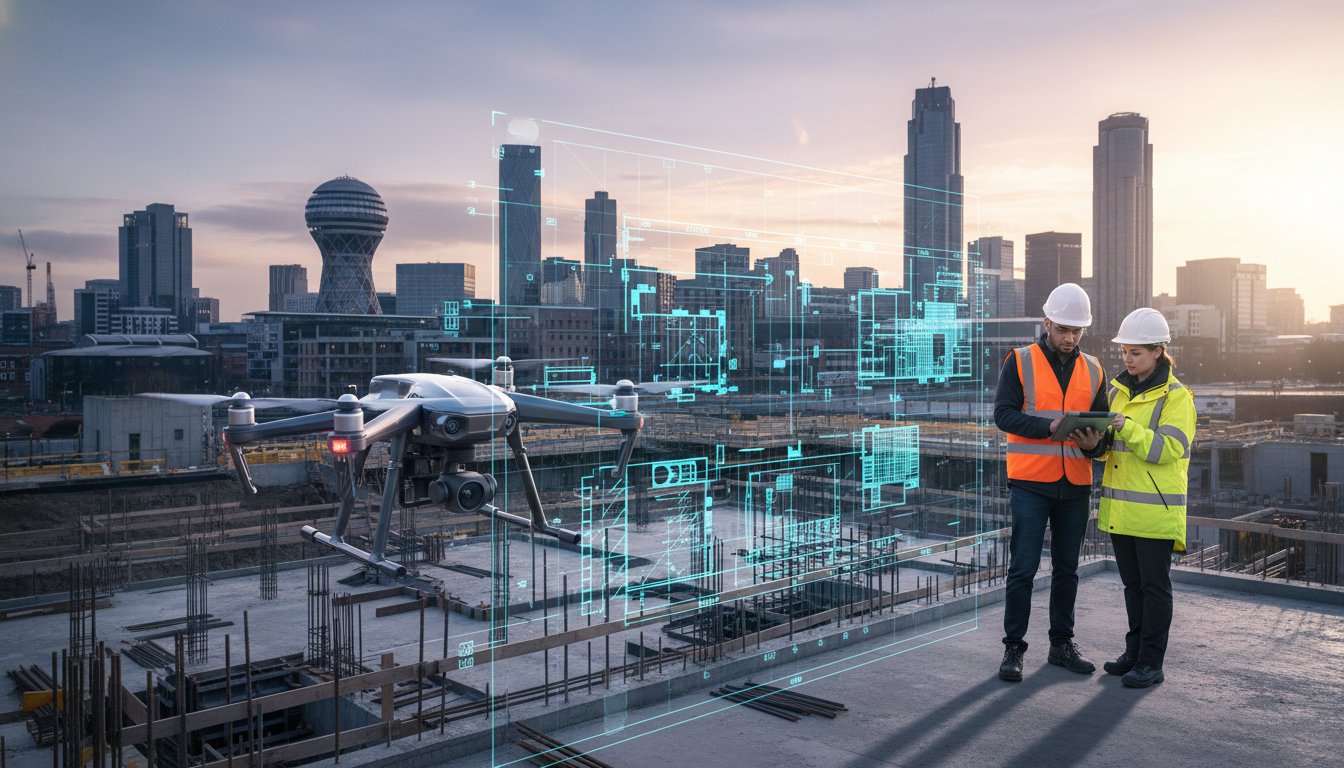
A 2026 survey revealed that 67% of construction companies now use drones for site surveying and progress monitoring, signaling a major shift toward data-driven project management. When a project grinds to a halt due to a disagreement over work quality or a boundary line, the resulting litigation costs often dwarf the original dispute. Utilizing professional drone photography for construction disputes provides a definitive, high-fidelity visual record that removes ambiguity from the conversation.
Our meticulous approach extends to our geographic reach. Based in the West Midlands, we leverage our central location to provide comprehensive nationwide coverage across the UK. This allows us to maintain a consistent standard of forensic data collection for clients with multiple sites, ensuring that the methodology used to resolve a dispute in Birmingham is identical to one in London or Manchester. For developers managing properties in the United States, professional teams like Palm Beach Drone Pros provide similarly high standards of aerial data collection throughout South Florida.
It’s incredibly difficult to prove the status of a site once concrete has been poured or scaffolding is removed, and we understand how stressful these emotive arguments can become for all parties involved. This guide demonstrates how to secure objective proof of work to resolve conflicts efficiently through mediation. You’ll learn how high-accuracy aerial data aligns with Land Registry records and why professional forensic imagery is now the gold standard for protecting your business from costly legal delays.
Key Takeaways
- Understand how professional drone photography for construction disputes provides forensic-grade evidence that is superior to traditional, ground-level site notes.
- Learn the importance of 4K HDR imagery and embedded metadata in proving the exact “when” and “where” of site activities for legal admissibility.
- Discover how consistent construction site monitoring captures critical “hidden” work, such as foundations and drainage, before they are permanently covered.
- Identify why partnering with a CAA-certified operator is essential for ensuring aerial data meets the strict regulatory and insurance standards required in court.
- Compare the efficiency of aerial surveys against traditional methods to gain an unobstructed, comprehensive view of complex site boundaries and progress.
The Cost of Conflict: Why Construction Disputes Need Objective Visual Evidence
Construction disputes represent a massive financial drain on the UK industry. When disagreements arise, they often hinge on subjective interpretations of site progress or quality. Traditional site diaries and ground-level photos often lack the necessary context to satisfy a court or mediator. This is where professional drone photography for construction disputes becomes a critical asset. By utilizing advanced aerial photography techniques, stakeholders can secure a comprehensive, time-stamped visual record that serves as a single source of truth.
These high-fidelity records transition from basic progress monitoring into forensic documentation. This shift is essential for Construction Dispute Resolution (CDR) because it provides the granular detail needed to verify structural integrity or site boundaries without relying on memory or incomplete paperwork. Our approach emphasizes precision and technical compliance, ensuring that every frame captured is a reliable asset for your legal or management team.
To better understand how aerial tools provide precise site data, watch this helpful video:
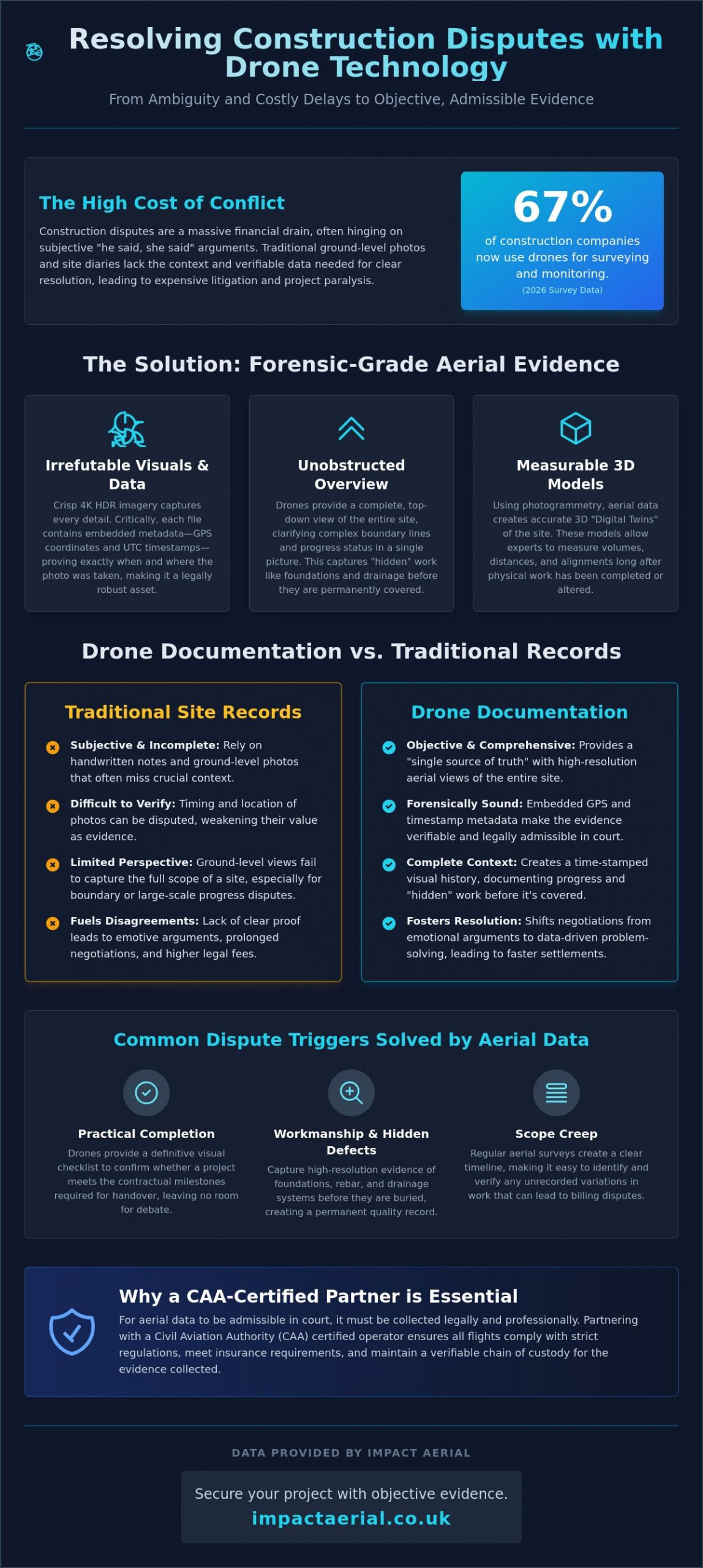
A 2026 survey indicated that 67% of construction companies now use drones for site surveying and progress monitoring. This widespread adoption is driven by the need to avoid the “He said, She said” trap. For example, a contractor might claim a foundation was poured to specification, while the client disagrees. Once that work is buried, resolving the issue becomes a matter of expensive legal debate. High-accuracy drone photography for construction disputes eliminates this ambiguity. It reduces legal billable hours by providing experts with clear evidence, often leading to faster settlements before a case reaches litigation.
Common Triggers for Construction Disputes in the UK
Disputes in the UK often stem from three specific areas where visual clarity is paramount:
- Practical Completion: Disagreements over whether a project has reached the contractual milestone required for handover.
- Workmanship and Hidden Defects: Issues with structural elements that are no longer visible to the naked eye after the build progresses.
- Scope Creep: Unrecorded variations in work that lead to unexpected billing or timeline delays.
The Psychology of Objective Evidence
High-resolution imagery does more than just provide data; it changes the tone of the negotiation. When all parties look at the same high-fidelity map or 4K photo, emotive arguments tend to fade. It establishes a “common operating picture” for stakeholders and mediators alike. This shift from an adversarial stance to a data-driven resolution allows projects to move forward with minimal friction. It ensures site boundaries and work quality are documented with clinical precision, providing the psychological comfort that comes from having an indisputable record.
Forensic Aerial Photography: How Drones Capture Admissible Evidence
Capturing a high-resolution image is only the first step in creating a legally robust record. For drone photography for construction disputes to hold weight in a courtroom or mediation room, it must meet strict forensic standards. This involves preserving a meticulous chain of custody from the moment the sensor captures data to the point it’s presented as evidence. Every digital file contains embedded metadata, including precise GPS coordinates and UTC time stamps, which eliminates any doubt regarding the authenticity or timing of the visual record.
Advanced techniques like Lidar and photogrammetry allow for the creation of 3D “Digital Twins” of a site. These models are far more than visual aids; they’re measurable environments where experts can verify volumes, distances, and structural alignments long after the site has changed. As highlighted in a systematic review on UAVs in claim management, this level of data-centric documentation is vital for resolving complex claims related to delays and site conditions. When data is handled with this degree of technical care, it becomes a powerful tool for de-escalating conflict and proving “hidden” flaws before they’re buried under new layers of construction.
High-Resolution Imagery vs. Consumer Drones
Forensic clarity requires DJI Enterprise-grade hardware rather than standard consumer models. A larger sensor and 4K HDR capability are essential for identifying micro-cracks or subtle material defects that a lower-quality camera would miss. Thermal imaging also plays a role in identifying “invisible” disputes. It can pinpoint water ingress behind facades or heat loss in structural elements, providing objective proof of workmanship issues that ground-level inspections often overlook.
Geospatial Accuracy and Boundary Mapping
Boundary disputes often become emotive and divisive because they lack a common, objective reference point. We solve this by using GPS-tagged data to overlay site images directly onto official Land Registry maps. RTK (Real-Time Kinematic) positioning provides the centimetre-level accuracy required to ensure that aerial maps align perfectly with official Land Registry records. This technical precision is what makes drone photography for construction disputes an indispensable asset for surveyors and legal professionals. If you need this level of forensic detail for your project, our drone commercial property surveys deliver the accuracy required to protect your interests.
Drone Documentation vs. Traditional Site Records: A Comparative Analysis
Traditional site records often rely on ground-level photography and manual site diaries, which are frequently prone to obstruction and human error. When deploying drone photography for construction disputes, the contrast in data quality and efficiency is stark. Surveying a 10-hectare site manually can take days of exhaustive site walks; an enterprise drone completes the same task in minutes. This speed doesn’t just save time. It ensures that the visual record is a precise snapshot of a specific moment, preventing the “data drift” that occurs when manual surveys are spread across several days.
The perspective provided by a “God’s eye view” offers a comprehensive understanding that ground cameras simply cannot replicate. While a ground-level photo might show a specific defect, it often lacks the surrounding context necessary to prove how that defect impacts the wider project. Consistent, time-stamped progress intervals allow legal teams to rewind the clock. They can see exactly how a site evolved, providing a level of transparency that traditional records lack. This chronological clarity is often the deciding factor in resolving claims related to project delays or sequencing errors.
Data Depth and Context
Ground-level photos frequently miss the “big picture” of site logistics, such as the placement of heavy machinery or the flow of materials. Aerial data allows experts to zoom into specific snagging list items while maintaining a wide geographic context. This dual-layer approach provides a much higher cost-per-data-point value than traditional surveyors. Research indicates that drone usage can lead to a 55% cost reduction for infrastructure inspections compared to traditional methods. This makes it a financially sound choice for firms looking to tighten their dispute resolution processes.
Safety and Risk Mitigation
Safety is a cornerstone of professional site management, especially during an active dispute where tensions may be high. Using drones reduces the need for personnel to conduct “at height” inspections or enter hazardous, unreachable areas of a site. Capturing data remotely minimizes the requirement for expensive scaffolding or specialized access equipment just to verify a claim. The impact of professional drone surveys on site-wide safety protocols is significant. By removing human inspectors from high-risk environments, contractors often benefit from lower insurance premiums and a reduced likelihood of secondary health and safety disputes. This meticulous approach to data collection provides psychological comfort to all stakeholders, knowing that the evidence is gathered without compromising site safety.
Implementing Drone Data in Mediation, Boundary Disputes, and Litigation
Deploying professional drone photography for construction disputes follows a structured lifecycle, moving from preventative site records to forensic presentation in legal settings. This methodical approach ensures that data is not just captured, but is technically robust enough to withstand scrutiny by RICS surveyors, mediators, or high-court judges. By integrating aerial data early, project managers can resolve disagreements before they escalate into full-scale litigation.
The implementation process typically follows four critical steps:
- Step 1: Pre-construction Baselines. We establish a definitive “before” state of the site and its boundaries. This aerial benchmark prevents future arguments regarding pre-existing damage to neighboring properties or site conditions.
- Step 2: Periodic Progress Monitoring. Regular flights document “hidden” work, such as the placement of steel reinforcement or drainage systems. Capturing these elements before they’re buried under concrete is essential for proving compliance with building standards.
- Step 3: Evidence Pack Preparation. We compile high-fidelity imagery and metadata into structured evidence packs. These are designed for immediate use by legal teams and expert witnesses during mediation.
- Step 4: Courtroom Presentation. In complex cases, we present 3D models and orthomosaics that allow a judge to virtually “walk” the site. This provides a level of clarity that static, ground-level photos can’t match.
Resolving Boundary Disputes with Land Registry Overlays
Boundary arguments are often the most emotive and divisive issues in property law. We resolve these by matching current high-resolution aerial imagery with historical Land Registry title plans. This process identifies “boundary drift” caused by the gradual movement of hedges, fences, or unauthorized new builds. Using drone data as a neutral third-party record provides mediators with an indisputable foundation for settlement, often saving parties thousands in protracted legal fees. If your project requires this level of oversight, our construction site monitoring services provide the continuous data stream needed to protect your boundaries.
Proving Delays and Liquidated Damages
Proving why a project fell behind schedule is notoriously difficult without objective records. We use time-stamped aerial data to verify subcontractor presence and actual site progress against the master schedule. This documentation is vital for supporting Extension of Time (EOT) claims or defending against liquidated damages. When a contractor claims weather-related delays, our records provide the visual proof of site conditions on those specific dates. This shift toward data-driven resolution ensures that financial settlements are based on forensic facts rather than anecdotal site diaries.
Securing Your Project: Why CAA-Certified Drone Partners are Essential
The admissibility of drone photography for construction disputes depends entirely on the legality of the operation. Hiring an uncertified pilot creates a significant risk that your evidence will be dismissed in court or mediation. If a pilot fails to adhere to UK Civil Aviation Authority (CAA) regulations, the data they capture is often viewed as illegally obtained, rendering it useless for forensic purposes. Professional operators ensure that every flight is conducted within the law, providing the psychological comfort that your evidence is beyond reproach.
As of 2026, UK regulations require anyone operating a drone over 100g to hold a valid Flyer ID and Operator ID, with the latter requiring an annual fee of £12.34. For complex construction environments, a General Visual Line of Sight Certificate (GVC) is the industry standard. This certification proves the pilot has the technical training to manage high-risk sites safely and legally. Furthermore, professional partners maintain £5m commercial liability insurance as a baseline. This level of coverage is essential for construction projects, protecting all stakeholders from the financial fallout of unforeseen operational incidents.
Our meticulous approach extends to our geographic reach. Based in the West Midlands, we leverage our central location to provide comprehensive nationwide coverage across the UK. This allows us to maintain a consistent standard of forensic data collection for clients with multiple sites, ensuring that the methodology used to resolve a dispute in Birmingham is identical to one in London or Manchester.
Compliance and Legal Robustness
A valid UK drone license is more than a regulatory hurdle; it’s your guarantee that data is gathered ethically and legally. Every professional operation is underpinned by detailed Risk Assessment and Method Statements (RAMS), which are critical for site safety and insurance compliance. We also handle the complexities of GDPR and privacy laws. By ensuring that aerial data collection doesn’t infringe on the rights of neighboring properties, we prevent the creation of new legal liabilities that could complicate an existing dispute.
Why Impact Aerial for Construction Disputes?
We combine technical expertise in drone photography with a deep understanding of the property and commercial sectors. Our team manages the entire project lifecycle, from the initial consultation and flight planning to high-end post-production services. This end-to-end management ensures that the “digital truth” we provide is accurate, high-fidelity, and ready for use in any legal framework. Don’t leave your project’s resolution to chance with amateur data. Protect your project and resolve disputes with Impact Aerial today.
Resolving Site Disagreements with Forensic Precision
The shift toward data-centric resolution is no longer a luxury; it’s a necessity for modern construction management. High-fidelity visual evidence provides the “digital truth” needed to move past subjective site arguments and costly delays. Professional drone photography for construction disputes transforms complex site data into admissible forensic assets, ensuring that project timelines and workmanship are documented with clinical accuracy. By establishing a clear visual record, you don’t just win arguments; you prevent them from escalating in the first place.
Impact Aerial provides the technical expertise and regulatory compliance required for these sensitive cases. Our team of CAA GVC Certified Pilots utilizes advanced 4K HDR and Lidar capabilities to capture every detail with centimetre-level precision. We’re Birmingham-based with full UK-wide coverage and carry £5m commercial liability insurance to provide complete operational security. Whether you’re facing a boundary disagreement or a complex structural claim, we deliver the objective data you need to reach a resolution.
Request a Forensic Drone Survey Quote from Impact Aerial and secure the objective proof required to protect your project’s future. We’re here to help you move forward with confidence.
Frequently Asked Questions
Is drone photography admissible as evidence in a UK court?
Yes, aerial imagery is admissible provided it meets strict legal and technical standards. The data must be captured by a CAA-certified pilot who maintains a clear chain of custody and adheres to all safety regulations. Metadata such as embedded GPS coordinates and UTC time stamps are vital for verifying the authenticity and timing of the records in a legal setting.
How much does drone photography for a construction dispute cost?
Costs for these services vary significantly based on the site’s geographic size and the complexity of the data required. Factors such as the number of flight hours, the need for specialized sensors like Lidar, and the depth of post-production analysis all influence the final investment. We recommend requesting a bespoke quote to ensure the survey meets the specific forensic requirements of your case.
What is the difference between a standard photo and a forensic drone survey?
A standard photo is a simple visual snapshot, but a forensic drone survey provides measurable geospatial data. Forensic surveys use photogrammetry or Lidar to create 3D models with centimetre-level accuracy. This allows experts to verify precise volumes, distances, and structural alignments that a ground-level or non-specialized photo simply cannot provide.
Can drones help with boundary disputes involving the Land Registry?
Yes, drones are highly effective for resolving boundary issues by overlaying current high-resolution imagery onto official Land Registry title plans. This process identifies “boundary drift” caused by the movement of fences or hedges over time. It provides a neutral, objective record that helps mediators and legal teams settle disagreements based on technical facts rather than anecdotal claims.
Do I need my neighbour’s permission to use a drone for a boundary dispute?
You don’t always need explicit permission for the flight itself, but you must comply with privacy and trespass laws. Professional pilots follow strict CAA flight path regulations and data protection protocols to ensure the survey is legal. Ensuring that the drone photography for construction disputes is conducted ethically prevents the risk of the evidence being dismissed due to privacy violations.
What certifications should a drone pilot have for construction site work?
A professional pilot must hold a valid Flyer ID and Operator ID, along with a General Visual Line of Sight Certificate (GVC) for complex site operations. These qualifications prove the pilot is trained in meticulous risk assessment and safety management. It is also essential to verify they carry professional commercial liability insurance to protect all stakeholders during the operation.
Can drones identify structural defects that are invisible from the ground?
Yes, drones equipped with thermal sensors or high-zoom 4K cameras can pinpoint issues that ground inspections miss. Thermal imaging is particularly useful for identifying water ingress or heat loss behind building facades. Using drone photography for construction disputes allows you to document micro-cracks and material defects in hard-to-reach areas, providing proof of workmanship flaws before they lead to structural failure.
How quickly can I get drone evidence for an ongoing construction dispute?
Data collection is often completed in a single day once site permissions and safety assessments are finalized. The delivery of the final evidence pack depends on the complexity of the 3D modelling or post-production required. Most professional firms provide a structured timeline, ensuring that high-fidelity visual records are ready for use in mediation or litigation as quickly as possible.
 2 Norton Drive, Wythall, Birmingham, B47 6HH Company registration number: 11138586. VAT Number: 366 9068 55