What if your most effective sales tool wasn’t a physical viewing, but a digital experience that builds more trust before a family even steps through your front door? Choosing a care home is one of the most emotionally charged decisions a family will ever make, and you’re likely aware that many initial enquiries come from a place of deep anxiety. You understand the frustration of hosting time-consuming physical viewings for ‘tyre-kickers’ who don’t convert, especially when your staff’s time is better spent on resident care. Implementing a high-quality virtual tour for care homes addresses these challenges by providing immediate, transparent access to your facilities.
This guide demonstrates how professional virtual tours build immediate psychological comfort and streamline the admissions process for 2026. We’ll examine how combining internal 360-degree views with CAA GVC certified aerial photography allows you to showcase extensive grounds and high-end interiors effectively. You’ll learn how to leverage technical precision and £5m commercial liability insurance standards to protect your brand’s reputation. By the end of this article, you’ll have a clear roadmap for reducing wasted viewings and increasing your tour-to-admission conversion rates through authoritative digital storytelling.
Key Takeaways
- Learn how a virtual tour for care homes aligns with CQC ‘well-led’ criteria by providing radical transparency and psychological comfort to families from the very first click.
- Understand the technical differences between internal 360-degree walk-throughs and cinematic drone fly-throughs to effectively showcase both high-end interiors and expansive grounds.
- Navigate complex privacy requirements and GDPR compliance while ensuring operational safety by working with CAA GVC certified pilots experienced in populated care environments.
- Discover how to integrate immersive visuals into your website and Google Business Profile to increase dwell time and convert more digital enquiries into actual admissions.
- See how professional post-production and £5m commercial liability insurance protect your brand’s reputation while delivering a high-tier, polished marketing asset.
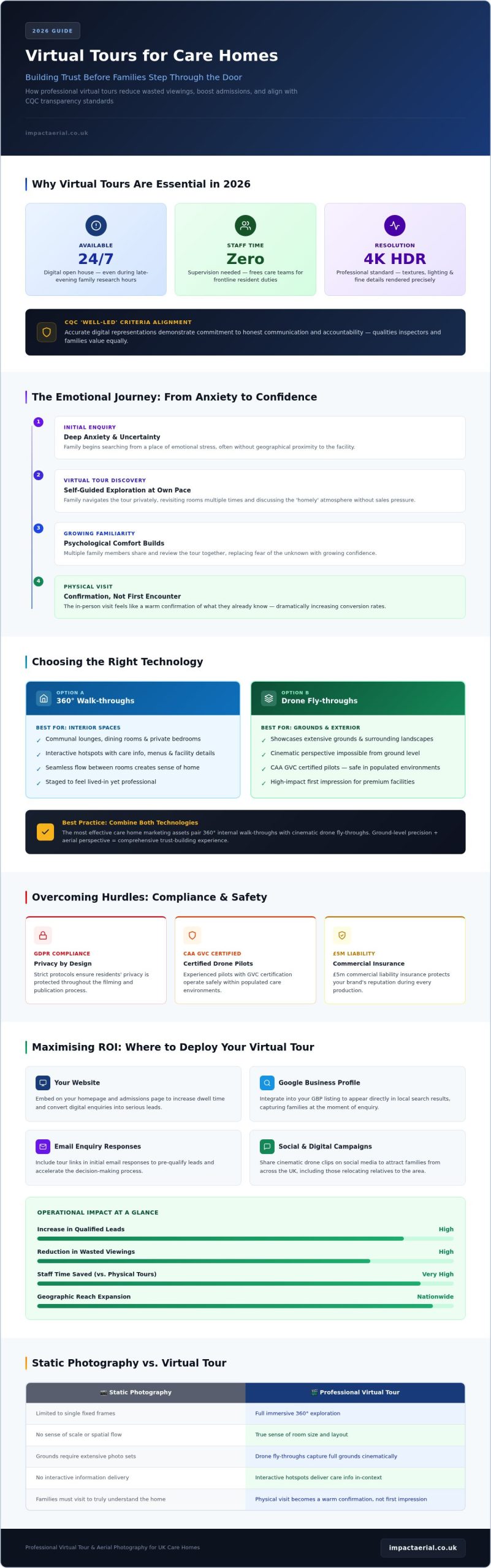
Why Virtual Tours are Essential for Care Homes in 2026
In the current UK care sector, transparency is the cornerstone of trust. A professional virtual tour for care homes serves as a 24/7 digital open house, allowing prospective residents and their families to explore facilities without the immediate pressure of a supervised visit. This technology is no longer just a visual luxury; it’s a vital tool for bridging the geographical gap when family members live far from the facility. By providing an immersive, high-fidelity view of the living spaces and communal areas, you offer a level of reassurance that static photography cannot match.
This level of digital openness aligns directly with the Care Quality Commission (CQC) ‘well-led’ inspection criteria. Demonstrating transparency through accessible, accurate digital representations shows a commitment to honest communication. It provides a clear record of the environment you provide, fostering a culture of accountability that inspectors and families value equally. Using professional-grade 4K HDR captures ensures that every detail is presented with technical precision, reinforcing the reliability of your brand.
The Emotional Impact on Prospective Families
The transition into residential care is often fraught with anxiety for both the resident and their loved ones. High-quality visual storytelling reduces the fear of the ‘unknown’ by allowing families to navigate your home at their own pace. They can revisit the tour multiple times, showing different family members and discussing the ‘homely’ atmosphere in private. This self-guided exploration builds psychological comfort, making the eventual physical visit feel like a confirmation rather than a first encounter. It removes the sales pressure often felt during initial site visits, replacing it with a sense of control and familiarity.
Operational Efficiency and Occupancy Rates
Implementing a virtual tour for care homes significantly streamlines the admissions process. It acts as a powerful filter, pre-qualifying leads so that your front-of-house staff spend less time on ‘tyre-kicker’ viewings and more time with serious enquiries. This reduces ‘tour fatigue’ for existing residents, as foot traffic from casual visitors is minimised. From a marketing perspective, the benefits are tangible:
- Increased Reach: You can attract families from across the UK who may be relocating a relative to a specific area.
- Staff Resource: Digital tours require zero supervision, freeing up care teams for frontline duties.
- 24/7 Accessibility: Your doors are effectively open even during late evening hours when families often conduct their research.
By integrating these immersive experiences, care providers can maintain a high-end, transparent brand image while simultaneously reducing the administrative burden on their teams. It’s a strategic investment that converts passive interest into confident admissions.
Choosing the Right Technology: 360° Walk-throughs vs. Drone Fly-throughs
Selecting the right technology for a virtual tour for care homes determines whether the final product feels like a clinical record or a welcoming home. While many providers offer basic 360-degree walk-throughs, the most effective marketing assets in 2026 combine internal precision with cinematic drone fly-throughs. This dual approach provides a comprehensive perspective that ground-level photography alone cannot achieve. Using 4K HDR resolution is a non-negotiable standard for professional care home marketing; it ensures that textures, lighting, and fine details are rendered accurately, which is essential for building trust with meticulous families.
To increase the utility of these tours, interactive hotspots should be integrated throughout the digital experience. These clickable points provide immediate information on care types, daily menus, or specific facility features without cluttering the visual field. This data-centric approach allows families to gather facts while they emotionally connect with the space. It transforms a static viewing into an informative tool that aids decision-making.
Internal 360° Photography: The Room Level Experience
Internal photography must create a seamless flow through communal lounges, dining rooms, and private bedrooms. Staging is critical here; the goal is to showcase a lived-in yet professional environment that reflects high standards of care. High-fidelity visuals allow prospective residents to inspect accessibility features, such as wet rooms or specialist furniture, from the comfort of their current home. To see examples of the latest equipment used to support independence, check out Mobility and You. This level of detail reduces the administrative burden on your front-of-house staff by answering technical questions before a physical viewing is even scheduled.
A significant gap in standard care home marketing is the failure to show the facility’s relationship with its surroundings. Aerial ‘Hero’ shots are essential for showcasing secure sensory gardens and the impressive scale of the grounds. By using professional drone photography, you provide families with a vital sense of place within the local UK community. This exterior context is particularly reassuring for families concerned about resident safety and the quality of outdoor spaces.
Combining these perspectives creates a powerful synergy. You aren’t just showing a room; you’re showing a lifestyle and a secure, well-managed environment. For providers looking to elevate their brand, investing in professional virtual tour creation ensures that every angle of your facility is captured with technical mastery and regulatory compliance.
Overcoming Hurdles: Privacy, Safety, and Compliance
Developing a comprehensive virtual tour for care homes involves more than just technical skill; it requires a deep understanding of the regulatory landscape governing residential care. In a sensitive environment where residents’ well-led status is paramount, the filming process must be handled with extreme care. Compliance with UK GDPR is the first priority. This means ensuring that every individual captured on camera has provided explicit, informed consent, or more effectively, designing the shoot to avoid capturing residents entirely. Professional operators act as technical consultants here, helping you navigate these legal requirements while maintaining a high-tier brand image.
Risk mitigation is another critical factor that separates professional services from hobbyist attempts. Standard commercial operations should always carry £5m commercial liability insurance. This level of coverage is the industry benchmark for working in populated, high-value environments. It provides psychological comfort to stakeholders, knowing that the facility is protected against any unforeseen operational incidents. Managing the ‘on-site’ day effectively is a matter of precision; schedules are coordinated to minimise disruption to daily routines, ensuring that the care home continues to function smoothly while the data is collected.
Resident Privacy and Dignity Protocols
Maintaining resident dignity is a non-negotiable aspect of the filming process. We typically recommend an ’empty-room’ strategy for communal areas and private bedrooms to ensure total privacy. If residents are present in the background of wider shots, advanced post-production techniques like blurred-face technology can be employed. Clear communication is essential; we recommend placing signage throughout the facility at least 48 hours before the shoot. Scheduling filming during low-activity periods, such as mid-morning after breakfast routines, further protects the residents’ environment from unnecessary intrusion.
Drone Safety in Sensitive Environments
When capturing the exterior scale of a facility, safety protocols are strictly enforced. It’s vital to use CAA GVC certified pilots who understand the complexities of flying in populated UK areas. Unlike standard consumer drones, DJI Enterprise-grade hardware is used to ensure maximum flight stability and signal reliability. These professional systems allow for precise flight paths over gardens and grounds without overflying sensitive neighbouring properties. For those requiring detailed external assessments alongside marketing visuals, a professional drone survey can be integrated into the project to provide a dual-purpose data set for both maintenance and marketing teams.
Maximising ROI: Where to Use Your Care Home Virtual Tour
Investing in a professional virtual tour for care homes is only the first step towards increasing your occupancy rates. To see a genuine return on investment, this asset must be integrated strategically across your entire digital admissions pipeline. A high-fidelity tour shouldn’t sit idle on a single landing page; it should function as a versatile sales tool that provides psychological comfort to families at every touchpoint. By deploying this technology effectively, you ensure that your facility remains visible and authoritative in a competitive UK market.
One of the most effective ways to use your tour is during initial phone enquiries. Training your admissions team to ‘walk through’ the facility with a family member over the phone can transform a standard enquiry into a guided digital experience. Staff can direct the caller to specific rooms or communal areas, answering technical questions about accessibility or layout in real-time. This proactive approach builds immediate trust and demonstrates a level of transparency that sets your home apart from providers relying on static imagery.
SEO and Google Business Profile Integration
Search engines prioritise rich media that improves user experience. Embedding 360-degree content directly onto your website signals to Google that your site provides high-value, relevant information for local searchers. To ensure these features integrate seamlessly and maintain fast load speeds, working with a creative web design partner like Insight Multimedia can help elevate your online presence. Immersive virtual content increases website dwell time by providing interactive, high-value visual data that keeps users engaged with your brand for longer periods. This increased engagement often leads to higher local search rankings, making your home more visible to families searching for care in your specific region.
Your Google Business Profile is often the first point of contact for local families. By uploading 360-degree photos and tour links to your Google Maps listing, you provide an immediate window into your home. This level of accessibility can significantly increase click-through rates from search results to your website, as families are more likely to engage with a brand that offers a transparent view of its facilities.
Social media platforms like Facebook and Instagram are primary research tools for the children of prospective residents. You can repurpose your tour by creating short ‘teaser’ clips that highlight specific features, such as a secure sensory garden or a high-end dining area. These clips act as high-performance advertisements that drive traffic back to the full immersive experience on your website. Additionally, including a direct link to the tour in your admissions team’s email signatures ensures that every piece of correspondence reinforces your professional brand image.
Digital brochures and PDF welcome packs should also feature prominent links to the virtual tour. This allows families to share the experience with other relatives who may be involved in the decision-making process but cannot visit in person. To start building a more transparent and effective admissions process, contact us to discuss professional virtual tour creation for your facility.
The Impact Aerial Approach: Expertise in Care Home Visuals
Impact Aerial understands that a virtual tour for care homes is far more than a simple marketing asset; it is a vital window into a living community. We combine technical drone mastery with a meticulous, professional approach that respects the unique privacy and routines of your residents. Our team provides comprehensive end-to-end project management, guiding you from the initial consultation through to the final post-production editing phase. This ensures a seamless, stress-free experience for care home managers who must maintain their primary focus on resident wellbeing while we handle the technical complexities of data collection.
We don’t just capture images; we build transparency tools that align with your operational goals. Our methodology is data-centric and grounded in professional service standards, ensuring that every frame of your tour serves a specific purpose in building trust with prospective families. By choosing a specialist rather than a general creative agency, you benefit from a partner who understands the specific regulatory and emotional requirements of the UK care sector.
Our Technical Credentials
Our pilots operate with full CAA GVC certification, ensuring every flight over your facility adheres to the latest safety protocols and national regulations. We utilise DJI Enterprise-grade hardware to deliver 4K HDR cinematic output, which is the benchmark for high-end care brands seeking to project a reliable and authoritative image. Based in Birmingham, our central location allows for responsive UK-wide deployment, enabling us to serve care groups with multiple sites across various regions with consistent quality. This specialized expertise makes us a leading choice for professional drone services tailored to the healthcare sector. We carry £5m commercial liability insurance as standard, providing the psychological comfort required when working in sensitive residential environments.
Start Your Virtual Tour Project
Successful projects begin with thorough preparation and a clear understanding of your facility’s unique selling points. We recommend staging communal areas to highlight a welcoming, homely atmosphere and briefing your staff on the filming schedule to ensure zero disruption to care delivery. We provide a structured pre-shoot checklist that covers everything from garden maintenance to bedroom staging, ensuring the final tour has the highest possible visual impact. Whether you manage a single boutique residence or an extensive national care portfolio, we offer tailored consultations to align our technology with your specific occupancy targets.
To begin your journey towards a more transparent and effective admissions process, you can Contact Impact Aerial for a Virtual Tour Quote. Our team is ready to help you build immediate trust with families through precision-engineered visual storytelling and technical excellence.
Future-Proofing Your Care Home Admissions
Implementing a virtual tour for care homes is no longer an optional marketing upgrade; it’s a fundamental requirement for building transparency and trust in 2026. By combining immersive 360-degree internal views with high-fidelity drone perspectives, you provide families with the psychological comfort they need during a difficult transition. This guide has demonstrated how technical precision, from 4K HDR resolution to interactive hotspots, transforms your facility into a 24/7 digital open house that pre-qualifies leads and reduces staff burden.
Our team brings specialized expertise to every project, ensuring your brand is protected through meticulous adherence to safety protocols. As specialists in West Midlands property visuals with a Birmingham base, we offer responsive UK-wide deployment for care groups of all sizes. We operate with full CAA GVC Certified Pilots and carry £5m Commercial Liability Insurance, giving you total peace of mind during the filming process. Elevating your digital presence is the most effective way to increase occupancy and streamline your admissions pipeline.
Request a Professional Virtual Tour Consultation to see how we can showcase your facility’s unique environment and build immediate trust with prospective families.
Frequently Asked Questions
How long does it take to film a virtual tour for a care home?
A typical filming session for a virtual tour for care homes takes between one and two days; the exact duration depends on the facility’s size and the scale of the grounds. We manage the entire process from initial consultation to final post-production to ensure minimal disruption to your daily operations. Larger facilities with extensive sensory gardens or multiple communal areas may require additional time for precise aerial data collection. We provide a detailed schedule beforehand so your team can prepare accordingly.
Do we need to move residents out of the way during filming?
You don’t need to relocate residents, but we recommend filming communal areas during low-activity periods to maintain a professional environment. Our “empty-room” strategy for private bedrooms ensures total privacy and dignity for every resident. If individuals are present in wider shots, we use advanced post-production techniques like blurred-face technology to maintain GDPR compliance. We work closely with your staff to coordinate the shoot around established daily routines and care schedules.
Is a drone safe to fly around a care home with elderly residents?
Drone operations are entirely safe when conducted by our CAA GVC certified pilots using DJI Enterprise-grade hardware. These commercial drones feature redundant safety systems and high-precision sensors to maintain absolute stability in sensitive environments. We plan specific flight paths that avoid overflying residents or neighbouring properties. This technical precision ensures we capture impressive aerial perspectives of your grounds without compromising the safety or psychological comfort of those in your care.
Can we update the virtual tour if we renovate a specific room?
Yes, your virtual tour for care homes can be updated modularly as your facility evolves. If you renovate a specific bedroom, lounge, or sensory garden, we can reshoot just those sections and integrate them into the existing tour. This ensures your digital marketing assets remain accurate and transparent without the cost of a full reproduction. Keeping your tour current is vital for maintaining the trust of prospective families and meeting CQC transparency standards.
What insurance cover do you have for filming on-site?
We maintain £5m commercial liability insurance for all on-site operations, which is the industry benchmark for professional drone services in the UK. This coverage provides essential protection for your property, staff, and residents during the filming process. We’re happy to provide copies of our insurance certificates and risk assessments as part of our standard professional service. This level of indemnity reinforces our commitment to safety-conscious and reliable operations within the residential care sector.
How do families actually view the virtual tour?
Families view the tour through a standard web browser on your facility’s website or via your Google Business Profile listing on Google Maps. The experience is fully interactive; it allows users to click and “walk” through rooms or communal spaces at their own pace. You can also send direct links to the tour via email or include them in digital welcome packs. This accessibility ensures that family members living far away can explore your home at any time.
Will a virtual tour work on mobile phones and tablets?
Every virtual tour we create is fully responsive and works seamlessly across mobile phones, tablets, and desktop computers. Since many families conduct their initial research on mobile devices, ensuring a high-quality experience on smaller screens is essential for engagement. The interface adjusts automatically to the user’s device, maintaining 4K HDR visual quality and smooth navigation. This technical flexibility ensures your home is accessible to prospective families wherever they choose to browse.
Do you provide the raw footage or just the finished virtual tour?
We typically deliver a polished, ready-to-use virtual tour that includes full post-production and professional editing. This finished product is optimized for web performance and immediate integration into your marketing channels. While our primary service focuses on delivering high-end interactive experiences, we can discuss the provision of raw 4K footage if you require it for other internal projects. Most clients prefer the end-to-end management we provide for a hassle-free, professional result.
 2 Norton Drive, Wythall, Birmingham, B47 6HH Company registration number: 11138586. VAT Number: 366 9068 55