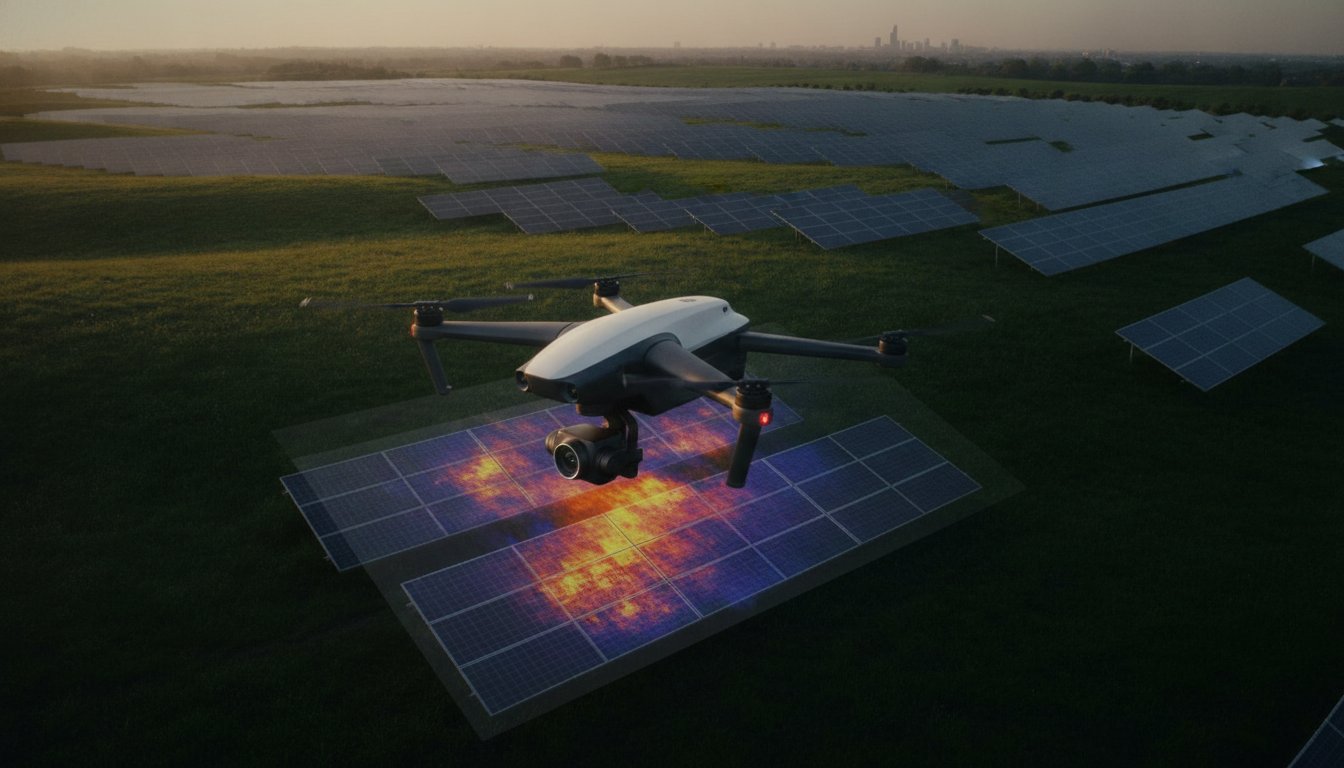
A manual inspection of a utility-scale solar site is no longer just inefficient; it’s a financial liability that leaves your most valuable assets at risk. You likely understand that even a minor string failure or a single bypass diode fault can quietly erode profit margins while remaining invisible to the naked eye. Relying on ground-based IV curve testing is slow, dangerous, and often misses the granular degradation that leads to long-term revenue loss. This is why a professional drone thermal survey for solar farms has become the industry benchmark for asset protection in 2026.
By reading this guide, you’ll learn how centimetre-level geolocating and high-resolution radiometric data identify PV faults with surgical precision to maximise your energy yield and ROI. We’ll explore the latest UK CAA requirements, including the mandatory UK class marks and Remote ID standards that define compliant operations this year. You’ll also discover how IEC-compliant reporting transforms raw aerial imagery into a bankable roadmap for maintenance, ensuring your site meets the rigorous standards required by insurers and investors alike.
Key Takeaways
- Learn how to transition from manual spot-checking to 100% asset coverage using radiometric sensors to detect bypass diode failures and PID.
- Discover how a professional drone thermal survey for solar farms can inspect over 10MW of capacity per day, drastically improving efficiency compared to manual testing.
- Understand how aerial thermography eliminates safety risks in high-voltage environments while providing the precise data needed to successfully claim on panel warranties.
- Identify the non-negotiable UK regulatory requirements for 2026, from mandatory CAA GVC certification to the essential £5m commercial liability insurance standard.
- Explore how centimetre-level fault geolocating with advanced RTK hardware allows your O&M teams to navigate directly to defective modules without delay.
What is a Drone Thermal Survey for Solar Farms?
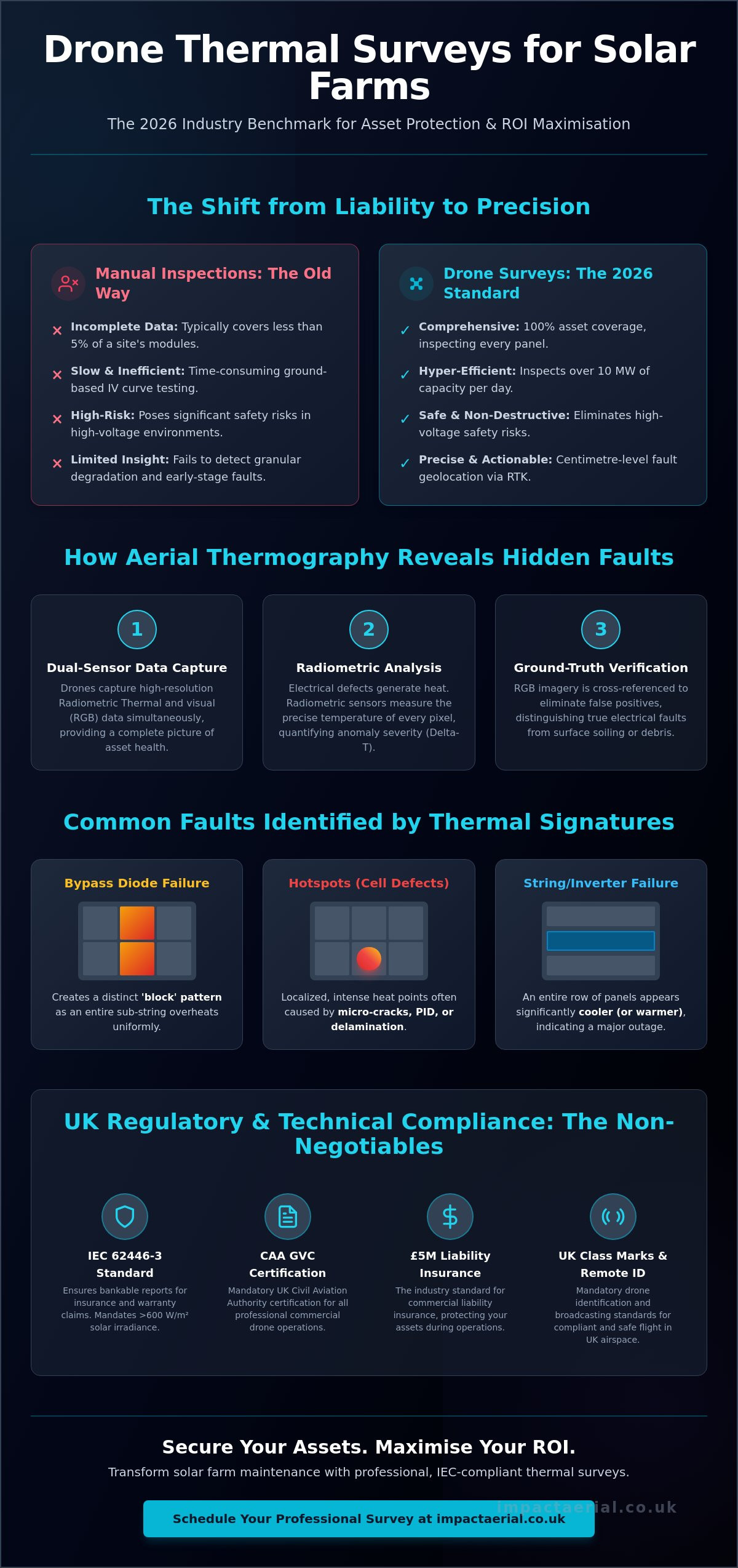
A drone thermal survey for solar farms is a systematic aerial inspection using radiometric thermal sensors to detect temperature anomalies in PV modules. Historically, asset managers relied on manual ‘spot-checking’ with handheld cameras or IV curve testing, which often covered less than 5% of a site’s total modules. This fragmented approach left massive gaps in data and allowed faults to worsen over time. Today, UAV technology enables 100% asset coverage, capturing data on every single panel in a fraction of the time. A drone thermal survey is a non-destructive testing method that geolocates PV faults using high-resolution infrared sensors.
To better understand how this technology transforms site management, watch this helpful video:
It is vital to distinguish between simple thermal imaging and radiometric data. While basic thermal cameras show temperature variations, radiometric sensors capture the specific temperature value of every pixel in the image. This level of detail is essential for sophisticated photovoltaic module analysis techniques. Without radiometric data, it’s impossible to quantify the severity of a delta-T (temperature difference), which is the primary metric used to categorise faults as minor, major, or critical.
The Role of IEC 62446-3 Standards
The IEC 62446-3:2022 standard provides the international framework for outdoor infrared thermography of PV modules. It dictates everything from the minimum solar irradiance required, typically 600 W/m², to the specific viewing angles needed for accurate data. Compliance with this standard isn’t optional for serious operators. It’s a fundamental requirement for insurance providers, manufacturer warranty claims, and investor reporting. Professional operators like Impact Aerial adhere to these strict data quality protocols to ensure every report is bankable and technically sound.
Thermal vs. RGB: The Dual-Sensor Advantage
Modern drone services utilise dual-sensor payloads that capture high-resolution visual (RGB) and thermal data simultaneously. This is critical for ‘ground-truth’ verification. A hotspot on a thermal map might indicate a failing cell, but the RGB image could reveal it’s actually caused by bird droppings, surface dirt, or a stray leaf. By overlaying these data sets, we rule out false positives and ensure maintenance teams only deploy to genuine electrical faults, saving significant O&M costs.
Technical Mechanics: How Aerial Thermography Detects PV Faults
Aerial thermography operates on the fundamental principle that electrical defects generate heat. When a solar cell or internal component fails, it often creates electrical resistance, which is dissipated as thermal energy. A professional drone thermal survey for solar farms captures this energy using radiometric sensors, allowing asset managers to see what remains invisible to the human eye. By visualising these heat patterns, we can diagnose the health of an entire site without ever touching a panel.
One of the most recognisable signatures is the ‘block’ heat pattern caused by bypass diode failures. When a diode fails, it can no longer bypass a shaded or defective part of the module, causing an entire sub-string to heat up uniformly. This creates a distinct rectangular thermal footprint that is easy to identify from the air. In contrast, ‘hotspots’ are usually localised and intense. These are often caused by micro-cracks in the silicon, delamination, or Potential Induced Degradation (PID). Even simple shadowing from overgrown vegetation or bird droppings can trigger these hotspots, which is why dual-sensor verification is vital to prevent unnecessary maintenance calls.
At a larger scale, thermal patterns reveal string-level outages or inverter failures. If an entire row of panels appears significantly cooler or warmer than its neighbours, it typically suggests an open circuit, a blown fuse, or a disconnected string. We categorise these anomalies using ‘Delta-T’, which is the temperature difference between the fault and a healthy reference point. A Delta-T of 10°C might indicate a minor performance issue, while a difference exceeding 30°C often signals a critical failure that poses a fire risk or significant revenue loss.
Common Fault Signatures in Solar Arrays
Defects typically fall into three categories: cell-level, string-level, and module-level. Cell-level defects like cracks or manufacturing flaws appear as small, intense points of heat. String-level issues are often systemic, appearing as entire lines of underperforming modules due to wiring faults or connector failures. Identifying whether a panel is completely ‘dead’ or merely underperforming is crucial for successful warranty claims. If you’re managing a large portfolio, our PV solar farm thermal surveys provide the granular data needed to justify these claims with manufacturers.
AI-Powered Data Analysis
The sheer volume of data from a utility-scale site is immense. We use AI-powered software to scan thousands of high-resolution images automatically. Machine learning algorithms are trained to recognise the specific signatures of bypass diodes, hotspots, and string outages with incredible accuracy. This automation reduces human error and significantly speeds up the reporting process. The final output is a digital ‘fault map’ with centimetre-level GPS coordinates, allowing your ground teams to walk directly to a problematic module rather than searching manually across acres of land.
Operational Benefits: ROI and Safety for Asset Managers
Transitioning to a drone thermal survey for solar farms moves your O&M strategy from reactive repair to proactive asset protection. The most immediate impact is the sheer speed of data collection. A professional drone team can survey over 10MW of capacity in a single day; a task that would take ground-based technicians weeks to complete using traditional IV-curve testing. This efficiency doesn’t just save on labour costs. It ensures that your site remains fully operational with minimal downtime during the inspection process.
Safety remains a non-negotiable priority for UK asset managers. Manual inspections require technicians to navigate uneven terrain while carrying handheld cameras in high-voltage environments. By moving the primary inspection tool into the air, you eliminate these ground-based risks. Drones capture high-resolution data from a safe distance, allowing your engineers to review findings from the safety of an office before any physical intervention is required. This methodical approach to risk mitigation is a hallmark of a mature, safety-conscious operation.
The financial justification for aerial thermography is found in revenue recovery. Research indicates that an undetected 5% yield loss on a 10MW solar farm can cost approximately £32,000 in lost revenue annually. A drone thermal survey for solar farms identifies these invisible losses by quantifying the kWh impact of every detected fault. Beyond immediate revenue, preventative maintenance catches minor hotspots before they escalate into catastrophic fire risks or total string failures, protecting the long-term integrity of your infrastructure. For firms looking to further optimize their fiscal position through R&D tax credits or corporate finance, recoupcapital.co.uk provides specialist guidance for the UK energy sector.
Manual vs. Drone Inspections: A Comparison
Traditional manual audits are often limited to a 5% or 10% sample size due to time and budget constraints. This leaves 90% of your asset unmonitored. Drone deployment provides 100% asset inspection, ensuring no defective module is overlooked. This comprehensive data set improves site-wide health scores, which is vital for maintaining high portfolio valuations during acquisitions or refinancing. It’s the difference between guessing your site’s performance and having a verified digital record of every panel.
Warranty and Insurance Support
Securing successful warranty claims against manufacturers requires indisputable evidence. We provide timestamped, geolocated radiometric data that proves the exact nature and location of a defect. This level of ‘due diligence’ is also highly valued by insurance providers, often leading to more favourable premiums. For new sites, using a drone survey during the handover from EPC to O&M creates a ‘digital twin’ that establishes a performance baseline, ensuring you don’t inherit existing faults from the construction phase.
Regulatory Compliance: UK Drone Laws in 2026
Operating a drone thermal survey for solar farms within the United Kingdom requires more than just high-end hardware; it demands strict adherence to Civil Aviation Authority (CAA) regulations. As of 2026, the legal framework has become more stringent regarding Remote ID and operator accountability. For any commercial activity on energy infrastructure, the use of CAA GVC certified pilots is the only way to ensure your site remains compliant and fully insured. Using uncertified or hobbyist operators doesn’t just risk a fine; it can invalidate your site’s broader public liability insurance.
Professional solar surveys often take place near public rights of way or sensitive national infrastructure. This necessitates £5 million in commercial liability insurance as an absolute minimum industry standard. This level of coverage protects asset managers against the unlikely event of equipment failure or accidental damage to high-value PV strings. Data protection and GDPR compliance are also vital. Every piece of aerial imagery must be handled according to strict privacy regulations, ensuring that any incidental capture of persons or private property is managed through robust data redaction and secure storage protocols.
The Importance of GVC Certification
A standard hobbyist drone license is insufficient for the complexities of a utility-scale solar farm. The General Visual Line of Sight Certificate (GVC) is the professional benchmark, allowing for an Operational Authorisation from the CAA. This authorisation is essential when flying in congested environments or where specific distance separations from uninvolved persons must be maintained. It ensures every drone survey meets the latest 2026 safety protocols, including the mandatory use of UK class-marked aircraft and active Remote ID broadcasting.
Risk Mitigation on Solar Farms
Solar farms present unique operational challenges, specifically Electromagnetic Interference (EMI) from high-voltage inverters and substations. Our pre-flight planning involves detailed EMI assessments and weather monitoring to prevent fly-aways or data corruption. We work closely with site managers to ensure our flight paths cause zero disruption to ongoing ground maintenance. This meticulous approach includes maintaining a clear audit trail of flight logs and safety briefings, providing you with total transparency. If you need to ensure your next inspection is fully compliant, contact our team at Impact Aerial to discuss your specific site requirements.
Impact Aerial: Professional Solar Thermal Intelligence
At Impact Aerial, we don’t just provide imagery; we deliver actionable asset intelligence that protects your bottom line. Our drone thermal survey for solar farms utilises the industry-leading DJI Matrice 350 RTK equipped with the Zenmuse H20T sensor. This hardware configuration provides centimetre-level geolocating accuracy, which is essential for large-scale utility sites where traditional GPS might lead technicians to the wrong row. Based in Birmingham, we provide UK-wide coverage with a specific focus on the West Midlands, ensuring that regional asset managers have access to local, high-tier technical expertise. Our bespoke drone services are designed to integrate directly into your existing O&M software, providing a seamless transition from aerial data to ground-based repair.
The true value of our service lies in the post-production phase. We transform thousands of raw thermal images into GIS-ready orthomosaics and digital twins of your entire site. This allows you to view your solar farm as a single, high-resolution map where every fault is clearly marked and categorised. By processing data with such precision, we ensure that your maintenance teams spend less time searching for problems and more time fixing them. This methodical approach is why we are trusted by some of the UK’s leading renewable energy investors to monitor their most critical infrastructure.
Our Technical Capability
We specialise in the capture and analysis of full radiometric thermal data. Unlike standard thermal video, radiometric files allow us to re-analyse every pixel post-flight to extract specific temperature values. This is vital for calculating Delta-T accurately and determining the urgency of a repair. Our expertise in aerial filming drone technology also allows us to produce cinematic-quality site visualisations that are perfect for stakeholder presentations and investor updates. We deliver data in multiple formats to suit your needs, including GeoTIFF for GIS software, RJPEG for detailed fault inspection, and interactive cloud-based maps for mobile access in the field.
The Impact Aerial Difference
Our operation is built on a foundation of meticulous safety and regulatory compliance. We don’t just fly drones; we manage high-stakes data operations in complex environments. This dedication to quality ensures that every report we produce is ‘bankable’. Whether you are preparing for a site acquisition, filing a warranty claim, or conducting an annual health check, our data provides the technical weight required by insurers and financial institutions. We act as your technical consultants, providing the reassurance and reliability you need to manage a high-performing solar portfolio. Please contact Impact Aerial for a detailed quote on your next solar farm survey.
Securing the Future of Your Solar Infrastructure
The transition from manual audits to automated aerial intelligence is no longer optional for utility-scale sites aiming for peak efficiency. By adopting a professional drone thermal survey for solar farms, you move beyond sample-based guessing to 100% asset transparency. You’ve seen how radiometric data identifies bypass diode failures and string outages with surgical precision; this allows your O&M teams to act before minor faults become critical liabilities.
Adhering to the latest 2026 UK regulations is vital for protecting your investment. Impact Aerial provides the technical expertise needed to navigate these high-stakes operations safely. Our team utilizes DJI Enterprise grade radiometric sensors and operates with CAA GVC certified pilots, backed by £5m commercial liability insurance for your peace of mind. We transform raw thermal signatures into bankable asset intelligence that secures your ROI for years to come.
Don’t leave your site’s performance to chance. Request a quote for your solar farm thermal survey from Impact Aerial today and take the first step toward total site optimisation. We’re ready to help you maximise your energy yield with precision and reliability.
Frequently Asked Questions
What is the best time of day for a solar thermal drone survey?
The best time for a survey is between 10:00 and 14:00 when the sun is at its highest point. This ensures that solar irradiance exceeds the 600 W/m² threshold required by international IEC 62446-3 standards. Panels must be fully active and under load to reveal the thermal anomalies that indicate underlying electrical faults.
Can drones detect micro-cracks in solar panels?
Drones detect the thermal signatures created by micro-cracks rather than the physical cracks themselves. These cracks create localized electrical resistance, which shows up as distinct hotspots on a radiometric thermal map. Identifying these issues early prevents them from developing into more serious problems like delamination or total module failure.
How much does a drone thermal survey for a solar farm cost?
The investment for a drone thermal survey for solar farms depends on the total megawatt (MW) capacity and the specific reporting requirements of the asset manager. Factors such as site location, terrain complexity, and the need for centimetre-level RTK accuracy will influence the final project cost. We recommend requesting a bespoke quote to ensure all technical and safety requirements are covered.
Do I need to turn off the solar farm during the drone survey?
You must keep the solar farm fully operational and connected to the grid during the inspection. Thermal sensors rely on the heat generated by the flow of electricity to identify defective components. If the system is powered down, the faulty cells won’t exhibit the temperature differences (Delta-T) necessary for a successful diagnosis.
What is the accuracy of a drone thermal sensor for PV modules?
Professional radiometric sensors provide incredible precision, often detecting temperature variations as small as 0.05°C. When these sensors are integrated with RTK positioning hardware, we can geolocate faults with centimetre-level accuracy. This level of detail allows your O&M teams to navigate directly to a defective module without wasting time searching across the site.
How long does it take to receive the final thermal inspection report?
Final reports are typically delivered within 5 to 10 working days after the flight operation is completed. This window allows for the processing of thousands of high-resolution images through AI-powered analysis platforms followed by a manual review by certified thermographers. For multi-site portfolios, we provide a structured delivery schedule to manage data flow efficiently.
What weather conditions are required for an IEC-compliant thermal survey?
Compliance requires clear skies, no precipitation, and wind speeds typically below 15mph to maintain aircraft stability. The most critical requirement is a stable solar irradiance of at least 600 W/m². Intermittent cloud cover can cause fluctuating panel temperatures, which leads to unreliable data and potential false positives in the final report.
Is a drone survey suitable for rooftop solar or only large-scale farms?
Drone technology is equally effective for commercial rooftop installations and utility-scale ground-mount sites. For rooftops, a drone thermal survey for solar farms or commercial buildings is often safer and more cost-effective as it removes the need for scaffolding or risky roof walks. The high-resolution radiometric data remains the same regardless of the installation’s height or mounting structure.
 2 Norton Drive, Wythall, Birmingham, B47 6HH Company registration number: 11138586. VAT Number: 366 9068 55