The lowest drone inspection quote may not be the best-value proposal. Sky-Futures pricing isn’t published as a standard rate, so buyers need to request a project-specific quote and compare what each provider will deliver, not just the headline figure.
Without a public price breakdown, it can be harder to budget and secure approval, especially when proposals cover different inspection scopes, equipment, reporting and safety requirements. This guide explains what may shape a Sky-Futures quote and what to prepare before you enquire. It also shows how to compare proposals fairly by looking at inspection methods, deliverables, operational requirements and provider experience. If your brief is for a commercial property or data-collection survey rather than specialist industrial inspection, we’ll explain when Impact Aerial’s services may be relevant. The aim is to help you understand the scope behind a quote, ask precise questions and assess whether the proposed approach meets your needs.
Key Takeaways
- The supplied Sky-Futures page extraction shows no public rate card or project price. Confirm current quote details directly before setting budget assumptions.
- Prepare a clear brief by identifying the asset, site location, inspection objective and decision the results need to support.
- Compare proposals against the same scope, methods, deliverables, site requirements and responsibilities, not just the quoted total.
- Before approving a quote, clarify its assumptions, exclusions, deliverables and any conditions that could affect feasibility.
- Impact Aerial’s commercial property and data-collection surveys may suit some UK briefs, but suitability depends on the project scope. They are not a like-for-like alternative for specialist industrial inspection.
Sky-Futures pricing: what buyers can and cannot learn from public information
The supplied Sky-Futures page extraction contains no public rate card or project price. It doesn’t provide enough information to estimate a fee, so confirm current service availability and quotation details directly with Sky-Futures before making budget assumptions.
A public list price and a project-specific proposal serve different purposes. A list price gives a standard rate, while a project proposal may be prepared around a defined brief. The available information doesn’t confirm whether Sky-Futures currently offers either format. This section is about assessing scope and value, not predicting what your project will cost.
For background on the technology, see this overview of the Unmanned Aerial Vehicle (UAV). Sky-Futures’ video also provides context on the company’s work:
Why a drone inspection quote depends on the brief
As a general procurement consideration, inspection scope can vary with the asset, objective, site conditions and requested outputs. Documenting visible surface condition, for example, is a different brief from collecting information to support a detailed engineering assessment. Access constraints or a particular reporting format may also affect what a provider proposes.
These are not confirmed Sky-Futures pricing rules. Only the provider can explain which factors apply to its proposal and how they affect scope or feasibility. A clear brief establishes what is being assessed, what the work needs to achieve and what evidence you expect to receive.
What Sky-Futures says about inspection value
Sky-Futures presents its inspection services in terms of risk reduction, inspection speed and data analysis. The company states that its drone-based inspections can be up to 85% faster and up to 85% more cost-effective than traditional methods. These are Sky-Futures’ stated claims, not guaranteed outcomes for every asset or project.
Before relying on a savings claim in a business case, ask what comparison supports it. Clarify the baseline method, assumptions, included activities and project evidence, then check whether the comparison reflects your site and inspection objective. This gives you a firmer basis for assessing operational value than a headline percentage alone. The aim when assessing Sky-Futures pricing is to understand what the proposed work includes and whether it meets your requirements, not to infer a fee from general claims.
What to define before requesting a Sky-Futures pricing proposal
A provider can respond meaningfully only when the brief explains what needs inspecting and what the findings must help you decide. Before requesting Sky-Futures pricing, prepare the core information you’d share with any prospective provider. This also gives you a consistent basis for comparing proposals later.
Describe the asset, site, and inspection objective
Start with the asset and its location, then explain the inspection purpose. The type of work matters: a visual inspection, gas detection, remote non-destructive testing (NDT), mapping or another service may require different methods and outputs. These are examples of services Sky-Futures lists, not a guarantee that a particular approach will suit your site.
- Identify the asset. Give its type, approximate scale, quantity and any relevant identifying details.
- Locate the site. Provide the address or location, along with access information and known restrictions.
- State the objective. Explain what you need assessed and the decision the results will support, such as maintenance planning or documenting condition.
- Describe site conditions. Note operating activity, access constraints, hazards or coordination requirements that may affect the work.
- Ask about feasibility. Ask the provider to confirm whether the requested method and scope are suitable and to identify site-specific operational requirements.
Specify outputs, timing, and project responsibilities
Define the required handover before proposals arrive. Separate essential outputs from optional analysis so providers aren’t quoting against different expectations. State whether you need imagery, collected data, analysis, a written report or particular file formats, and explain how the results should be handed over.
- Required outputs: List the information and formats needed to make the project decision.
- Optional extras: Identify additional analysis or reporting you’d consider, but don’t treat as essential.
- Timing and coordination: Give your preferred schedule and any site operating windows, access arrangements or stakeholder coordination needs.
- Responsibilities: Ask who handles planning, permissions, site access and client-provided information. Confirm what each party must supply and when.
These details turn a broad request into a workable scope. The Business Research Company’s drone inspection and monitoring market report offers wider industry context, but it can’t replace a project-specific assessment or quote.
If your requirements are for a commercial property or data-collection survey, you could also assess whether Impact Aerial’s survey services fit the brief. Confirm the specific scope with the provider. These services aren’t a like-for-like alternative for specialist industrial inspection.
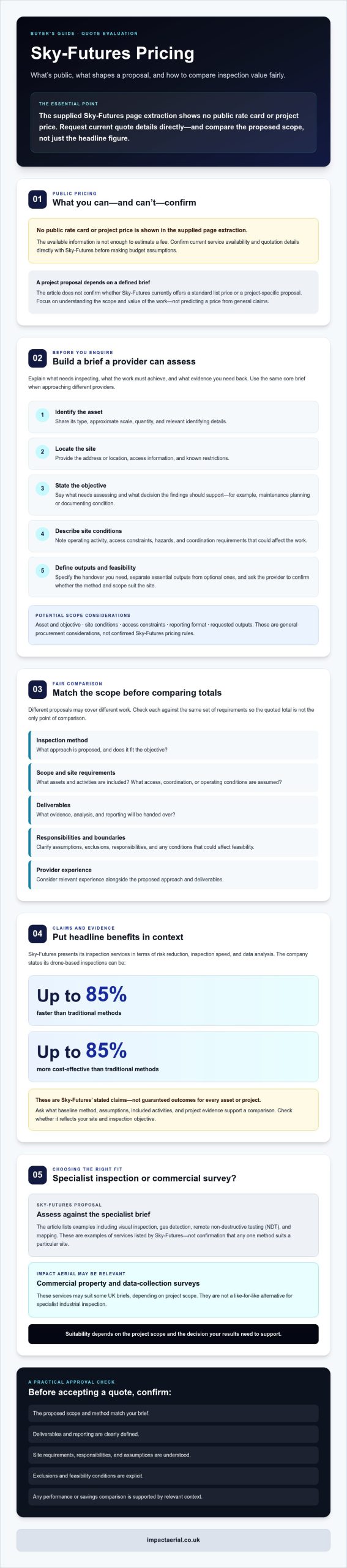
How to compare Sky-Futures pricing with another drone inspection proposal
A lower proposal total matters only if the work and outputs are comparable. Give each provider the same brief, then compare scope, methods, deliverables, site requirements and responsibilities side by side. If one quote covers a specialist industrial inspection and another covers a general commercial survey, they may not be alternatives at all.
Compare the work and outputs, not just the proposal total
Build a comparison table with a row for each item below. Record what each proposal includes, excludes or leaves unclear. This makes differences visible before you assess the quoted total.
- Scope: Which assets and areas are covered, and what inspection objective will the work address?
- Methods: What data-capture or inspection method is proposed, and does it meet the stated objective?
- Analysis and deliverables: Are imagery, collected data, analysis and reporting included? Note requested formats and handover requirements.
- Site requirements: What access, operating conditions or coordination does the provider assume?
- Assumptions and responsibilities: List exclusions, additional work, client inputs and tasks assigned to each party.
Don’t compare proposals if they specify different inspection objectives, asset coverage or reporting standards. Ask providers to clarify gaps or revise their scopes against the same brief. For broader context on aerial data collection and commercial surveys, see this commercial drone survey guide.
Assess operational assurance and evidence
Price is only one part of procurement. Check that the provider explains how the proposed work will be planned and delivered safely, and whether its people, insurance and equipment are appropriate for your site and objective. Don’t assume a credential or specification is relevant simply because it appears in a proposal. Ask how it supports the work you need.
- Qualifications and insurance: Confirm relevant pilot qualifications and the insurance cover applicable to the project.
- Equipment and method: Ask why the proposed equipment and data-capture approach are suitable for the asset and required outputs.
- Planning and constraints: Clarify how site access, operating conditions, identified risks and coordination will be addressed, and what could affect feasibility.
- Data handling: Confirm how collected information will be processed, reported and handed over.
- Performance claims: Ask for the baseline, assumptions and project evidence behind claims about speed, risk reduction or savings. Then assess whether they apply to your brief.
Impact Aerial’s CAA GVC certified pilots, £5m commercial liability insurance and commercial-grade enterprise drones are details to consider for suitable commercial property or data-collection survey briefs. They don’t establish equivalence with Sky-Futures’ specialist industrial inspection capabilities. Compare providers against the actual scope and verify project suitability directly.
Questions to ask before accepting a Sky-Futures quote
Before approval, resolve anything that could change what the provider does, what your team receives or what the site needs to support. Clear answers help procurement, operations and technical stakeholders assess the same scope rather than relying on different interpretations of the proposal. Keep responses with the quotation, and request an updated version if a clarification changes the agreed work.
Clarify scope, exclusions, and change conditions
Ask the provider to confirm exactly what the proposal covers and where its limits lie. These questions can help close gaps before you commit:
- Which assets, areas and inspection activities are included?
- What assumptions have been made about access, asset condition and site operations?
- What is excluded, including analysis, reporting or follow-up work?
- Which client inputs or site arrangements does the proposal depend on?
- What happens if site conditions differ from the brief or additional work is requested?
Ask how a change would be assessed and approved before extra work proceeds. This helps distinguish a genuine change in scope from an item that was unclear in the original proposal. It also clarifies which circumstances could affect feasibility, rather than leaving you to discover them during delivery.
Confirm outputs, safety, and delivery expectations
Agree on the handover in practical terms. “Inspection data” or “report” can mean different things to different teams, so specify what end users need to review and act on. Check that safety planning and site coordination are addressed for the proposed work, without assuming the provider or client automatically owns a particular task.
- What will the final report contain, and what imagery, data formats or analysis are included?
- How will the results be transferred, and who will receive or review them?
- Who coordinates site access, operational approvals and safety documentation?
- What planning information or site support must the client provide?
- What are the project milestones, and who is responsible for updates and decisions at each stage?
Ask for milestones and dependencies to be stated, without treating an unconfirmed delivery date as guaranteed. If the provider refers to speed, cost-effectiveness or risk reduction, request the relevant baseline and assumptions, then consider whether they apply to your asset and objective. This is more useful than using a general claim to predict Sky-Futures pricing or project outcomes.
Once the answers are agreed, circulate the clarified scope to procurement, operations and technical reviewers. For a separate commercial property or data-collection survey brief, you can discuss your survey requirements with Impact Aerial. Confirm directly whether its services fit the specific project.
When Impact Aerial may suit a commercial drone survey brief
Impact Aerial provides commercial property surveys and drone data-collection surveys across the UK. These services may be relevant if you need to document a commercial site or collect aerial information for a defined project purpose. Suitability depends on the asset, objective, site conditions and requested outputs, so confirm the proposed scope with the provider.
This is not a like-for-like alternative to Sky-Futures’ specialist industrial inspection work. If your brief involves a specialist inspection method or a challenging industrial environment, check directly that any provider under consideration has the relevant capability. The professional UK drone services guide offers broader context on service types and how to assess fit.
Match the project to Impact Aerial’s confirmed services
First distinguish a commercial survey or data-collection requirement from a specialist inspection requirement. Impact Aerial’s confirmed services include commercial property surveys and data-collection surveys. Its pilots are CAA GVC certified, it holds £5m commercial liability insurance, and it uses commercial-grade DJI Enterprise drones with 4K HDR cameras.
Use these details as evaluation points, not proof that every project is suitable or that the service will cost less. Ask whether the provider can meet your specific inspection objective, deliver the outputs your team needs and plan for the conditions at your site. For oil and gas, marine, hazardous-environment or other specialist industrial work, don’t assume its services match Sky-Futures’ capabilities. Confirm the scope and suitability directly before comparing proposals.
Prepare a clear brief and take the next step
A focused enquiry helps the provider assess the work and respond to the actual requirement. Include:
- Site and assets: Location, asset type, approximate scale and any relevant access constraints.
- Survey objective: What you need documented or collected, and what decision the results will support.
- Site conditions: Operating activity, coordination needs and any known limitations that could affect feasibility.
- Required outputs: Imagery, data, analysis or reporting needs, including preferred formats or handover expectations.
Also ask who will manage planning, site coordination and client inputs, and what project support is included through relevant post-production. Clear responsibilities help you assess delivery and operational fit alongside qualifications, insurance and equipment. They don’t establish price superiority or guarantee that one provider is the right choice.
If your project is a commercial property or data-collection survey, discuss your drone survey brief with Impact Aerial to establish whether its confirmed services fit your requirements. Compare any response against the same scope and outputs you use to assess Sky-Futures pricing.
Make your next survey decision with confidence
The supplied Sky-Futures page extraction contains no public rate card, so don’t try to infer a fee from general claims. Confirm current quotation details directly, then evaluate proposals against a shared brief: the assets and objectives, inspection methods, deliverables, site requirements, assumptions and exclusions. That’s the fairest way to assess scope and operational value.
Impact Aerial may be worth assessing if your project is a commercial property or data-collection survey rather than a specialist industrial inspection. Its CAA GVC certified pilots, £5m commercial liability insurance and commercial-grade DJI Enterprise drones with 4K HDR cameras are relevant evaluation points, not evidence of price superiority or automatic project fit.
If your brief matches those survey services, discuss your commercial drone survey requirements with Impact Aerial. A clear scope and the right provider questions will help you compare options carefully and choose an approach that supports your project.
Frequently Asked Questions
Does Sky-Futures publish its drone inspection prices?
The supplied Sky-Futures page extraction contains no public rate card or project price. The available information directs prospective customers to contact the company for a quote, but confirm the current quotation process and service availability directly. Don’t treat the absence of a price list as evidence of a fixed fee or assume a figure for one project would apply to another inspection brief.
How much does a Sky-Futures inspection cost?
There isn’t enough public pricing information in the supplied extraction to state how much an inspection costs. Confirm Sky-Futures pricing with the provider for the specific project rather than estimating from broad industry figures or general claims. To obtain a useful proposal, explain the asset, location, inspection objective, site conditions and required outputs, then ask what work and deliverables the proposed fee covers.
What affects the price of a commercial drone inspection?
Project scope can vary with the asset type and scale, location, inspection objective, site access and operating conditions. The method and requested outputs, such as imagery, specialist data, analysis or reporting, may also affect what a provider proposes. These are general procurement considerations, not confirmed Sky-Futures pricing rules. Ask which factors apply to your brief and whether any assumptions or exclusions could change the scope.
What should a Sky-Futures inspection quote include?
Ask the provider to set out the assets and activities covered, the proposed inspection method and the required outputs, including any analysis, report contents and data formats. The quotation should also clarify site requirements, planning and coordination responsibilities, assumptions, exclusions, dependencies and how changes will be handled. If a detail is unclear, request written confirmation so technical, operational and procurement teams review the same scope before approval.
Are drone inspections cheaper than traditional inspection methods?
They can be, but it depends on the project and the comparison. Sky-Futures states that its drone-based inspections can be up to 85% more cost-effective than traditional methods. That is the company’s claim, not a guaranteed saving for every job. Ask what baseline, assumptions and project evidence support the comparison, and check whether it matches your asset, inspection objective and required outputs.
Can Impact Aerial provide an alternative to Sky-Futures?
Impact Aerial may suit some commercial property or data-collection survey briefs, but it shouldn’t be treated as equivalent to Sky-Futures’ specialist industrial inspection services. Impact Aerial’s pilots are CAA GVC certified, the company holds £5m commercial liability insurance and uses commercial-grade DJI Enterprise drones with 4K HDR cameras. Confirm directly whether its services meet your project’s specific scope and output requirements.
What information should I provide when requesting a drone inspection quote?
Provide the asset type and approximate scale, site location, inspection objective and the decision the results need to support. Include access constraints, operating conditions, coordination needs and preferred timing. Specify essential outputs, such as imagery, data, analysis or reporting, and note preferred formats. Identify known dependencies or client inputs, then ask the provider to confirm feasibility, responsibilities and any site-specific requirements.
 2 Norton Drive, Wythall, Birmingham, B47 6HH Company registration number: 11138586. VAT Number: 366 9068 55