Could one missing permission stop an otherwise compliant drone shoot? It can. If you’re researching how to get a drone filming permit uk, start by knowing there isn’t one universal permit for every flight and filming location. CAA requirements govern where and how a drone may fly; landowner access and location-specific approvals are separate parts of the plan.
A pilot’s CAA credentials don’t settle every permission question, and a location booking doesn’t automatically clear the airspace. The checks depend on the planned operation, aircraft, airspace and where you intend to launch, land and film. Missing one can delay a shoot or force a change of plan.
This guide explains how to identify the permissions relevant to your project, what information to prepare for the CAA, local authorities or landowners, and how to keep flight approval separate from site access. It also shows how to build those checks into a filming schedule, so production planning starts with a clear view of the requirements.
Key Takeaways
- There isn’t one universal UK drone filming permit. Learn how to get a drone filming permit uk by identifying the separate flight, location and launch-access permissions your project may need.
- Match the planned flight to the relevant CAA operating category and authorisation route. Filming for business doesn’t create a separate permit category.
- Separate permission to film at a location from approval to fly in the airspace, and account for local variations in council processes.
- Prepare key project details, including the date, site, launch point, aircraft, flight area, crew and activity, before approaching the relevant authorities or landowners.
- See how professional flight planning supports production, with Impact Aerial’s CAA GVC-certified pilots and £5m commercial liability insurance.
How to get a drone filming permit in the UK: understand the permissions first
The permissions for a UK drone shoot depend on the proposed flight, location and filming activity. There isn’t one document that clears every part of a production: aviation requirements, consent to film at a site, and access to the land used for take-off and landing are separate checks.
A practical answer to “how to get a drone filming permit uk” starts with defining the shot. For an orbit around a privately owned building, for example, the operator must assess whether the flight can take place under the applicable CAA rules. The production may also need the owner’s consent to film on site and permission to use a suitable launch area. One approval doesn’t automatically provide the others.
A drone shoot may need more than one permission because approval to fly, consent to film and access to launch land address different risks and rights.
Is there one UK-wide drone filming permit?
No. There isn’t a single UK-wide drone filming permit that automatically grants every necessary approval. The CAA regulates aviation safety, and the flight must follow the operating rules and authorisation route that apply to it. Separately, a site owner or manager may set conditions for filming on their property, and a local authority may have its own process for filming in a managed public location.
The applicable route depends on the aircraft, planned flight and site. A straightforward shoot in an open area may raise different aviation and access questions from filming near people, buildings or restricted airspace. Check current CAA guidance for the proposed operation rather than assuming commercial filming always requires a particular authorisation. Commercial purpose alone isn’t a universal trigger for a separate CAA permit.
Who may be involved in approving a drone shoot?
Start with the CAA for aviation requirements. Depending on the site and how it is managed, location enquiries may also involve a local authority, landowner, site manager or location manager. The person who can consent to filming may not control the airspace, just as flight approval doesn’t grant permission to enter private land or launch from it.
Protected or restricted locations need case-specific checks. Restrictions and contacts can vary, so identify the exact site and flight area before making assumptions. Confirm who manages the launch point and whether separate location arrangements apply to the filming activity.
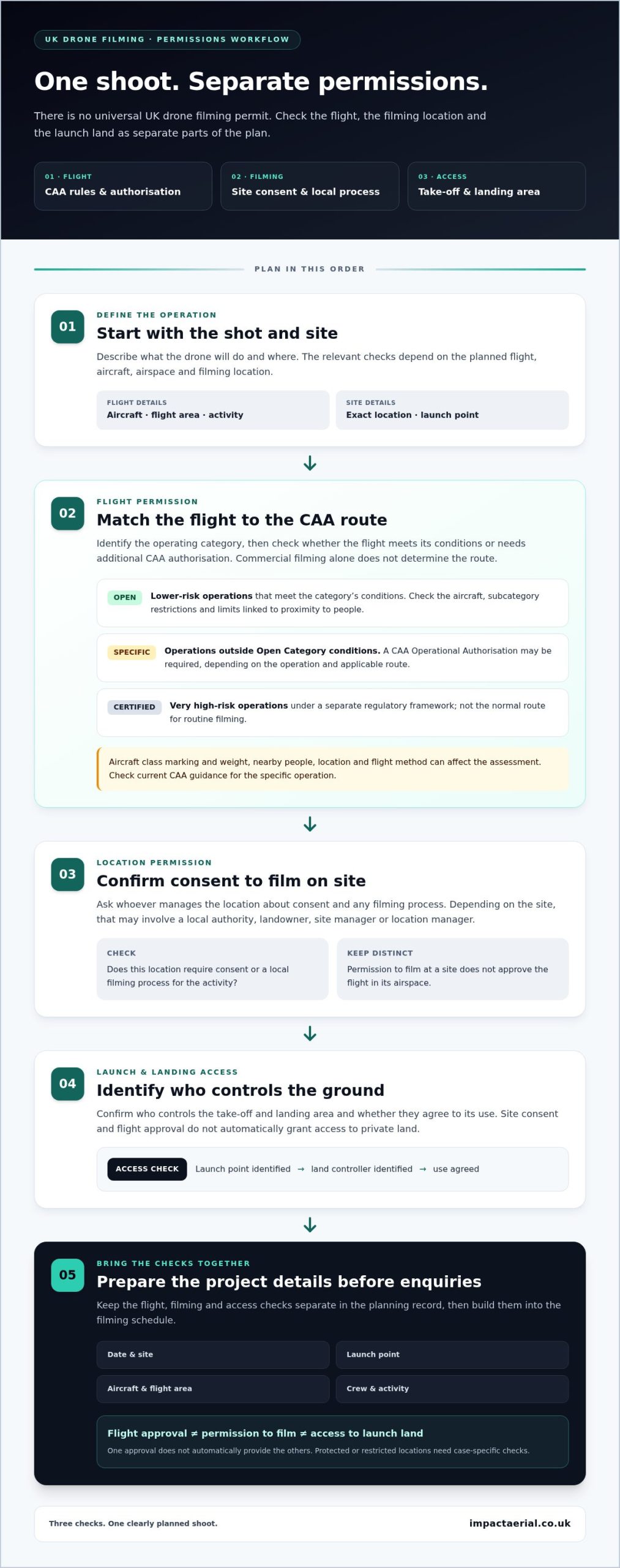
For a clear planning record, keep these three questions distinct:
- Flight: What CAA rules and any operational or airspace permissions apply to this specific flight?
- Filming: Does the location require consent or a local filming process for the activity?
- Access: Who controls the take-off and landing area, and have they agreed to its use?
These checks work together, but they aren’t interchangeable. Establishing them early helps identify the right contacts and prevents a location booking, land-access agreement or pilot credential from being treated as blanket approval for the shoot.
CAA drone rules for filming: check the flight category and authorisation
The CAA’s rules are based on the risk of the operation, not simply whether footage is made for a client or payment. First identify the applicable operating category, then check whether the flight meets that category’s conditions or needs additional CAA authorisation. The aircraft’s class marking and weight, the people nearby, the location and how the drone will be flown can all affect the assessment.
The CAA permission route depends on the operation’s risk and the rules that apply to it.
| Operating category | What it means for planning |
|---|---|
| Open | For lower-risk operations that meet the category’s conditions. Check the aircraft and applicable subcategory restrictions, including limits linked to proximity to people. |
| Specific | For operations that fall outside the Open Category conditions. A CAA Operational Authorisation may be required, depending on the operation and applicable route. |
| Certified | For very high-risk operations, subject to a separate regulatory framework. It is not the normal route for routine filming. |
This comparison is a starting point, not approval to fly. UK drone class markings and rules can affect the route, and legacy aircraft may be subject to different operating restrictions. Check current CAA guidance for the specific aircraft and flight rather than relying on a category label alone.
When might a drone operator need CAA authorisation?
Additional authorisation may be needed if the proposed operation cannot be conducted within the applicable Open Category conditions. A shot planned close to people or in a constrained setting, for example, may need a different operating assessment from a flight in a clear, open area. The location, aircraft and operating method all matter. Commercial filming is not, by itself, the test for whether authorisation is required.
Before fixing the shot, check current CAA requirements for the intended flight, including any relevant separation rules and airspace restrictions. If the flight needs an authorisation, its conditions shape what the pilot can safely and lawfully do on the day.
What do operator ID, flyer ID and GVC mean?
An Operator ID identifies the person or organisation responsible for managing a drone, while a Flyer ID demonstrates that a flyer has passed the required theory test. Current CAA rules set requirements according to factors such as aircraft weight and whether it has a camera. Under the 2026 requirements, a Flyer ID applies from 100g, and an Operator ID is required from 100g for a camera-equipped drone; drones from 250g to 25kg require both.
A GVC is a remote-pilot qualification relevant to certain operations and permission routes. It is not a universal filming permit. CAA terminology and qualification routes are changing, with RPC-L1 replacing GVC as the entry point for more complex operations, so check the current route before planning. For a fuller explanation of UK drone licensing and CAA rules, review the requirements alongside the planned flight. Productions that need flight planning and aerial footage handled together can also explore professional aerial filming and photography.
Location filming permission and drone launch access: what to check
A location booking doesn’t automatically provide permission to launch a drone, and access to a launch site doesn’t establish that the flight is permitted. Treat filming consent, ground access and aviation requirements as separate workstreams, then coordinate them around the same shot plan. This distinction is central to how to get a drone filming permit uk without mistaking one approval for another.
A production might have consent to film inside a privately managed estate but still need the landowner or site manager to agree to take-off and landing from a particular area. The flight must also comply with the relevant CAA rules. Even an accessible launch point may be unsuitable, so the operator needs to consider whether it supports a safe, compliant flight.
Do you need permission to take off or land?
Arrange permission for the specific land used for take-off and landing, including any recovery point that differs from the launch site. This may involve a private landowner, venue, site manager or another party responsible for the ground. Agree where the crew can set up, how the area will be used and whether the planned activity fits the site’s conditions.
That consent covers access to land, not permission to conduct the flight. CAA requirements still apply independently, and permission to fly doesn’t grant access to private property. Keep both decisions documented with the shoot plan.
How do council and location filming processes differ?
Local filming arrangements depend on who manages the site and the planned activity. A council, film office or location manager may handle requests through its own process, and requirements for a managed public space may differ from those for private premises. Ask the authority responsible for that location what information and approvals it requires; don’t assume one council’s process applies elsewhere.
Film London provides filming information for London, while FilmFixer supports location filming processes in areas it serves. These are location-filming resources, not aviation regulators. Their guidance may help identify location contacts, but it doesn’t replace CAA checks or land-access consent. Dorset is another reminder that filming arrangements are location-specific: check the relevant council or site manager rather than applying a London process across the UK.
Before confirming the location, check the exact launch and landing points, the site boundary and any restrictions that may affect filming. Protected places and restricted locations can have additional considerations, so identify the responsible authority or site body and verify applicable requirements directly. Allow time in the production schedule for responses and conditions, such as limits on where the crew can work.
- Identify the decision-makers: Separate the site owner or manager from the local filming contact and aviation authority.
- Describe the activity clearly: Provide the filming date, take-off and landing locations, intended flight area and crew activity.
- Record conditions: Keep written access consent and location requirements with the flight plan, and review any changes to the site or shot before filming.
Clear coordination helps prevent an approved location from being mistaken for an approved flight, or an accessible field from being treated as permission to use it.
How to apply for drone filming permission in the UK: a project checklist
A clear application starts with a defined shot, not a generic request to “film by drone”. Set out what you plan to capture, where the aircraft will launch and land, and how the flight fits the location. The steps below turn how to get a drone filming permit uk into a practical sequence, while allowing for different authorities to request different information.
- 1. Define the shot. Describe the intended footage, the activity being filmed and the proposed flight area. Note any movement, people or site features that affect how the operation will be planned.
- 2. Fix the location and date. Identify the site, its boundaries and the intended filming date or dates. If the schedule is flexible, say so rather than implying a date is approved.
- 3. Mark launch and recovery points. Record the areas proposed for take-off and landing, and identify who controls that land. Include an alternative point only if it forms part of the plan.
- 4. Identify the aircraft and pilot. Prepare the drone’s make, model and relevant class or weight details, alongside the pilot’s information and qualifications relevant to the planned operation.
- 5. Check the flight area. Review current CAA requirements and airspace information for the site and proposed flight. Identify restrictions or additional permissions that may apply, and verify them with the responsible authority.
- 6. Contact the right parties. Send location requests to the organisation managing the site, land-access requests to the landowner or site manager, and aviation queries or applications through the relevant CAA route. Don’t assume one recipient handles every approval.
- 7. Confirm before committing the crew. Keep responses, conditions and the agreed flight plan together. Confirm they still match the planned date, aircraft, launch point and activity.
What information should a filming permission request include?
Give each receiving body the information relevant to its decision. A location request should explain the project purpose, proposed dates, site boundaries and filming activity. For an aviation assessment, include the aircraft, pilot details, intended flight area and practical safety controls suited to the operation and site. A clear plan helps the recipient understand the request without having to infer what the crew intends to do.
Provide evidence of relevant pilot qualifications, authorisations or insurance if requested. Requirements and forms vary, so follow the current instructions for each application rather than sending the same incomplete pack to every party.
What should happen before the shoot day?
Before deployment, confirm written permissions and access arrangements with the relevant parties, then make sure any conditions are reflected in the flight plan. Recheck the weather, current restrictions and site conditions, since a changed environment or schedule can affect whether the planned operation remains suitable. Keep a named production contact and a practical contingency plan available to the crew.
Approval times and documentation depend on the authority, location and operation. Build realistic time for enquiries and responses into the schedule without assuming a fixed turnaround. For productions that need coordinated flight planning and footage delivery, plan professional aerial filming with Impact Aerial, from initial project support through post-production.
Plan compliant drone filming with a professional UK aerial team
Once you’ve mapped out the permission checks, the next challenge is delivering the planned shots within the applicable approvals and site conditions. A professional aerial team can coordinate flight preparation with the production brief, considering creative requirements alongside aircraft, location and operational constraints. The operator still needs to follow the relevant CAA rules and permissions on the day; hiring a filming team doesn’t replace those requirements.
Impact Aerial provides aerial filming and photography with CAA GVC-certified pilots, professional-grade commercial drones with 4K HDR cameras, and £5m commercial liability insurance. These credentials support a carefully planned shoot, while the specific flight route and permissions depend on the operation and location.
What does a professional drone filming workflow cover?
Project support can begin by scoping the footage needed, the intended setting and how aerial shots will fit the wider production. Shot planning and site coordination then help align the desired angles with practical launch access, the flight area and operating conditions. Whether the brief calls for a building reveal, a site overview or a moving sequence, consider each shot against the real location and approved flight plan, not just as a camera request.
Preparation also gives the production team a clearer view of the information and arrangements needed before filming. The workflow can continue through capture and post-production, connecting the original footage requirements to the final output. For context on how aerial work fits into broader commercial applications, see this professional drone services guide.
When is an experienced drone filming team useful?
An experienced team is useful when a production needs aerial footage but doesn’t want to manage aircraft operations as a separate workstream. The filming operator can coordinate flight preparation, crew activity and footage capture, while the production focuses on its wider schedule. Clear communication still matters: the team needs to understand the intended scenes and site conditions, and the production needs to allow the flight plan to guide what can be captured safely.
Impact Aerial supports projects from initial consultation through post-production. CAA GVC-certified pilots and £5m commercial liability insurance provide specific operational and insurance credentials, while 4K HDR equipment supports aerial capture. This connects planning, filming and delivery rather than leaving the production to piece together separate stages.
If your project needs aerial footage supported by professional planning and post-production, explore Impact Aerial’s drone filming services and see how the team can support your production brief.
Start shaping your aerial filming brief
Turn the intended result into a concise shot brief. Identify the images that matter most to the story, where they need to fit in the production, and what could change if the location or operating conditions limit a particular shot. This gives the filming team a useful creative starting point while leaving room to plan within the permissions and conditions that apply.
If you’re still working out how to get a drone filming permit uk for your project, bring the brief and proposed location into planning early. Aerial filming works best when the visual goal and practical flight plan are considered together, rather than treated as separate decisions at the last minute.
Impact Aerial supports productions from initial project planning through post-production, with CAA GVC-certified pilots, £5m commercial liability insurance and commercial-grade 4K HDR drone filming. Explore professional drone filming with Impact Aerial and take the next step towards planning aerial footage that fits your production.
Frequently Asked Questions
Is there one permit for drone filming in the UK?
No, there isn’t one universal document that clears every drone flight and filming location. Your shoot may involve separate CAA flight requirements, consent to film at a site and permission to access the launch or recovery area. A venue’s filming consent, for example, doesn’t by itself confirm that the planned flight is allowed. Check current CAA guidance and the relevant site or land authority for your specific plan.
Does commercial drone filming need a CAA permit?
Not solely because the filming is paid or for business use. The relevant CAA requirements depend on the operation, including the aircraft, flight conditions and risk involved. A planned shot near people, for example, may need a different assessment from one over an open area. Check current CAA guidance against the precise flight plan rather than treating commercial purpose as an automatic permit trigger.
Do I need permission to take off and land a drone on private land?
Arrange permission from the landowner or person managing the site before using private land for take-off or landing. This also applies if the drone will recover at a different point from where it launched. Confirm the access route, where the crew may set up and whether site conditions affect the shoot. Ground access consent is separate from the aviation requirements for the flight itself.
How do I apply for a drone filming permit in the UK?
Start by describing the intended shots, filming dates, site, aircraft and proposed flight area. Then identify who handles aviation questions, land access and location filming at that site. The phrase how to get a drone filming permit uk can suggest one application, but you may need to make separate enquiries and provide different information to each party. Keep responses together and confirm they match the final plan before filming.
Can I film with a drone in a public place in the UK?
Public access doesn’t automatically mean a drone can fly there. A busy public square, for instance, presents different operational considerations from a quiet open space, and the applicable CAA rules still apply. You may also need to identify who manages the location and whether filming or launch access has site-specific conditions. Check current flight requirements and contact the responsible authority before treating the location as suitable.
Does a CAA GVC certificate give me permission to film anywhere?
No. A GVC is a pilot qualification relevant to certain operational routes, not blanket approval for every flight or location. The operation must still meet applicable CAA requirements, and a site may have separate access or filming conditions. A qualified pilot may still need permission to use a private launch area, for example. Check the current CAA route for the planned operation, especially as qualification terminology and pathways evolve.
How long does it take to get permission for a drone filming shoot?
There’s no single approval timeframe for every UK shoot. Timing can depend on the operation, the location’s process, which organisations need to respond and whether they request more information. A shoot involving several locations may require separate enquiries, each with its own steps. Start the permission process before locking in the production schedule, allow flexibility for responses and don’t treat an acknowledgement or booking as final approval.
 2 Norton Drive, Wythall, Birmingham, B47 6HH Company registration number: 11138586. VAT Number: 366 9068 55