
Table of Contents
- Do You Need Permission to Fly Over Private Land?
- The CAA Drone Code for Private Land: Rules You Must Follow
- Take-off and Landing: Why Landowner Consent Matters
- Understanding Drone Privacy Laws UK Operators Must Know
- How to Ask: Landowner Permission Letter Template
- Common Mistakes to Avoid When Flying Near Private Land
- Conclusion: Fly Safely and Within the Law
- Frequently Asked Questions
Last Updated: September 9, 2026
Do You Need Permission to Fly Over Private Land?
Understanding drone flight permission for private land UK explained starts with a surprising fact: there is no blanket law prohibiting overflight of private property. According to Coptrz guidance on UK drone laws, operators can generally fly over private land provided they comply with all Civil Aviation Authority (CAA) regulations and respect privacy laws. The distinction matters because many pilots assume land ownership equates to airspace control, which is incorrect.
What you cannot do without consent is take off from or land on private land. This guide breaks down the legal boundaries, the practical steps for securing permission, and the common mistakes that lead to disputes.
Drone flight permission is governed primarily by the CAA rather than by property law. The right to fly over land does not grant you the right to use that land as a launch site. This distinction between airspace and physical land access is the foundation of every rule that follows.
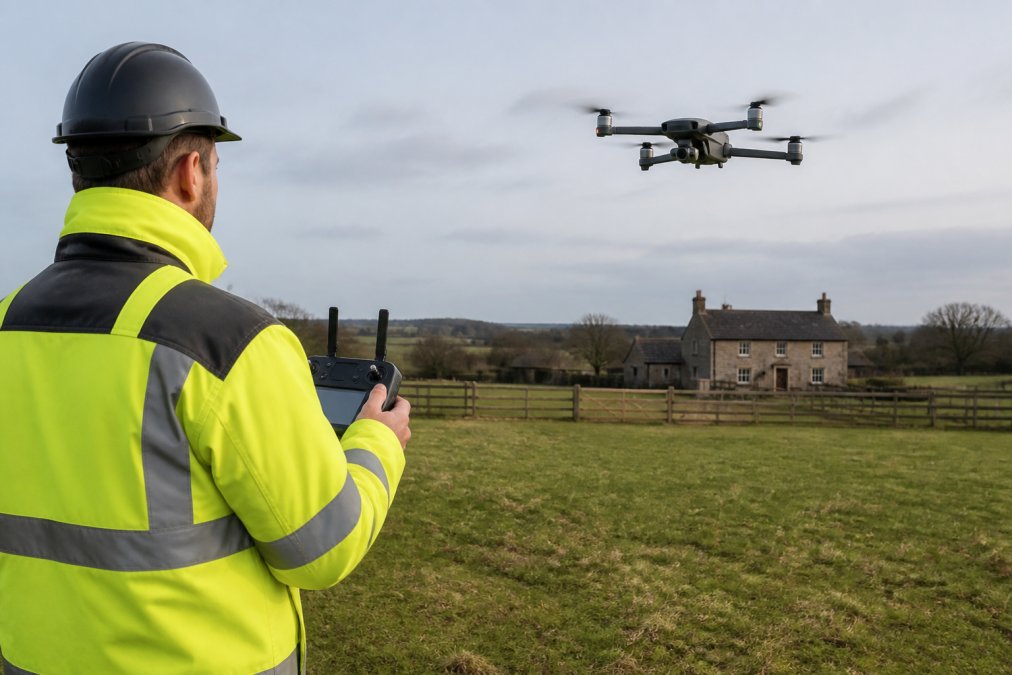
The CAA Drone Code for Private Land: Rules You Must Follow
The CAA Drone Code is the definitive regulatory framework for all drone operations. It applies uniformly regardless of whether the land below is privately owned, publicly accessible, or agricultural.
Altitude Limits and Visual Line of Sight
Every flight must remain below 120m from the closest point of the earth’s surface, as stated in the Civil Aviation Authority Drone Code. If the terrain rises or falls, your drone must maintain this distance from the ground directly beneath it. This rule exists to separate drones from manned aircraft and applies over all land types.
Visual line of sight (VLOS) is equally non-negotiable. You must keep your drone within unaided sight at all times unless the CAA has granted special authorisation. This practical constraint means you cannot fly over distant parts of a large estate and still claim compliance.
Flying beyond visual line of sight without CAA authorisation can result in enforcement action, including fines. The 120m altitude limit is measured from the surface below the drone, not from your take-off point.
Take-off and Landing: Why Landowner Consent Matters
The critical distinction in drone flight permission for private land UK explained is that takeoff and landing require express landowner authorisation. You cannot launch or land a drone from land you merely have walking access to, such as a public footpath crossing private property.
This requirement stems from trespass law rather than aviation regulation. While airspace above 120m is largely unrestricted for compliant drones, the physical act of landing or launching involves your presence on the land itself. Landowners retain the right to control who accesses their property.
Some legal perspectives argue that landowners should have the right to exclude aircraft from the column of airspace directly above their property, as discussed in Brookings analysis of airspace rights. While this view has not prevailed in UK law, it signals the sensitivity surrounding low-level flights over private residences.
Before any commercial survey or filming project, confirm the landowner’s identity through Land Registry records. Verbal consent from a tenant or farm manager may not constitute valid authorisation from the freeholder.
Understanding Drone Privacy Laws UK Operators Must Know
Drone privacy laws UK operators must navigate sit alongside CAA regulations. Overflight may be legal, but capturing images of people or property can raise privacy and trespass concerns under civil law.
Research published in MDPI study on drone regulation in urban environments found that drones flown indoors at a private residence do not require permits provided they do not affect the general public. This principle extends to outdoor operations: the moment your flight intrudes on someone’s reasonable expectation of privacy, you may face legal consequences.
The legal consensus, as clarified in Coptrz 2026 guide to British drone laws, is that while overflight is generally permitted, privacy and tort laws remain applicable. This means you should avoid hovering over gardens, through open windows, or in a manner that harasses residents.
| Scenario | Permission Required | Key Consideration |
|---|---|---|
| Flying over private land at altitude | No | Stay below 120m, maintain VLOS |
| Take-off or landing on private land | Yes | Written landowner consent |
| Filming identifiable individuals | Yes | GDPR and privacy law apply |
| Commercial operations | Yes | CAA operational authorisation |
How to Ask: Landowner Permission Letter Template
Securing formal consent protects you legally and builds trust with landowners. A written request is always preferable to a verbal agreement, particularly for recurring or commercial operations.
Use this template as a starting point for your landowner permission letter:
Subject: Request for Drone Operations Over [Property Address]
Dear [Landowner Name],
I am writing to request permission to operate a small unmanned aircraft over your property at [address] on [date(s)]. The purpose of this flight is [site survey / aerial photography / inspection].
The drone will remain below 120m altitude and within my visual line of sight at all times. I hold [CAA operator ID / GVC certificate] and carry [£5m] public liability insurance.
I would also like permission to take off from and land on your property at [specific location]. No images of people will be captured without consent.
Please contact me at [phone/email] to confirm your approval or to discuss any concerns.
Kind regards,
[Your Name]
Common Mistakes to Avoid When Flying Near Private Land
Pilots frequently assume that permission to overfly extends to landing rights. It does not. Treat these as two separate authorisations and secure consent for both.
Another frequent error involves ignoring the mandatory operator ID requirement. Regulatory focus on operator identification has increased, with operator ID now a mandatory requirement for drone pilots, as reported in UK drone community guidance. Flying without visible operator ID leaves you exposed to enforcement.
Failing to account for changing ground elevation is also common. A drone launched from a hilltop that climbs to 120m above the launch point may exceed the legal limit relative to the valley floor below.
Conclusion: Fly Safely and Within the Law
Drone flight permission for private land UK explained ultimately comes down to respecting the boundary between airspace and physical land. Overflight is generally lawful; landing, launching, and intrusive filming are not.
The regulatory landscape continues to evolve, with C1 class drones now permitted closer to uninvolved people under recent Civil Aviation Authority updates. Staying current with these changes is essential for every operator.
For commercial projects requiring aerial surveys, inspections, or filming, working with experienced professionals removes the regulatory burden. Impact Aerial’s fully trained and licensed CAA GVC pilots manage permissions, safety, and compliance on your behalf, backed by £5m commercial liability insurance.
Get in touch with Impact Aerial to discuss how professional drone services can support your next project.
Frequently Asked Questions
Do I need permission from a landowner to fly a drone over their property?
No blanket permission is required to overfly private land in the UK. The CAA does not prohibit flight over private property, provided you follow the Drone Code. However, you do need explicit permission to take off or land on that land. You must also respect drone privacy laws UK regulations set out in the Data Protection Act, and be prepared to land if asked by police or a landowner concerned about safety.
Is it trespassing to fly a drone over private land in the UK?
Flying over private land is generally not considered trespass, as the landowner’s rights do not extend indefinitely into the airspace above their property. The legal position is that overflight is permitted, but privacy and tort laws remain applicable. However, taking off or landing without permission on private land can constitute trespass. Always secure consent for launch and recovery points to avoid civil claims.
What should I do if a landowner asks me to stop flying?
You should land your drone immediately and comply with the request. While you may have a legal right to overfly their land, continuing to operate after being asked to stop could escalate the situation and lead to allegations of harassment or nuisance. Politely explain your CAA permissions if relevant, but always prioritise de-escalation. Land elsewhere if you need to continue your flight.
Where can I find a landowner permission letter template?
A formal letter helps secure written consent for drone operations on private land. Your letter should state your name, operator ID, the purpose of the flight, proposed dates and times, and the exact takeoff and landing locations. Include confirmation of your £5m public liability insurance and CAA GVC certification. Send the letter at least 14 days before your planned flight to allow time for a response.
 2 Norton Drive, Wythall, Birmingham, B47 6HH Company registration number: 11138586. VAT Number: 366 9068 55


