
Quick Summary
Drone safety protocols are the written rules, checks and roles that keep aerial work safe and legal on site. Start by naming one remote pilot in command for each flight, then complete a risk assessment before every job. Standard procedures, checklists and emergency plans turn those rules into steps the team can follow.
- Name one remote pilot in command for every flight and make sure everyone knows who it is.
- Score each hazard on a 5×5 matrix and treat anything rated 12 or above as unacceptable until controlled.
- Run pre-flight, in-flight and post-flight checklists every time, so small steps are never skipped.
- Land at 30 per cent battery remaining, with return-to-home at 20 per cent and emergency landing at 10 per cent.
- Practise emergency procedures through tabletop and practical drills, so the team does not first read the plan during an incident.
Table of Contents
- Why Drone Safety Protocols Matter on UK Construction Sites
- Step 1: Assign Roles, Competencies and Communication Lines
- Step 2: Build a Drone Risk Assessment Before Every Job
- Step 3: Write Drone Standard Operating Procedures
- Step 4: Run a Drone Safety Checklist Before, During and After Flight
- Step 5: Plan Drone Emergency Procedures and Contingencies
- Keeping Your Drone Safety Records Audit-Ready
- Putting Your Drone Safety Protocols Into Practice With Impact Aerial
- Frequently Asked Questions
Why Drone Safety Protocols Matter on UK Construction Sites
Drone safety protocols are the written rules, checks and roles that keep aerial work safe and legal on site.
The Civil Aviation Authority (CAA) sets the rules for flying drones in the UK, including visual line of sight and keeping clear of people.
2025 review of UAV risk mitigation published in ScienceDirect
Most problems come from gaps between people, not the aircraft.
Here is the short version of what a working protocol covers:
- Who is responsible for each flight, and who can stop it
- What risks are identified before every job
- Which procedures apply, written down and followed
Each step builds on the last. Start with roles, because nothing works until people know who decides what.
Step 1: Assign Roles, Competencies and Communication Lines
Name one remote pilot in command for every flight, and make sure everyone on site knows who that is.
Work through these points before any flight:
- Remote pilot in command: holds the authority to start, pause or abort a flight
- Visual observer: keeps the drone in sight and warns the pilot of hazards, where the flight needs one
- Site supervisor: clears the work area and stops people entering it
Competence needs checking, not assuming.
Keep communication lines short: a shared radio or messaging channel for pilot, observer and supervisor is usually enough.
Watch out: a site supervisor who can only be reached by phone during a flight is a gap.
Step 2: Build a Drone Risk Assessment Before Every Job
A drone risk assessment identifies what could go wrong on a specific flight and what will stop it. Write one for every job, even a short repeat survey, because the site changes and so does the risk. What separates a risk assessment that sits in a folder from one that prevents incidents is a consistent scoring method and controls someone else can check.
Use a simple 5×5 matrix
Score each hazard twice: how likely it is (1 = rare, 5 = almost certain) and how serious the outcome would be (1 = minor, 5 = severe injury or loss of the aircraft over people). Multiply the two scores to get a risk rating from 1 to 25. Treat anything scoring 12 or above as unacceptable until a control brings it down, and anything scoring 6 to 11 as tolerable only with the controls written down and briefed.
| Likelihood \ Severity | 1 Minor | 2 | 3 | 4 | 5 Severe |
|---|---|---|---|---|---|
| 5 Almost certain | 5 | 10 | 15 | 20 | 25 |
| 4 Likely | 4 | 8 | 12 | 16 | 20 |
| 3 Possible | 3 | 6 | 9 | 12 | 15 |
| 2 Unlikely | 2 | 4 | 6 | 8 | 10 |
| 1 Rare | 1 | 2 | 3 | 4 | 5 |
Run a site survey before you score
Walk the site and record the answers to these questions. The survey feeds the matrix, so do it first.
- Airspace: Is the site inside controlled airspace, a flight restriction zone or near an aerodrome? Check the CAA’s airspace map and local notices before you fly.
- Obstacles: Note overhead lines, cranes, scaffolding, trees and tall plant, with approximate heights.
- People: Where are workers, visitors and public rights of way? Mark the closest point of public access to the flight path.
Worked example
A roof inspection on a warehouse with a public footpath along one side. The hazard “drone drifts over the footpath” scores likelihood 3 (possible in gusty conditions) and severity 4 (people below), giving 12, unacceptable. The control is to move the take-off point to the opposite corner, set a geofence along the footpath boundary and brief the observer to call a hold if anyone stops beneath the flight path.
Common controls to draw on
- Exclusion zones: barriers and signage at a set radius from the flight path, with a named person responsible for keeping them clear.
- Geofencing: a software boundary set inside the site line so the aircraft cannot cross into a public area even if the pilot errs.
- Altitude caps: a maximum height set below any obstacle or airspace limit, written into the flight plan.
Brief, sign off and reassess
Review the assessment with the team before the flight and sign it off; a short briefing at the start of each shift works well. If conditions change on the day, such as a crane moving into the flight path or wind picking up beyond the forecast, stop and reassess, recording it on the same form so the audit trail shows the decision.
Watch out: a risk assessment copied from the last job and re-dated is worse than none, because it looks like a control while describing a different site. Score the hazards in front of you.
Step 3: Write Drone Standard Operating Procedures
Standard operating procedures (SOPs) turn your rules into steps anyone on the team can follow, reducing the chance a pilot improvises under pressure.
A workable SOP usually covers:
- Scope: the types of flight the SOP applies to
- Equipment: the drone models approved for site use
- Pre-flight: checks to complete before take-off
- Flight conduct: altitude limits, distances from people and the line-of-sight rule
- Post-flight: handling of batteries, data and defects
- Emergencies: what happens when things go wrong
Keep the language plain. “Keep the drone within visual line of sight at all times” is clearer than a paragraph about operational requirements.
Review the SOP after any incident, near miss or change in regulation. An SOP written in the office and never revisited soon stops matching what happens on site.
Step 4: Run a Drone Safety Checklist Before, During and After Flight
A checklist makes sure nothing gets skipped. Pilots often know what to check, but under time pressure small steps slip, so a short checklist used every time beats a long one that is ignored.
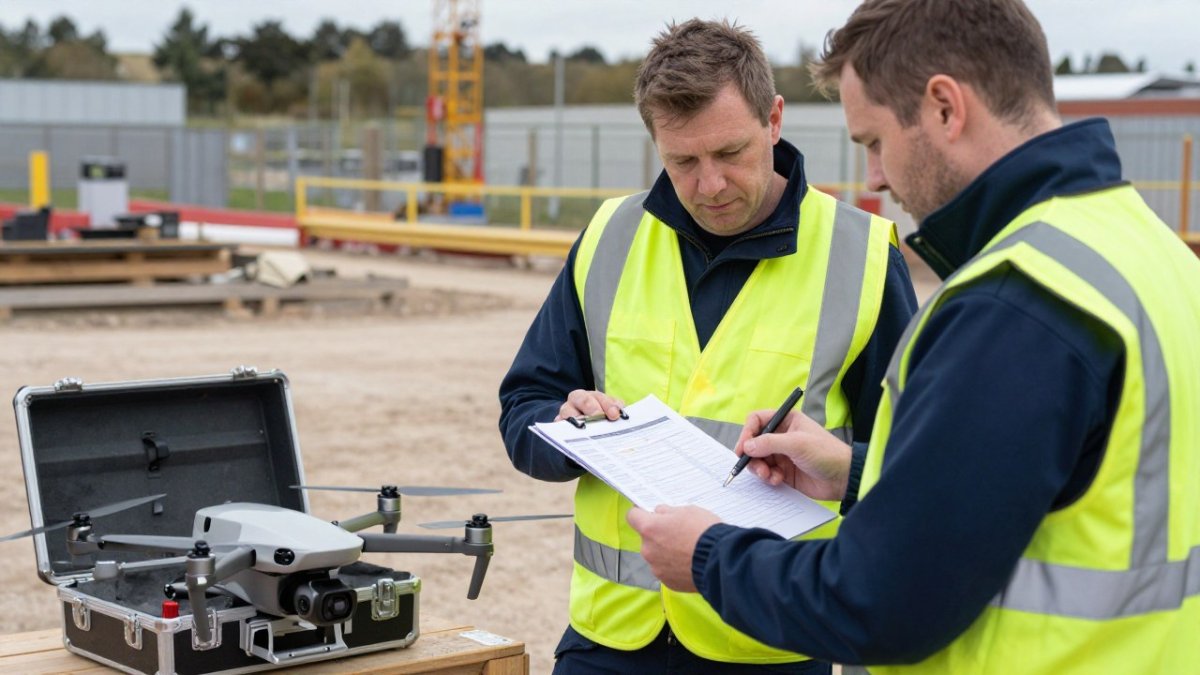
Run the checklist at three points:
Before flight
- Risk assessment reviewed and signed off
- Airspace and restrictions checked for the site
- Weather within limits for wind and visibility
During flight
- Drone kept within visual line of sight
- Altitude and distance limits observed
- Observer watching for people and hazards
After flight
- Drone landed and powered down safely
- Batteries removed and checked for swelling or heat
- Any incident or near miss logged
Keep a printed copy in the drone case, and sign it for each flight. This takes minutes and gives you a record if questions come up later.
Step 5: Plan Drone Emergency Procedures and Contingencies
Plan for failure before it happens. Batteries run low, GPS drops out and wind picks up faster than forecast; your emergency procedures decide whether these become incidents. The test is not whether a procedure reads well but whether a pilot under pressure can follow it without thinking.
Set decision thresholds in advance
Agree the numbers before the flight so nobody has to calculate mid-air.
- Battery: land at 30 per cent remaining, not at the last safe moment. Treat 20 per cent as a mandatory return-to-home trigger and 10 per cent as an emergency landing.
- Wind: set a maximum gust figure for the aircraft model and stick to it. If the forecast or the on-site reading exceeds it, do not launch.
- Visibility: set a minimum visibility distance and cloud base for the flight window; if either drops below it, land.
Scenario playbook
- Loss of link: the aircraft’s return-to-home function activates. The pilot keeps the controller powered and the observer watches the return path. If the aircraft does not reappear within the expected time, the pilot follows the lost-drone procedure and notifies the site supervisor.
- Flyaway: if the aircraft moves away under control but outside the planned area, the pilot does not chase it on foot. Note the last known position and heading, switch to the lost-drone procedure and keep the observer watching. Do not attempt to grab the aircraft in flight.
- Low battery: the pilot lands at the set threshold at the pre-agreed landing point, not wherever is closest. If the landing point is occupied, the pilot holds and diverts to the emergency landing area.
Lost-drone procedure
Write a short, numbered procedure and keep it with the controller. It should cover: the last known position and heading, the time of loss, the battery state at loss, the action taken (return-to-home, hold or land), who was notified, and the search area. Record the aircraft serial number and any registration mark so a finder can report it. Report a lost aircraft to the CAA if it is registered and the loss meets the reporting threshold.
Test the plan with a drill
A tabletop walkthrough with the whole team takes under an hour and shows you where the gaps are. Run one scenario per drill: read it aloud, ask each person what they would do, and note where answers diverge.
Watch out: many teams write emergency procedures and never practise them, so the first time anyone reads the plan is during the emergency.
Keeping Your Drone Safety Records Audit-Ready
Good records protect you if a client, insurer or regulator asks questions. Keep them in one place and make them easy to find.
Store these documents for each project:
- Risk assessments, signed and dated
- Pilot authorisations and training certificates
- Completed pre-flight, in-flight and post-flight checklists
Retain records for the period your contract or insurer requires. Back them up in a second location, and make sure the right people can access them quickly.
Records also help you improve. Reviewing the logs each quarter can spot repeated near misses, weak weather limits or a battery that keeps failing early, and that information drives better protocols over time.
Putting Your Drone Safety Protocols Into Practice With Impact Aerial
Writing protocols is the first step. Running them consistently on live sites is harder, and it is where most teams struggle.
Impact Aerial is a UK drone operator with CAA GVC-certified pilots, a fleet of 4K HDR DJI Enterprise drones and £5m commercial liability insurance.
If you want an external partner to take on the flying, get in touch with Impact Aerial.
Impact Aerial provides professional drone photography, videography and survey services across the UK. Contact us to discuss your next project.
Frequently Asked Questions
What safety checks should you complete before flying a drone?
Before any flight, confirm the airspace status, weather and wind limits, the site boundary and the people who need to be kept clear. Inspect the airframe, propellers, batteries and firmware, and check the controller link and GPS lock. Confirm the pilot holds the correct CAA qualification for the operation and that the flight is covered by your insurance. Record each check in writing so the file shows the aircraft was fit to fly before take-off.
What should be included in a drone pre-flight checklist?
A useful pre-flight checklist covers the aircraft, the pilot and the site. Include battery charge and condition, propeller security, firmware version, compass and GPS calibration, and a return-to-home altitude that clears nearby structures. Add the operating area boundaries, the named visual observer, the emergency contact and the weather check. Keep the checklist short enough to complete every time, and sign it before the drone leaves the case.
Who is responsible for drone safety on a construction site?
Responsibility is shared, but the remote pilot in command carries the primary legal duty for the flight under CAA rules. The site manager or principal contractor remains responsible for managing the wider site, including exclusion zones and coordination with other trades. Name both roles in your drone standard operating procedures so the lines of responsibility are clear before any flight takes place.
What should a drone operator do if the weather changes during a flight?
Stop the flight as soon as conditions move outside your limits. Watch for rising wind, reduced visibility, rain or a drop in temperature that affects battery performance. Bring the aircraft back to a safe landing point using your planned return route, and do not attempt to push a flight to finish a job. Log the incident and the decision in your flight record, then review whether the weather limits in your risk assessment need tightening.

 2 Norton Drive, Wythall, Birmingham, B47 6HH Company registration number: 11138586. VAT Number: 366 9068 55


