
Quick Summary
Choosing a drone for business photography starts with the work you actually sell, not the headline specifications. List your three most common deliverables, then judge sensor quality, RAW capture, flight time, portability and legal compliance against that list. Buy for the typical job rather than the best-case one.
- Write down your three most common deliverables before looking at any aircraft.
- Sensor size, lens quality and bright-sky handling matter more than megapixel count.
- Plan battery cycles around the shoot, and expect less flight time in wind and cold.
- Total cost includes spare batteries, storage, insurance, CAA training and replacement every two to three years.
- Check CAA operator and pilot requirements before flying for any client.
Table of Contents
- Why Business Photography Needs a Different Kind of Drone
- Matching Your Drone to Client Sectors and Deliverables
- Professional Drone Camera Features That Affect Image Quality
- The Best Drone for Commercial Photography by Budget and Skill Level
- Flight Time, Portability and Reliability on Real Jobs
- Drone Photography for Property Marketing: What Makes the Footage Sell
- Operator Qualifications and Permissions You Need Under UK CAA Rules
- Booking Your First Commercial Drone Shoot With Impact Aerial
- Frequently Asked Questions
Why Business Photography Needs a Different Kind of Drone
Last Updated: 24 November 2026
Choosing a drone for business photography is not the same as picking one for weekend flying.
The first mistake is focusing on headline specifications.
Second, buyers often underestimate the operational side.
Finally, businesses must consider legal compliance from the start. In the UK, commercial operations fall under Civil Aviation Authority rules, which require specific operator qualifications and permissions.
Keep these points in mind as we work through the seven checks that matter most before you commit.
Matching Your Drone to Client Sectors and Deliverables
Start with the work you actually sell. A property agent needs bright, well-framed stills and smooth orbit video. A construction firm needs repeatable survey-grade imagery over the same site every fortnight.
Write down your three most common deliverables before you look at any aircraft, because choosing a drone for business photography starts with the work you actually sell. Note the resolution clients expect, whether they need 4K video, and how often you will revisit the same location. This list becomes your filter, and it stops you paying for features you will never use.
A common mistake is buying for the best-case job rather than the typical one. A drone that excels at cinematic video may struggle with the repeatable, geotagged imagery a surveyor needs.
Professional Drone Camera Features That Affect Image Quality
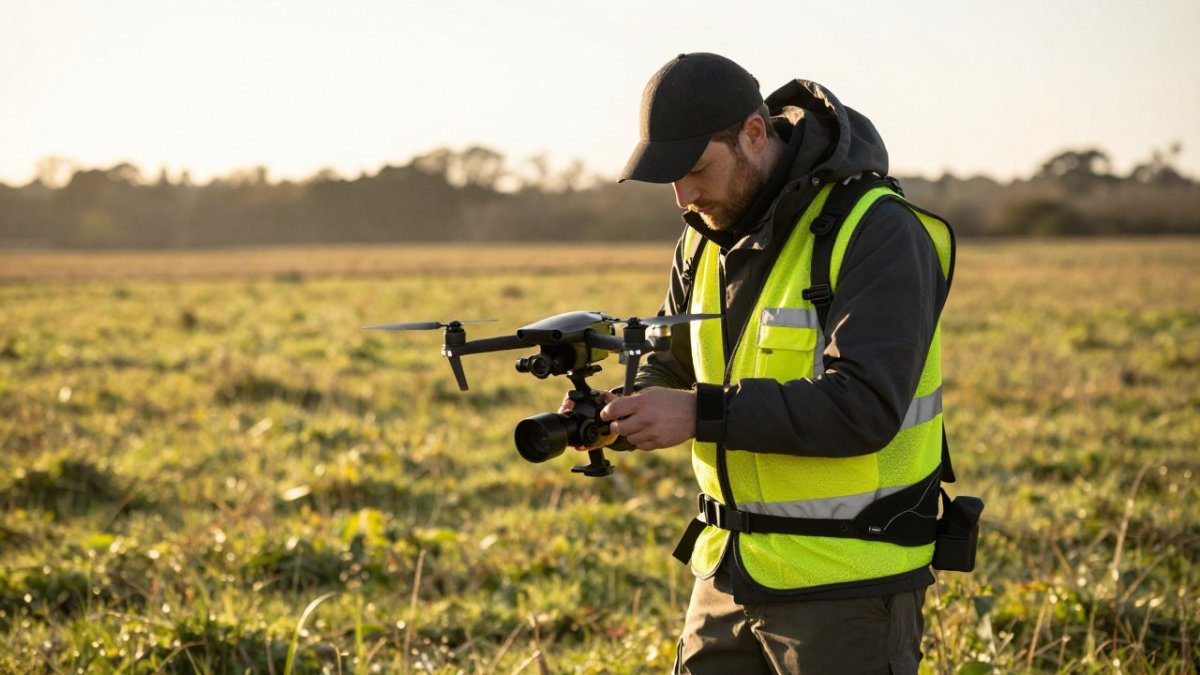
Image quality is where most commercial buyers should spend their attention. The camera determines whether your footage looks like a professional deliverable or a hobbyist clip.
Sensor size, resolution and low-light performance
A larger sensor generally captures more light and produces cleaner images in dim conditions, such as early mornings or overcast days on a construction site. Resolution matters for cropping and for large print work, but it is not a substitute for sensor quality. For most commercial video, 4K capability is the practical baseline, and the sensor should hold detail in shadow areas rather than turning them to noise.
RAW capture, dynamic range and colour accuracy
RAW capture gives editors far more latitude than compressed JPEGs. It lets you recover highlights in a bright sky and lift shadows on a building facade without visible damage. Dynamic range determines how much detail survives in those extremes. Colour accuracy matters for property and advertising work, where clients will compare the footage with the actual site.
The table below summarises the camera considerations covered in this section.
| Feature | Why it matters | Practical note |
|---|---|---|
| Sensor size | Captures more light in dim conditions | Helps on early mornings and overcast days |
| Resolution | Useful for cropping and large prints | Not a substitute for sensor quality |
| 4K capability | Practical baseline for commercial video | Keep shadow detail rather than noise |
| RAW capture | Gives editors far more latitude | Recovers highlights and lifts shadows |
| Dynamic range | Determines detail kept in extremes | Test in conditions like your typical jobs |
| Colour accuracy | Clients compare footage with the actual site | Matters for property and advertising work |
The Best Drone for Commercial Photography by Budget and Skill Level
Budget and skill level should shape your choice together, but the useful question is not “what is the best drone?”, it is “what is the cheapest aircraft that will reliably deliver the work I actually sell?” That reframing turns a product comparison into a business decision, and it is the step most buying guides skip.
A practical decision framework for a photography business
Work through these five filters in order. Stop at the first aircraft that passes all of them; anything above that is a want, not a need.
- Deliverable resolution. List the highest resolution your clients actually require. Property portals and web listings rarely need more than 12-20 megapixels after cropping; large-format print and detailed survey work push higher. If 90% of your work is web and social, a 1-inch sensor with 20MP stills and 4K video will cover it.
- Typical lighting. If most shoots happen at golden hour or on overcast days, sensor size and dynamic range matter more than resolution. If you shoot midday construction progress, highlight recovery and RAW latitude matter more.
- Revisit frequency. Repeatable survey or progress work rewards geotagging, waypoint automation and consistent camera settings. One-off marketing shoots reward gimbal smoothness and colour science.
- Site access and transit. If you travel by train or carry kit between multiple sites in a day, a foldable sub-900g airframe changes your working day. If you work from a vehicle with an assistant, weight matters less.
- Pilot confidence. Be honest about your experience. A larger aircraft with a superior sensor is a liability if you cannot fly it confidently in wind or close to structures.
Matching equipment to client sectors and deliverables
A simple matrix helps you choose based on the jobs you actually book rather than generic rankings:
- Property and estate agency: bright, well-framed stills, smooth orbit and reveal video, consistent exposure across a sequence. Prioritise a 1-inch sensor, reliable gimbal and good low-light performance for interior-to-exterior transitions.
- Construction and infrastructure: repeatable, geotagged imagery over the same site every fortnight. Prioritise waypoint automation, stable hover, and a camera that holds detail in flat midday light.
- Tourism and hospitality: cinematic footage with wide dynamic range for grading. Prioritise 10-bit or log capture, ND filter compatibility and smooth manual exposure control.
Total cost of ownership and return on investment
Purchase price is the smallest part of the real cost. A business-focused cost model should include:
- Aircraft and controller: the headline figure.
- Spare batteries: budget for spares so that shoots are not limited by battery life.
- Storage and cards: high-speed microSD or SSD media, plus backup drives.
Watch out: buying for the best-case job rather than the typical one is the most common and most expensive mistake, a drone that excels at cinematic video may struggle with the repeatable, geotagged imagery a surveyor needs.
Pricing depends on quantity, dates and delivery. For current pricing on drone photography and video services, please contact Impact Aerial directly for a quote.
Flight Time, Portability and Reliability on Real Jobs
Flight time, portability and reliability are usually treated as spec-sheet items. In commercial work they are workflow variables: they determine how many chargeable shots you capture per site visit and whether you can complete a job without a second trip. A foldable airframe can make that balance easier to manage when travel and tight packing are part of the job, while Arc manage pro.com offers a useful next step in considering how portability shapes aerial photography.
Realistic flight time and battery planning
Manufacturer figures are quoted in still air at optimal temperature with no payload beyond the camera.
Plan a shoot around battery cycles, not minutes. A typical commercial visit involves a site survey, setup, several flight sequences and pack-down.
Watch out: cold weather cuts usable capacity noticeably, so winter shoots need more batteries or shorter sequences than the same job in summer.
Portability and transit
Portability matters most when you travel between sites. A foldable airframe that fits in a single case saves setup time and reduces the risk of damage in transit. If you work by train or on foot, total kit weight, aircraft, controller, batteries, landing pad and case, is the figure that matters, not the aircraft alone.
Reliability, support and firmware
Reliability is harder to judge before purchase. Ask about local support, parts availability and how the manufacturer handles firmware updates. A firmware release that grounds the fleet before a booked shoot is a business risk, so check whether updates can be deferred and whether rollback is possible.
An end-to-end commercial workflow
Equipment choices only pay off inside a repeatable workflow. A practical sequence for a commercial shoot looks like this:
- Site survey and permissions. Check airspace, temporary restrictions and landowner permission before the day. Confirm whether the site is in controlled airspace or near sensitive locations.
- Shot planning. Agree the deliverable list with the client and map each shot to a flight sequence and battery.
- Safe operation. Brief any assistants, set a landing zone, monitor wind and battery, and keep flight logs.
- Capture. Shoot RAW stills and log or 10-bit video where the deliverable needs grading latitude.
- Editing and delivery. Apply consistent colour correction, crop to client formats, and export client-ready files in the formats the client’s team can use.
- Handover and archive. Deliver via a shared link or drive, keep a backed-up archive, and record what was flown for future repeat visits.
A useful test before committing to any aircraft is to simulate a full working day: pack the kit, set up at a site, fly your standard sequence and pack down again. Note how long each stage takes and whether anything slows you down. That single rehearsal tells you more about whether an aircraft suits your business than any specification sheet.
Drone Photography for Property Marketing: What Makes the Footage Sell
Property marketing has its own requirements. Buyers and tenants respond to clear, well-lit imagery that shows the surroundings and the setting of a building.
Prioritise smooth, steady footage and consistent exposure across a sequence. Our UK commercial real estate drone photography guide shows what sells listings.
Editing finishes the job. Colour correction and careful cropping make the difference between usable footage and marketing material that converts.
Operator Qualifications and Permissions You Need Under UK CAA Rules
Before any commercial flight, you need the correct authorisation. Our article on legal requirements for flying drones over residential property explains the rules that apply to your shoot.
Permissions also depend on where you fly. Flying over people, close to buildings or in controlled airspace can require additional approval.
Insurance is equally important. Public liability cover protects your business and your clients if an incident occurs.
Booking Your First Commercial Drone Shoot With Impact Aerial
Once you have worked through these checks, the next step is putting them into practice.
Tell us about your sector, your deliverables and your timescale. You can find our Birmingham professional aerial photography service details and an overview of what a commercial shoot involves.
Ready to see what professional aerial footage can do for your projects? Get in touch with Impact Aerial to discuss your next shoot.
Frequently Asked Questions
What should I look for in a drone for business photography?
Prioritise a large camera sensor for clean detail and low-light work, a camera that records RAW files for editing flexibility, a gimbal for stable footage, and enough flight time to complete a shoot without swapping batteries mid-job. Check that the model is supported for commercial use under UK CAA rules and that the manufacturer offers reliable spares and support. Match the choice to the deliverables you sell, whether that is stills for listings, video for campaigns or surveys for site monitoring, rather than buying on headline megapixel count alone.
How much should a business spend on a photography drone?
Pricing varies widely depending on the aircraft, the camera payload, the number of batteries and accessories, and whether you also need training and insurance. Rather than budgeting on the purchase price alone, factor in spare batteries, storage, editing software, maintenance and the cost of certification. Impact Aerial does not publish fixed rates for equipment, so pricing depends on quantity, dates and delivery. Visit the Impact Aerial website or request a quote for current costs for your specific project.
Is it better to buy a drone or hire a professional drone operator?
Buying makes sense if you will fly frequently, have trained staff and can absorb the cost of maintenance, insurance and regulatory compliance. Hiring a specialist operator is usually more practical for occasional shoots, one-off campaigns or projects that need high-end equipment you would rarely use. A professional operator brings CAA-approved procedures, commercial liability cover and post-production skills, which are easy to underestimate when comparing equipment prices alone.
What permissions and qualifications may be needed to fly a drone for business?
Commercial drone work in the UK is governed by the Civil Aviation Authority. Operators generally need a GVC (General Visual Line of Sight Certificate) or equivalent qualification, a valid operating permission for the type of flight, and insurance covering commercial activity. Flights over people, near congested areas or beyond visual line of sight may need additional approvals. Always confirm the current requirements with the CAA before a job, as rules are updated periodically.

 2 Norton Drive, Wythall, Birmingham, B47 6HH Company registration number: 11138586. VAT Number: 366 9068 55


