
Last Updated: November 5, 2026
Quick Summary
Aerial property tours improve buyer engagement by letting purchasers explore a property remotely before committing to a viewing, which helps filter serious interest from curiosity. They sell the experience of a property rather than its price, so treat them as a lead-quality tool rather than a valuation lever.
- Homes with aerial photography sell 68% faster than those without, per RubyHome’s 2026 statistics.
- Research on 75,000 home sales found virtual tours improve accessibility but do not significantly boost sale prices.
- Stills do the scouting work in portal thumbnails and brochures, while video does the persuasion work.
- Track listing views, qualified enquiries, viewings booked and days to offer over a 90-day window.
- Confirm the operator’s CAA certification and proof of commercial liability cover before booking.
Table of Contents
- Do Aerial Property Tours Actually Sell Luxury Homes Faster?
- The Difference Between Drone Photography and Videography for Property Marketing
- How Aerial Tours Improve Buyer Engagement and Attract Qualified Leads
- CAA Drone Regulations for Residential Property Filming
- Best Practices for Luxury Real Estate Drone Videography
- The Psychology of Luxury Buyers and Lifestyle Marketing
- ROI Metrics for Luxury Agents: What to Track
- Booking an Aerial Property Tour That Earns Its Place in the Listing
- Frequently Asked Questions
Do Aerial Property Tours Actually Sell Luxury Homes Faster?
Homes with aerial photography sell 68% faster than those without, according to RubyHome’s 2026 real estate photography statistics. That single figure explains why so many premium listings now open with a drone shot. But at Impact Aerial, we think the honest answer to whether aerial property tours sell luxury homes faster is more layered than the headline suggests, and the research backs us up.
What the Sales Data Shows
The case for aerial imagery is widely discussed on velocity. Listings with video content are reported to receive substantially more enquiries (RubyHome, 2026), and properties marketed with virtual tours are reported to attract more views (Travvir, 2026). Aerial tours combine both: the drone establishes the property’s setting, then the tour lets buyers walk it remotely. For a country house where the grounds matter as much as the floor plan, that combination can shorten the qualification stage.
Where the Evidence Gets Thinner
Here is the part most guides skip. Research on 75,000 home sales found that virtual tours improve accessibility but do not significantly boost sale prices, and in some conditions may prolong time on market, per Harvard Business School Working Knowledge’s study. Aerial tours sell the experience of a property, not its price. Treat them as a lead-quality tool, not a valuation lever. For a practical walkthrough of how footage shortens listing timelines, see using drone footage to sell property faster.
The Difference Between Drone Photography and Videography for Property Marketing
Drone photography captures still aerial images, while drone videography records continuous moving footage, and the distinction matters because each serves a different stage of the buyer’s decision. Most guides stop there.
Stills do the scouting work: they appear in portal thumbnails, brochures and press packs, communicating scale and location in a single glance. A well-composed elevated still of a country house, approach drive, parkland and boundary line in one frame, does more qualification in a thumbnail than a paragraph of copy.
How the Two Formats Sequence Across a Campaign
A common pattern among luxury agents is a staged release. Hero stills can go live with the portal listing and the printed brochure, where they carry the widest reach. The cinematic tour can then be released to a registered buyer list, where the audience is already qualified.
This sequencing matters because the formats serve different roles. Stills work well for portal and print use, while a cinematic tour is usually treated as the anchor asset.
What Luxury Buyers Actually Watch
Aerial video earns its place when it answers questions that ground-level media cannot. For a country house, that means the approach and sense of arrival, the relationship between the main house and outbuildings, the extent and privacy of the grounds, and the surrounding landscape context.
Stills, by contrast, are better at the detail that video rushes past: the symmetry of a façade, the maturity of planting, the condition of a roof or driveway. A buyer scanning a portal on a phone will decide in seconds whether to tap; that decision is made on the still, not the video.
Deliverables to Specify in the Brief
A luxury brief should specify the deliverables in advance, including still count, tour length, aspect ratios for each platform, and what is included in the final edit. It should also specify the property’s lifestyle story, the amenities, the privacy, the setting, so the edit is built around that narrative rather than around the pilot’s favourite moves. Our drone videography for luxury properties guide covers the cinematic end of the craft in more detail.
Watch out: commissioning video and stills in different sessions or weather conditions can produce an inconsistent look that undermines premium positioning.
How Aerial Tours Improve Buyer Engagement and Attract Qualified Leads
Aerial tours can improve buyer engagement by letting purchasers explore a property remotely before committing to a viewing, which helps filter serious interest from curiosity. For luxury stock, where a physical viewing takes considerable time for both agent and buyer, that filtering effect can be valuable.
Remote Viewing and 24/7 Accessibility
International and relocating buyers can view at their own convenience, in any time zone. That round-the-clock accessibility matters in the luxury sector, where many buyers report preferring virtual tours when browsing.
The mechanism behind that accessibility is qualification. A buyer who has already viewed the grounds and the approach arrives at a physical viewing with a clearer sense of fit, so the viewing can become a confirmation rather than a discovery exercise.
Showing Property Scale, Layout and Location Context
Ground-level photography can present an estate as a sequence of rooms. An aerial tour can show the relationship between house, grounds and surroundings, and location context becomes visible quickly. Our drone virtual tours for real estate guide covers how to structure that narrative.
Integrating the Tour with Lifestyle Marketing
Aerial footage can be most useful when treated as part of a lifestyle campaign rather than a standalone asset. A single flight can supply imagery for several uses, such as brochures, portal listings and social media, all carrying a consistent visual identity.
The lifestyle angle is where aerial media outperforms ground photography. A flight that shows the property in relation to a village, a private estate, a golf course, a coastline or a transport link tells a buyer what the property is part of, not just what it contains.
Attracting Qualified Leads Rather Than Browsers
The distinction between a view and a qualified lead is the difference between a vanity metric and a pipeline metric.
A common pattern is to gate the full tour behind a short enquiry form or to release it only to registered buyers. This trades reach for qualification, and for luxury stock that trade is usually correct: a smaller pool of proceedable buyers is worth more than a large pool of curiosity.
Measuring Engagement That Matters
Track the metrics that map to the funnel rather than to the platform. Completion rate on the tour indicates whether the edit holds attention, enquiries per hundred tour views indicate audience quality, and viewings booked per enquiry indicate whether qualification is working. If views rise but viewings do not, the footage may be attracting browsers rather than buyers, which is often a targeting question rather than a production one.
CAA Drone Regulations for Residential Property Filming
Filming a residential property commercially generally requires a pilot holding the appropriate Civil Aviation Authority (CAA) certification, and flights in congested areas or near people may require additional permissions. Compliance with these regulatory frameworks ensures that the visual presentation of a property remains professional, much like the careful preparation involved in exterior home staging.
Operators without the right certification can create problems for a shoot, including disruption or a privacy complaint from a neighbour. Before booking anyone, it is sensible to ask for their certification and proof of commercial liability cover. Our guide to getting a drone filming permit explains the process in full.
Best Practices for Luxury Real Estate Drone Videography
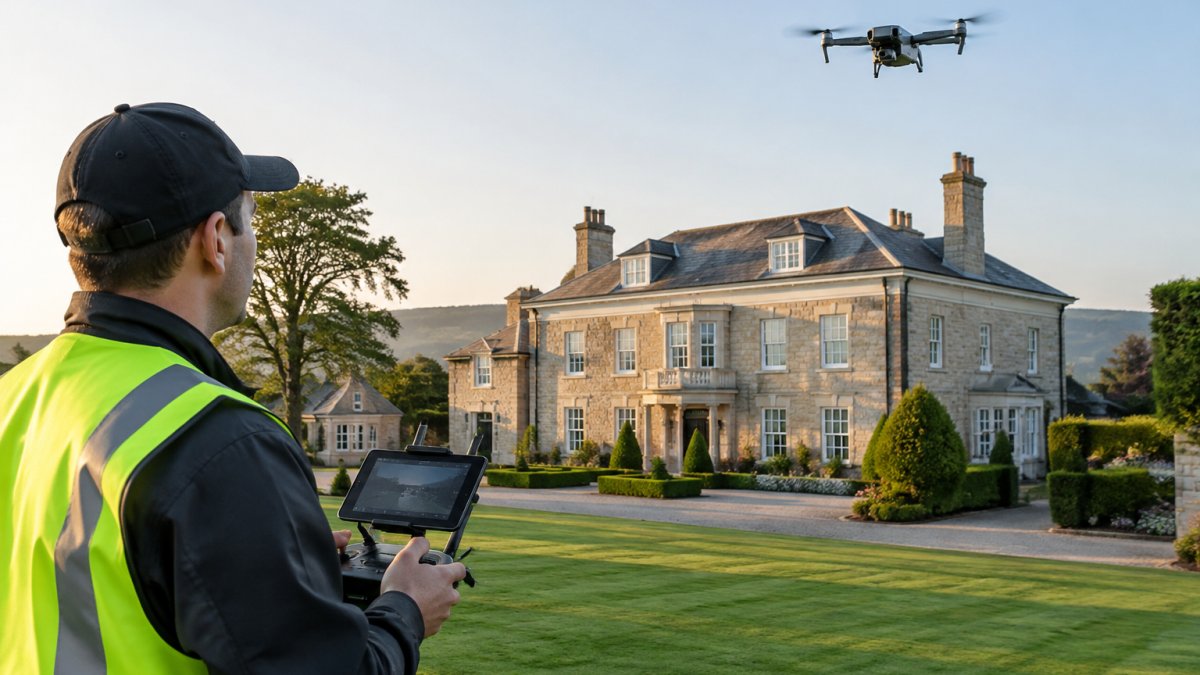
Luxury real estate drone videography works best when the flight is planned around the property’s story rather than the pilot’s convenience. Practical rules to consider:
- Fly at golden hour for long shadows and warm elevation tones
- Open wide to establish grounds, then descend to details
- Keep moves slow and deliberate; speed reads as cheap
- Capture stills and video in the same session for consistency
- Avoid identifiable neighbours’ windows and private gardens
A common mistake is treating the drone as a novelty. A tightly edited sequence that reveals the approach, the grounds and the setting can communicate the lifestyle more effectively.
The Psychology of Luxury Buyers and Lifestyle Marketing
Luxury buyers purchase identity and privacy as much as square footage, and aerial footage speaks to both. A drone shot showing uninterrupted grounds and screened boundaries answers the unspoken question: can I be left alone here? That is why aerial imagery works so well as lifestyle marketing. It sells the morning view, the seclusion, the sense of arrival, rather than the number of bedrooms.
ROI Metrics for Luxury Agents: What to Track
Track four numbers: listing views, qualified enquiries, viewings booked, and days to offer. Compare each against your ground-photography baseline over a 90-day window. Views and enquiries tell you whether the aerial assets are earning attention; viewings and days to offer tell you whether they are converting. If views climb but viewings do not, your footage is attracting browsers rather than buyers. That is a targeting problem, not a production one.
Four numbers are worth tracking against your ground-photography baseline over a 90-day window.
| Metric | What it tells you |
|---|---|
| Listing views | Whether the aerial assets are earning attention |
| Qualified enquiries | Whether the aerial assets are earning attention |
| Viewings booked | Whether the aerial assets are converting |
| Days to offer | Whether the aerial assets are converting |
Booking an Aerial Property Tour That Earns Its Place in the Listing
When booking an aerial property tour, it is sensible to confirm the operator’s CAA certification, agree the shot list in advance, and schedule around weather and light. It can also help to ask for a sample edit from a comparable property. A commercial operator should be able to provide its certification and insurance details. When you are ready to compare providers, see our guidance on hiring a commercial drone operator.
Frequently Asked Questions
Do aerial property tours increase the sale price of luxury homes?
The evidence is mixed. Research on 75,000 sales from Harvard Business School found virtual tours did not significantly lift final prices and could extend time on market in some conditions. Treat aerial property tours as a tool for speed and reach rather than a guaranteed price uplift, and judge them on viewings booked and days on market.
Are drone operators required to have CAA permission for residential filming?
Yes. Filming over residential property in the UK falls under Civil Aviation Authority rules, and commercial work requires a flyer holding a General Visual Line of Sight Certificate (GVC) and operating under a specific category. Operators must also respect privacy and data protection law when capturing homes and neighbouring land. Before booking, ask for the pilot’s GVC status, insurance cover and how they handle permissions over neighbouring property.
What is the difference between drone photography and videography for property marketing?
Drone photography produces stills for listing portals, brochures and press, and a handful of strong frames can carry a whole campaign. Drone videography adds motion, reveal shots and FPV fly-throughs that suit social media and cinematic previews. Most luxury listings benefit from both: stills do the search and press work, while video drives enquiries, which Third-party reporting suggests can be substantially higher for listings with video content.
How do aerial tours improve buyer engagement for high-value properties?
Aerial tours give buyers geographic context, show the full scale of a plot and let remote buyers view at any hour. Third-party reporting suggests listings with virtual tours can receive considerably more views, and that homes with aerial photography may sell faster. For high-value properties, that extra reach matters most with overseas and time-poor buyers who shortlist remotely before travelling to a viewing.
The difference between footage that sells and footage that decorates comes down to planning, certification and editing discipline. Impact Aerial brings over 20 years of aerial media experience, a fleet of 4K HDR DJI Enterprise drones flown by CAA GVC certified pilots, and £5m commercial liability insurance to every shoot. Get started with Impact Aerial and give your next luxury listing the visual presence it deserves.

 2 Norton Drive, Wythall, Birmingham, B47 6HH Company registration number: 11138586. VAT Number: 366 9068 55


