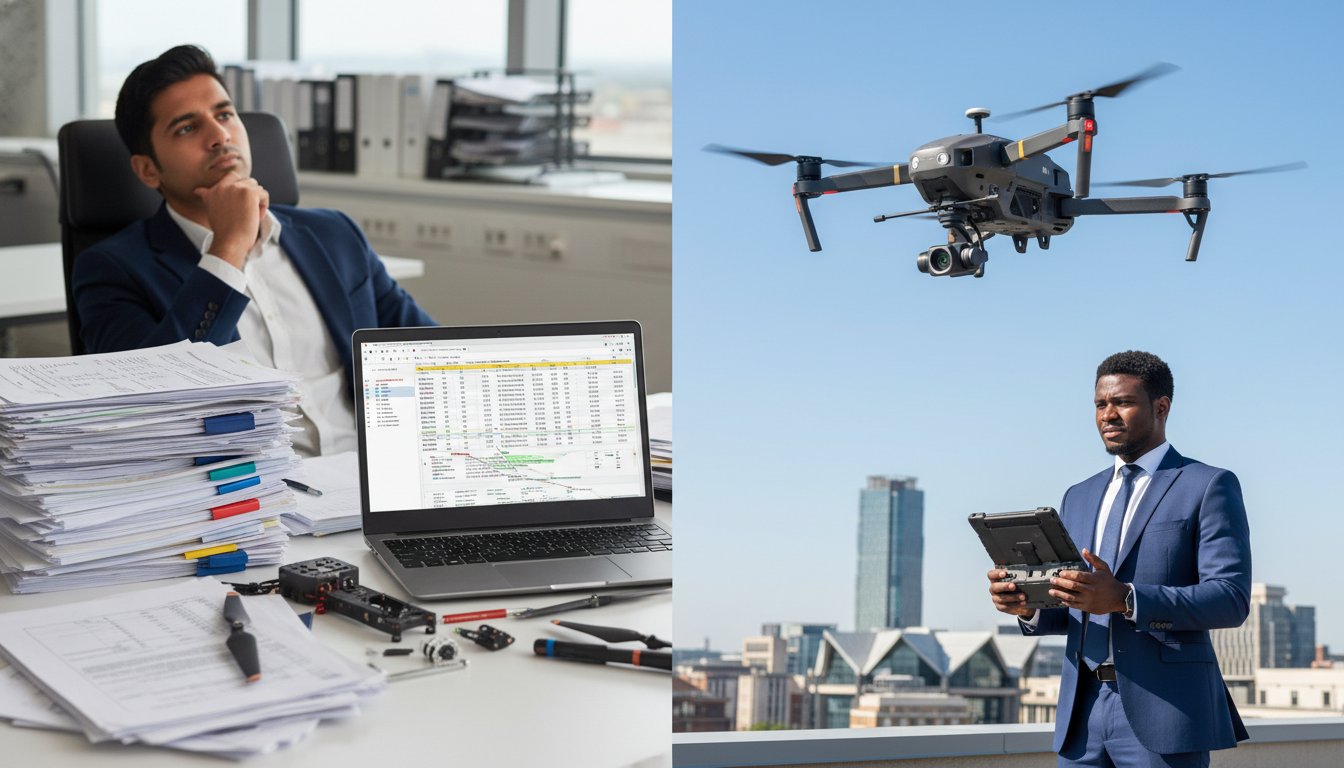
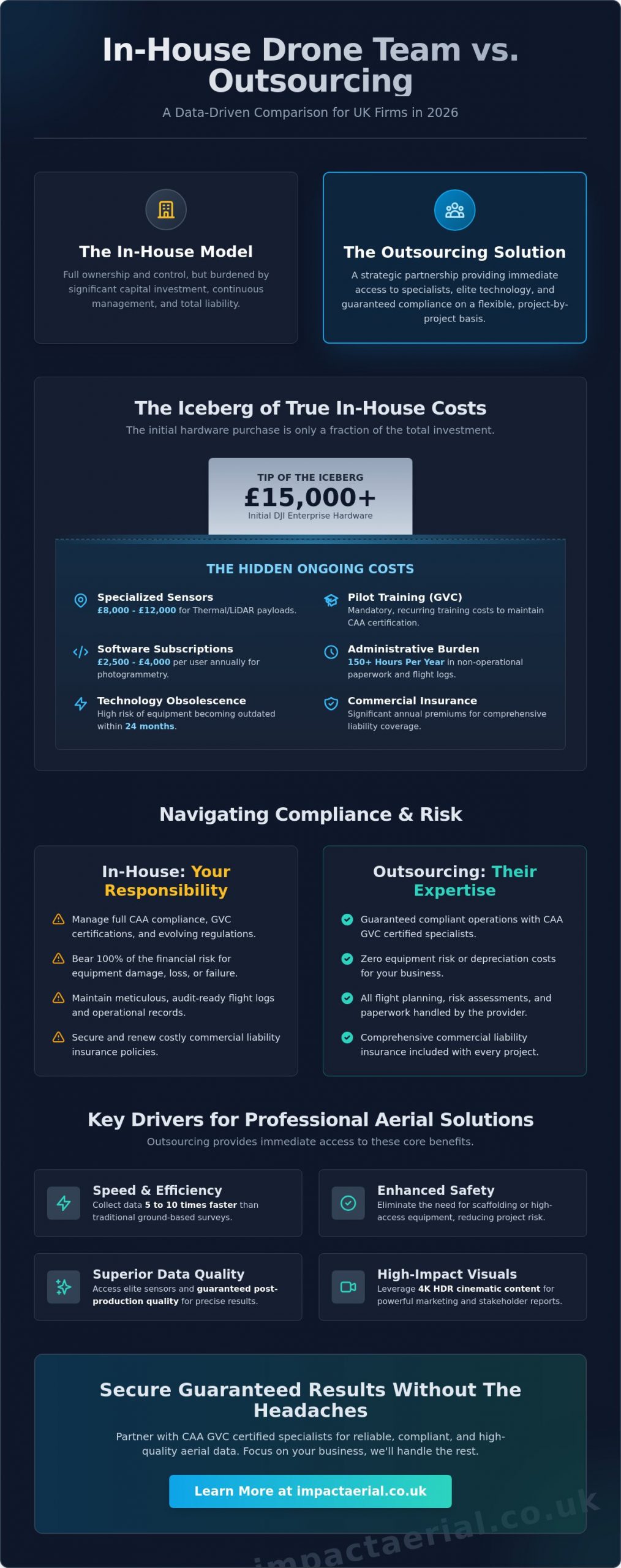
By 2026, the administrative burden of maintaining a UK Civil Aviation Authority (CAA) compliant drone department will consume over 150 hours per year in purely non-operational paperwork. You probably believe that bringing aerial operations under your own roof offers more control and lower long-term costs. However, when evaluating an in-house drone team vs outsourcing, it’s easy to overlook that the £5,000 to £10,000 initial investment in hardware is just the tip of the iceberg. Between mandatory GVC training, commercial liability insurance, and the risk of equipment becoming obsolete within 24 months, the internal model often creates more friction than it solves.
This guide delivers a data-driven comparison to help you make an informed choice for your specific operational needs. You’ll gain a clear understanding of current UK legal requirements and a transparent cost-benefit analysis of both approaches. We’ll explore how partnering with a professional service provider ensures consistent, high-quality results while providing the peace of mind that comes from guaranteed compliance. From photogrammetry to site surveys, you’ll learn how to secure the best aerial data without the hidden headaches of fleet management.
Key Takeaways
- Understand the significant upfront capital expenditure required for professional DJI Enterprise hardware and the hidden ongoing costs of advanced UK pilot training.
- Navigate the complex legal landscape of CAA compliance, including the mandatory GVC certification and the administrative burden of maintaining rigorous flight logs.
- Evaluate the strategic trade-offs of an in-house drone team vs outsourcing to determine which model offers the best ROI and operational safety for your firm in 2026.
- Discover how professional outsourcing provides immediate access to elite sensors and guaranteed data quality for drone surveys without the risk of equipment depreciation.
- Learn why partnering with CAA GVC certified specialists offers peace of mind through comprehensive liability insurance and expert-level post-production results.
In-House Drone Team vs Outsourcing: The 2026 Landscape
The role of the unmanned aerial vehicle (UAV) has undergone a radical transformation. What was once a niche gadget for enthusiasts is now a fundamental commercial data tool. For UK businesses in 2026, the debate between building an in-house drone team vs outsourcing has reached a critical point. An in-house drone team requires a substantial internal investment in specialized DJI Enterprise hardware, pilot training, and the management of complex Civil Aviation Authority (CAA) licensing. Conversely, outsourcing involves hiring specialized, CAA-certified operators who provide their own equipment and expertise on a project-by-project basis. The decision is no longer just about cost; it’s about managing the technical sophistication of modern aerial platforms.
To better understand the strategic differences between these business models, watch this helpful video:
The Current State of UK Drone Adoption
Drone adoption across the UK construction, property, and solar sectors has seen a 45% increase since 2024. The days of ‘hobbyist’ flying are over for commercial applications. UK regulations are now so stringent that casual operation doesn’t meet the legal or safety standards required for professional sites. Leading firms now rely on high-quality drone services to provide the technical accuracy needed for photogrammetry and site inspections. This shift ensures that data is gathered by experts who understand the nuances of the CAA GVC certification and carry the appropriate commercial liability insurance. For added peace of mind, professional operators manage the entire regulatory burden, from flight planning to risk assessments.
Key Drivers for Choosing Aerial Solutions
Speed of data collection is the primary motivator for UK businesses. Aerial methods are often 5 to 10 times faster than traditional ground-based surveys, allowing for rapid decision-making. Safety is another massive driver. Drones completely remove the need for personnel to use scaffolding or high-access equipment, which significantly lowers the risk profile of any project. Beyond technical data, the demand for high-end marketing visuals has never been higher. 4K HDR cinematic content is now the baseline for commercial property developers. These high-quality perspectives allow businesses to showcase developments with breathtaking clarity, providing a level of detail that ground-level photography simply cannot achieve. Whether it’s for a roof survey in Birmingham or a promotional film in London, the precision of 2026 aerial technology is transformative.
The True Cost of Building an In-House Drone Team
Establishing an internal drone department requires a significant financial commitment that extends far beyond the initial purchase of an aircraft. When weighing the pros and cons of an in-house drone team vs outsourcing, businesses must look at the total cost of ownership over a three-year cycle. While a consumer-grade drone might cost £1,500, these units lack the data precision and sensor reliability required for professional UK construction or surveying projects. A professional enterprise setup often starts at £15,000 for the airframe alone, excluding specialized payloads.
Hardware and Software Investment
Commercial operations require DJI Enterprise-level equipment, such as the Matrice 350 RTK, to ensure stability and accuracy. These systems integrate with high-spec thermal or LiDAR sensors that can cost an additional £8,000 to £12,000 per unit. Beyond the hardware, the “Technology Trap” creates a cycle of continuous spending. You’ll need to budget for:
- Data Processing: Annual subscriptions for photogrammetry software like Pix4D or DroneDeploy typically range from £2,500 to £4,000 per user.
- Computing Power: Processing high-resolution 4K imagery requires high-spec workstations with dedicated GPUs, often costing £3,000 per unit.
- Maintenance: Intelligent Flight Batteries have limited life cycles and cost approximately £500 each; a standard mission set requires at least six batteries to maintain a continuous workflow.
Personnel and Training Realities
The human element is the most expensive component of any drone program. Hiring a dedicated, CAA GVC certified pilot in the UK involves a salary commitment of £35,000 to £55,000 depending on their technical expertise in data-gathering. If you choose to train existing staff, you face the “lost time” cost where highly skilled engineers or surveyors spend hours on flight planning and risk assessments instead of their primary roles. To maintain operational safety and technical proficiency, an internal pilot must commit to a minimum of 40 hours of logged flight time and simulated emergency drills annually.
Administrative overhead adds another layer of complexity. Every flight requires a detailed Risk Assessment Method Statement (RAMS) and meticulous logging to remain compliant with Civil Aviation Authority (CAA) regulations. Managing these logs and staying updated on evolving UK airspace restrictions takes up roughly 15% of a pilot’s working week. For many West Midlands firms, utilizing professional drone services eliminates these logistical burdens and provides immediate access to high-end sensors without the capital risk. This approach ensures you only pay for the data you need, rather than maintaining a fleet of depreciating assets that may become obsolete within 24 to 36 months.
The Regulatory Burden: CAA Compliance and Liability
Operating a commercial drone in the UK isn’t a hobby; it’s a disciplined branch of aviation. When weighing up an in-house drone team vs outsourcing, the sheer volume of administrative oversight often tips the scales. You aren’t just buying equipment. You’re adopting a rigorous legal framework governed by the Civil Aviation Authority (CAA) that requires constant monitoring and updates.
CAA GVC Certification and Beyond
The transition from the old PfCO to the GVC (General Visual Line of Sight Certificate) is now complete. For any complex commercial site work, an A2 CofC is rarely sufficient. You’ll need a full GVC to secure the necessary Operational Authorisation from the CAA. This process involves more than a one-off drone license; it requires the creation and maintenance of a bespoke Flight Operations Manual (FOM).
This FOM is a living document. It must detail your specific emergency procedures, pilot competency records, and technical specifications for every aircraft in your fleet. In 2026, the CAA expects these logs to be digital, precise, and available for inspection at any time. Failing to keep these records up to date can result in the immediate suspension of your flight permissions, rendering your expensive hardware useless.
Managing Aviation-Grade Liability
Standard business insurance policies don’t cover aerial accidents. Commercial operators must hold specialist insurance that meets EC 785/2004 requirements. We recommend a minimum of £5m in commercial liability insurance for construction and industrial sites. This provides peace of mind when operating near high-value assets or public infrastructure. Without it, a single technical glitch could lead to a catastrophic financial claim that your standard public liability insurance will simply reject.
The legal chain of command is also unforgiving. If a drone fails, the responsibility rests with the UAS Operator (the business entity), not just the individual pilot. For flights in congested areas like Birmingham, operators must conduct detailed ground risk assessments and maintain strict 30-metre safety cordons from uninvolved persons. This level of planning is mandatory to avoid the heavy fines the CAA now levies against unauthorised or unsafe flights.
Choosing the in-house drone team vs outsourcing path means deciding if your staff has the capacity to log every minute of flight time and battery cycle. Outsourcing transfers this entire regulatory burden to a certified specialist, ensuring your project stays compliant without the internal paperwork headache.
When to Outsource: Strategic Advantages for UK Firms
For many UK enterprises, the decision regarding an in-house drone team vs outsourcing often hinges on the balance between operational control and capital efficiency. Outsourcing allows firms to bypass the significant upfront investment required for enterprise-grade hardware. A high-specification drone setup, such as the DJI Matrice 350 RTK equipped with thermal or LiDAR sensors, can easily exceed £25,000 in initial costs. By partnering with a specialist, businesses access this elite technology without the risk of rapid equipment depreciation or the ongoing expense of maintenance and firmware updates.
Scalability represents another critical advantage. A construction firm with projects spanning from Birmingham to Glasgow can’t easily deploy a single internal pilot to multiple sites simultaneously. Professional service providers maintain nationwide networks, enabling them to mobilize multiple teams for concurrent projects without increasing your permanent headcount. This approach ensures that every project benefits from guaranteed data quality. Professional pilots produce superior drone survey results because they fly daily, not just occasionally between other duties.
The administrative burden of drone operations is also a major factor. Managing an internal fleet requires constant oversight of flight logs, battery health, and CAA-mandated operational manuals. Outsourcing removes this friction entirely, as the service provider manages all logistics and technical upkeep.
Consistency and Expert Post-Production
The gap between raw data and actionable insights is often where internal teams struggle. Professional providers deliver sophisticated 3D modeling and photogrammetry that require high-end processing power and specialized software licenses. For marketing departments, specialized providers handle complex aerial filming drone projects to achieve a cinematic finish. There is a vast difference between shaky, raw footage and the polished, colour-graded assets required for high-stakes property development pitches.
Risk Mitigation and Peace of Mind
Operating drones in the UK involves complex legal frameworks. When you outsource, you transfer all flight-related liability to the service provider. They carry specialist commercial drone insurance, often with £5 million to £10 million in public liability coverage. You don’t need to worry about the latest changes to GVC or A2 CofC regulations; your provider ensures 100% compliance. This allows your staff to focus on their core competencies, such as asset management or civil engineering, rather than aviation management.
Partnering with Impact Aerial for Professional Drone Services
Deciding between an in-house drone team vs outsourcing is a pivotal strategic choice for UK businesses in 2026. Impact Aerial simplifies this transition by providing a turnkey solution that eliminates the need for internal overhead, training, and equipment maintenance. Based in Birmingham and serving clients across the UK, our pilots are fully CAA GVC certified. This certification serves as a primary marker of our commitment to legal compliance and operational excellence. We don’t just fly; we manage the entire lifecycle of your aerial project. This full-service approach covers everything from the initial technical consultation to the final delivery of expert post-production assets.
Safety is the foundation of our operations. For added peace of mind, we carry £5m commercial liability insurance as standard on every project. This level of protection is often a significant financial barrier for internal teams to maintain. We invest heavily in the latest hardware, utilizing a fleet of 4K HDR DJI Enterprise drones. These machines are built for the rigours of commercial work, offering superior data accuracy and high-resolution sensors that consumer-grade drones simply cannot match. By outsourcing to us, you gain immediate access to this top-tier technology without the capital expenditure.
Expertise Across Diverse Sectors
Our experience spans a niche but increasingly diverse market, allowing us to provide tailored data for various industries. We deliver specialized surveys for the property, construction, and solar sectors, where precision and technical data-gathering are non-negotiable. For clients focused on marketing and brand identity, we provide high-end drone photography that captures breath-taking perspectives for advertising campaigns. Our team also specializes in:
- Bespoke Virtual Tours: Creating immersive digital experiences for commercial property developers.
- 3D Data Collection: Utilizing photogrammetry to create accurate digital twins of construction sites.
- Thermal Inspections: Identifying heat loss or structural defects in large-scale industrial assets.
Getting Started with Impact Aerial
We remove the logistical and regulatory burden of aerial operations from your business. Our team handles all flight planning and site-specific risk assessments, ensuring every mission complies with the latest Civil Aviation Authority regulations. This meticulous planning is essential for operations in complex urban environments like Birmingham or London. Our transparent pricing model allows you to achieve professional results without the hidden costs of software subscriptions or hardware depreciation.
Impact Aerial provides the reliability and precision required to make your project a success. Whether you need a one-off inspection or a long-term data-gathering partner, we offer the technical expertise to deliver. Contact our West Midlands team today for a custom project consultation. We’ll help you determine the most efficient way to integrate high-quality aerial data into your business workflow.
Future-Proof Your Aerial Operations for 2026
Navigating the 2026 drone landscape requires a strategic balance of financial foresight and regulatory precision. For many UK firms, the complex choice between an in-house drone team vs outsourcing becomes clear when you factor in the high capital expenditure for enterprise-grade hardware and the continuous burden of CAA GVC compliance. Managing internal liability and detailed flight logs can often distract from your primary business objectives. Outsourcing eliminates these overheads while providing immediate access to the latest 4K HDR data-gathering technology and expert flight planning.
Impact Aerial offers the professional reliability your projects demand. We provide peace of mind through our Birmingham-based team of experts who maintain full CAA GVC Certification and carry £5m in commercial liability insurance. This ensures every operation is legal, safe, and meticulously executed. Our UK-wide coverage means you get high-quality aerial data and breathtaking perspectives without the administrative weight of an internal department. Don’t let regulatory hurdles slow your growth; let us handle the technical complexities while you focus on results.
Request a professional drone service quote from Impact Aerial today
We look forward to helping you elevate your next project with precision and safety.
Frequently Asked Questions
Is it legal for my employees to fly a drone for work without a license?
No, your employees cannot fly drones for commercial purposes without meeting Civil Aviation Authority (CAA) requirements. Every business must have an Operator ID, which costs £11.13 annually as of 2024, and pilots must hold a Flyer ID. For most professional tasks, your staff will need a specific qualification like an A2 CofC or a GVC to ensure they operate within UK law and safety regulations.
How much does it cost to train an in-house drone pilot in the UK?
Training a single pilot for a General Visual Line of Sight Certificate (GVC) typically costs between £500 and £800 for the course and examination. You should also budget for the annual Operational Authorisation fee paid to the CAA, which is currently £290 for new applications. These figures don’t include the indirect costs of staff downtime during the three to five days required for study and flight assessments.
What insurance do I need if we operate drones internally?
UK law requires commercial drone operators to have insurance that is compliant with EC 785/2004. Standard public liability insurance often excludes aviation, so you’ll need a specialist commercial drone policy. Most enterprise clients require a minimum of £1 million to £5 million in public liability coverage to provide peace of mind during high-risk site surveys or inspections.
Can an outsourced drone team work on short notice for construction monitoring?
Professional drone service providers typically offer rapid deployment within 24 to 48 hours for urgent construction requirements. When comparing an in-house drone team vs outsourcing, external teams offer the advantage of scale. They can deploy multiple pilots to different sites simultaneously, whereas an internal team is limited by the number of trained staff on your payroll.
What is the difference between a GVC and an A2 CofC for business use?
The A2 CofC (Certificate of Competence) allows for “close to people” operations with smaller drones, while the GVC (General Visual Line of Sight Certificate) is the professional standard for complex commercial work. A GVC is mandatory if you intend to apply for an Operational Authorisation from the CAA. This allows you to fly heavier aircraft or operate in more restricted environments that are common in industrial sectors.
Will outsourcing drone services save my business money in the long run?
Outsourcing is usually more cost-effective for businesses conducting fewer than 30 flight days per year. Maintaining an internal department requires a minimum initial investment of £5,000 for enterprise hardware like the DJI Matrice series, plus £1,500 annually for software and maintenance. Outsourcing eliminates these capital expenditures and removes the risk of hardware obsolescence in this fast-moving technology market.
How do I verify if a drone service provider is actually CAA certified?
You must ask the provider for their CAA Operational Authorisation document and their insurance certificate. Valid operators are often listed on the Drone Safe Register, which vets pilots for UK compliance. Checking these credentials ensures the provider is meticulous about safety and holds the necessary legal permissions to operate in your specific business environment.
What happens if a drone crashes on my site during a survey?
The pilot in command must follow the emergency procedures outlined in their CAA-approved operations manual, which includes securing the area and recording data for an incident report. If you use a professional service, their commercial liability insurance covers the costs of any third-party damage. This provides added peace of mind compared to internal operations, where your company would be directly liable for any legal or financial repercussions.
 2 Norton Drive, Wythall, Birmingham, B47 6HH Company registration number: 11138586. VAT Number: 366 9068 55