
Table of Contents
- Drone Photography vs Videography: What Each One Does Best
- Quick Comparison: Photography vs Video for Property Listings
- When Aerial Photos Close the Sale: Facts and Figures
- When Drone Video Sells the Lifestyle: Engagement Data
- The Right Drone Video Length for Property Marketing
- Best Practices for Property Drone Video That Converts
- CAA Drone Regulations for Estate Agents: Staying Legal
- Conclusion: Which Format Should Your Property Marketing Use?
- Frequently Asked Questions
Last Updated: September 8, 2026
Drone Photography vs Videography: What Each One Does Best
Choosing between drone photography vs videography for property marketing comes down to one question: are you documenting a building or selling a lifestyle? Aerial photos deliver the factual details buyers need, while drone video creates the emotional pull that gets them through the door. This guide from Impact Aerial, a UK-based aerial filming service with over 20 years in the industry, breaks down exactly when each format earns its place in your marketing budget.
The market has clearly embraced both. According to Pinnacle Real Estate Marketing’s 2026 industry guide, approximately 82% of real estate agencies now use drone technology in their marketing strategy. Yet many agents still treat the two formats as interchangeable. They are not. Drone photography is a factual tool; drone videography is a persuasion tool. Knowing which one a listing needs can be the difference between a property that lingers and one that sells.
Quick Comparison: Photography vs Video for Property Listings
Aerial photography excels at conveying factual information such as property lines, layout, and landscaping. Drone videography, by contrast, sells an “experience” and captures buyer attention through cinematic movement, as documented in Pinnacle’s 2026 analysis of drone video versus drone photos.
| Factor | Drone Photography | Drone Videography |
|---|---|---|
| Primary role | Factual documentation | Selling the lifestyle |
| Best for | Property lines, layout, roof condition | Cinematic fly-throughs, surroundings |
| Buyer impact | 68% more likely to sell | 403% more enquiries |
| Typical use | Listing portals, floor plans | Social media, premium campaigns |
| Production time | Faster turnaround | Longer edit and post-production |
The table above summarises the practical split. Photos answer “what does this property include?” Video answers “what would it feel like to live here?” Both have their place, but they serve different moments in the buyer’s journey.
When Aerial Photos Close the Sale: Facts and Figures
Aerial photography is the workhorse of property marketing, and the data backs its effectiveness. Homes displayed with aerial shots are 68% more likely to sell compared to those without, according to the National Association of REALTORS®. That figure alone justifies adding drone stills to most listings.
The value of aerial photos increases with property value. Research from V1 Drone Media shows drone usage for marketing rises for listings valued at £600,000 and above, where buyers expect a professional presentation of the full site. For these properties, a single high-resolution aerial shot can communicate boundary lines, garden size, parking, and neighbouring context in a way ground-level photography simply cannot.
What most guides miss is that photos remain essential even when you invest in video. Listing portals and property search filters still display stills as the primary browsing format. A strong set of aerial photographs ensures your property stands out in the initial scroll, before a buyer ever presses play on a video.
When Drone Video Sells the Lifestyle: Engagement Data
Drone video is where the emotional connection happens. Listings that incorporate video content receive 403% more enquiries compared to those that do not, reports RubyHome’s real estate photography statistics. For premium properties, that engagement translates directly into more viewings and stronger offers.
The shift in 2026 is clear: static imagery is increasingly reserved for factual representation, while video is prioritised for selling the lifestyle experience. A cinematic fly-over that sweeps from the street, rises over the roofline, and glides across the garden tells a story that a photograph album cannot match.
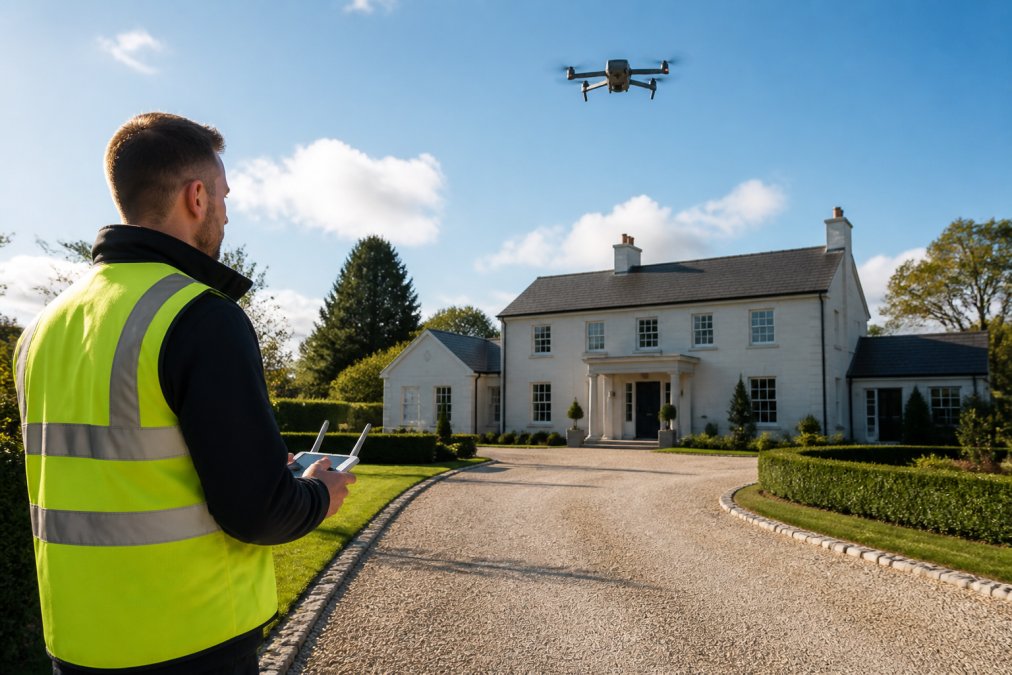
Video also handles the spaces photography cannot reach. For exterior amenities, site layout, and neighbourhood positioning, drone footage provides spatial context that flat images lack. The SkyeBrowse analysis of aerial data integration confirms that combining drone footage with 3D tours delivers a richer sense of a property’s position and condition.
The Right Drone Video Length for Property Marketing
The ideal drone video length for property marketing is 60 to 90 seconds for most listings. This window is long enough to showcase the property and its surroundings, yet short enough to hold a buyer’s attention through to the end.
Platform matters as much as property type. Social media feeds reward brevity, so cut 30 to 45 second versions for Instagram and TikTok. Your website and listing portals can carry the full 90 second cut. For high-value commercial properties, extending to two minutes is acceptable when the footage covers extensive grounds or multiple buildings.
Keep the structure consistent. Open with an establishing shot that shows the property in context, move through the key exterior features, then finish with a smooth approach to the entrance. Buyers should finish the video feeling they have seen the whole site, not just the prettiest angle.
Best Practices for Property Drone Video That Converts
The best practices for property drone video centre around motion, pacing, and purpose. Slow, controlled movements read as premium; fast pans and aggressive yaw read as amateur. Aim for gentle forward flights at low altitude, then reveal the full site with a gradual climb.
The market for these services is growing. The real estate drone photography service market is projected to grow at a compound annual growth rate of 6.9% between 2026 and 2033, according to LinkedIn’s market analysis. That growth means more listings will feature aerial content, so quality becomes the differentiator.
Shoot for the edit, not the scene. Capture 20 to 30 seconds of continuous footage for each planned shot, then cut ruthlessly in post-production. A 90 second final video typically draws from 15 minutes of raw footage.
Lighting makes or breaks aerial video. Schedule flights for the golden hour, the first and last hour of daylight, when shadows add depth and facades warm up. Midday sun flattens detail and makes windows glare. If the property faces south, consider a morning flight for the front elevation and an evening flight for the rear garden.
CAA Drone Regulations for Estate Agents: Staying Legal
CAA drone regulations for estate agents are not optional, and the penalties for ignoring them are real. Any commercial drone operation, including marketing flights for property listings, requires an operator to hold the relevant permissions from the Civil Aviation Authority.
Commercial work falls under the Open Category or the Specific Category depending on the drone’s weight and the flight’s risk. Most estate agency marketing flights sit within the A2 or A3 sub-categories, which demand a valid flyer ID and operator ID. Flights near people, buildings, or congested areas require additional permissions and, in many cases, a licensed pilot with a GVC qualification.
Flying a drone over a property without the correct CAA permissions can result in fines and, in serious cases, prosecution. The operator, not the estate agent commissioning the work, carries the legal responsibility. Always verify that your provider holds valid CAA credentials and carries commercial liability insurance before they fly.
This is where hiring professionals pays for itself. A fully licensed team handles the regulatory burden, carries the insurance, and delivers footage that meets aviation safety standards.
Conclusion: Which Format Should Your Property Marketing Use?
The difference between drone photography and videography for property marketing is not about choosing one over the other. It is about deploying each where it works hardest. Use aerial photos to document the facts of the property and to perform in search listings. Use drone video to create the emotional pull that drives enquiries and viewings.
For most premium listings, the answer is both. A property marketed with aerial stills and a cinematic video outperforms one with either format alone. That is where professional execution matters, from CAA compliance to post-production polish.
At Impact Aerial, our fully trained and licensed CAA GVC pilots operate a fleet of 4K HDR DJI Enterprise commercial drones, backed by £5m commercial liability insurance. We bring over 20 years of aerial photography and videography experience to every property we shoot. Get started with Impact Aerial and give your listings the perspective they deserve.
Frequently Asked Questions
Is drone photography or videography better for selling a house?
Most agents use both because they serve different roles. Aerial photos communicate factual information such as plot size, layout, and landscaping, while drone video sells the lifestyle and captures buyer attention through movement. Listings with aerial shots are 68% more likely to sell, and those with video generate 403% more enquiries. For premium properties valued at £600,000 and above, drone marketing becomes increasingly common. The strongest approach pairs high-resolution stills for portals with a short cinematic video for social media and email campaigns.
What are the CAA regulations for commercial drone use in property marketing?
Any drone flight for property marketing is commercial work, so it falls under the Civil Aviation Authority’s Open or Specific categories. The operator must hold a valid GVC qualification and the drone needs an Operator ID registered with the CAA. Flights must stay within visual line of sight, respect the 120-metre height limit, and maintain minimum distances from uninvolved people and properties. A competent commercial operator will also carry public liability insurance. Estate agents should confirm these credentials before booking rather than assuming a consumer drone licence is sufficient.
What is the ideal duration for a property marketing drone video?
The ideal length depends on where the video will be published. For property portals and social media, keep the edit between 60 and 90 seconds: long enough to show the external features, grounds, and surrounding area, but short enough to hold attention before viewers scroll past. For email campaigns or a dedicated property website page, a 2 to 3 minute cut allows more time to showcase key selling points. Always structure the video so the exterior and setting appear in the first 15 seconds, when retention is highest.
Do aerial videos increase engagement on property portals like Rightmove or Zoopla?
Yes. Industry data from 2026 shows listings that include video content receive 403% more enquiries than those without it. Aerial video is particularly effective at conveying the experiential side of a property: the approach, the garden, the views, and the relationship between the house and its surroundings. While portal stills remain essential for factual comparison, video is what stops a buyer scrolling and prompts them to click through. For higher-value properties, this engagement advantage becomes even more pronounced.
How much does professional drone videography cost for residential listings?
Professional drone videography is priced per project rather than per hour, so costs vary with the size of the property, the number of flights required, and the editing time involved. A single residential listing with one exterior shoot and a short edited video will cost less than a multi-location campaign or a large estate requiring several flights. For an accurate quote, contact the provider directly with the property’s location and your intended use for the footage. Most reputable operators will also outline what post-production is included in the price.
 2 Norton Drive, Wythall, Birmingham, B47 6HH Company registration number: 11138586. VAT Number: 366 9068 55


