What if the most hazardous and time-consuming task on your site could be completed with 1-3 cm horizontal accuracy without a single person setting foot on a high-risk face? For many site managers, the traditional approach to inventory and safety inspections is a slow process that often results in reconciliation errors. Relying on manual stockpile estimates isn’t just inefficient; it’s a liability. Integrating a professional drone survey for quarry management into your workflow changes this dynamic by delivering high-precision geospatial assets that bridge the gap between site safety and financial clarity.
We understand that maintaining operational continuity while meeting the strict demands of the Quarries Regulations 1999 is your top priority. You need data that is both defensible and actionable. This guide demonstrates how the latest 2026 aerial technology, from LiDAR-equipped Matrice systems to automated volumetric reporting, provides a safer and more cost-effective alternative to ground-based surveys. You’ll discover how to leverage precise 3D site models to eliminate downtime, satisfy stakeholders, and ensure your site remains at the forefront of industry compliance.
Key Takeaways
- Learn how DJI Enterprise hardware and RTK technology provide centimetre-level geospatial accuracy for complex, high-output quarry environments.
- Understand how a professional drone survey for quarry management ensures full compliance with the Quarries Regulations 1999 by removing personnel from high-risk faces.
- Discover the workflow for achieving precise weighbridge reconciliation through automated volumetric analysis and detailed 3D site modelling.
- Explore how high-resolution aerial filming and virtual tour creation streamline stakeholder reporting and support environmental reclamation initiatives.
The Evolution of Drone Surveys for Quarry Management
The modern drone survey for quarry management is a sophisticated, multi-layered data collection process. It has moved far beyond simple aerial snapshots. Today, professional operators use high-resolution sensors to capture millions of data points, creating a comprehensive digital record of the site. The Evolution of Drone Surveys has its roots in advanced remote sensing, allowing managers to analyze geological structures and material volumes with unprecedented detail. This shift from reactive photography to proactive geospatial mapping is fundamental for high-output UK quarries.
By moving to this data-centric approach, site managers can now support the “Digital Twin” concept. This involves creating a virtual replica of the physical quarry that evolves throughout its lifecycle. This model allows for precise planning of extraction phases, environmental monitoring, and infrastructure management. It’s an essential tool for long-term site viability and operational efficiency. The transition from basic photography to high-density LiDAR and photogrammetric mapping means we aren’t just looking at the site; we’re measuring it in three dimensions with surgical precision.
To better understand how precision is maintained on-site, watch this helpful video regarding ground control:
Overcoming Traditional Surveying Limitations
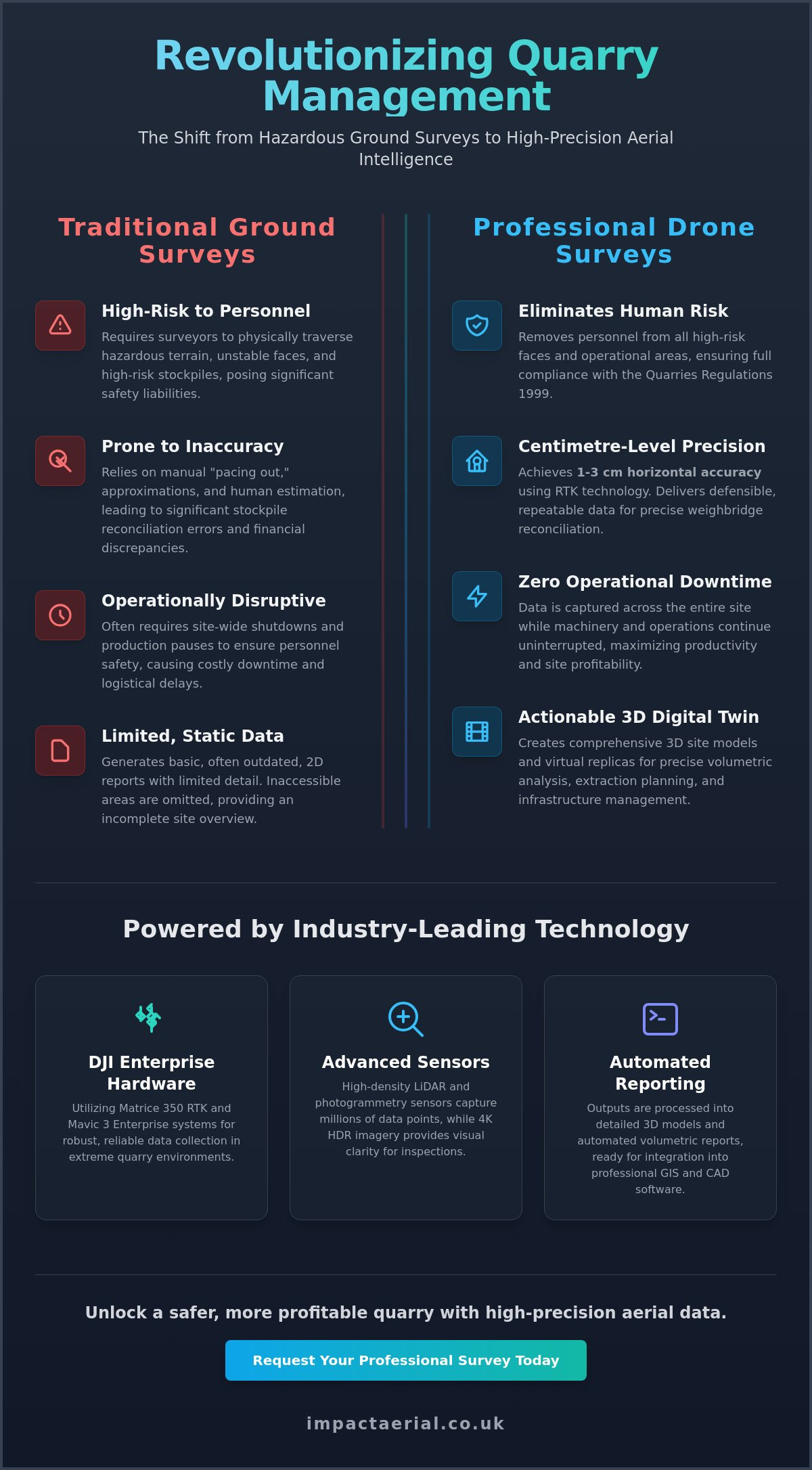
Traditional ground-based surveying is quickly becoming obsolete in modern industrial environments. Historically, surveyors had to physically traverse hazardous terrain, often requiring site-wide shutdowns or production pauses to ensure personnel safety. Drone technology eliminates these disruptions. We can now capture data across the entire site while machinery remains in operation. This approach also removes the human error associated with manual “pacing out” methods for stockpile estimation. Instead of relying on approximations, managers receive accurate, repeatable data from areas that were previously inaccessible, such as unstable faces or high-risk stockpiles.
Meeting Modern Industry Standards in 2026
In 2026, the standard for site documentation has reached a new level of technical sophistication. High-resolution 4K HDR imagery is now a baseline requirement for rigorous site documentation and compliance audits. These visuals provide the clarity needed for detailed face inspections and environmental monitoring. We align all aerial data with current UK geospatial standards for mining and excavation, ensuring that our outputs are ready for integration into professional GIS and CAD software. Essentially, we define drone quarry surveying as the integration of aerial photogrammetry with site-specific safety protocols. This technical synergy ensures that every flight contributes to both the safety and the profitability of the operation.
Technical Precision: DJI Enterprise Hardware and Data Collection
Achieving the highest levels of Technical Precision in a drone survey for quarry management requires more than just a standard aerial platform. It demands the DJI Enterprise ecosystem, specifically designed for industrial applications where environmental variables are extreme. By utilising platforms like the Matrice 350 RTK or the Mavic 3 Enterprise, we ensure centimetre-level geospatial accuracy through Real-Time Kinematic (RTK) technology. This system communicates directly with base stations or network corrections to eliminate the drift common in consumer-grade GPS. It’s this level of reliability that allows site managers to trust the resulting 3D models for critical financial and safety decisions.
Beyond positioning, the choice of sensor determines the quality of the geological data. High-resolution 4K HDR cameras, such as those found on the Zenmuse P1, capture fine-detail geological features and infrastructure wear that traditional methods might miss. These sensors provide the visual clarity needed to identify hairline fractures in rock faces or subtle erosion on haul roads. This level of detail is essential for maintaining a rigorous safety audit trail and supporting long-term site maintenance strategies.
Why Commercial-Grade Hardware Matters in Quarries
Quarries are notoriously difficult environments for flight. High winds, heavy dust, and magnetic interference from massive steel structures can compromise lesser equipment. DJI Enterprise models are built with IP-rated weather resistance and advanced redundancy systems, including dual vision and Time-of-Flight sensors on all six sides. This ensures the aircraft remains stable and safe even in the most exposed sites across the West Midlands and the wider UK. These platforms integrate seamlessly with professional surveying software, allowing for rapid data processing and a turnaround that keeps pace with high-output production schedules.
LiDAR vs. Photogrammetry for Topographical Mapping
Choosing the right sensor is as vital as the aircraft itself. We deploy LiDAR sensors, like the Zenmuse L3, when we need to penetrate thick vegetation on site boundaries or map areas obscured by heavy dust. LiDAR provides a high-density point cloud that can be “cleaned” to reveal the true ground level. Conversely, photogrammetry is the superior choice for high-detail 3D visual models and realistic textures. For the most complex sites, we often combine both methods to deliver a comprehensive drone survey that covers every technical requirement. Our team at Impact Aerial specializes in selecting the exact hardware configuration needed to meet your specific site objectives.
Safety Compliance and Volumetric Accuracy
The technical precision established in the hardware phase directly translates into tangible financial and safety benefits. A drone survey for quarry management provides the objective, repeatable evidence required to satisfy both internal financial auditors and external health and safety inspectors. While traditional methods rely on manual measurements that introduce risk and uncertainty, aerial data offers a comprehensive view of the entire site without placing staff in harm’s way. Research published by the Society for Mining, Metallurgy & Exploration demonstrates how integrated aerial data supports Safety Compliance and Volumetric Accuracy through systematic site analysis and risk mitigation.
By keeping personnel away from high-risk quarry zones, operators can significantly reduce the potential for RIDDOR incidents. High-resolution data allows for the documentation of face stability and blast patterns over time, creating a historical record that helps predict and prevent potential failures. This proactive approach to safety is no longer an optional extra; it’s a core component of modern quarry operations. We use these visual assets to identify rock mass discontinuities and monitor the effectiveness of blast designs, ensuring that every phase of the extraction process is documented and reviewed.
Stockpile Management and Tonnage Reconciliation
Achieving weighbridge reconciliation is often the primary financial driver for aerial surveying. Our software calculates stockpile volumes by comparing the current high-density point cloud against a known “base” surface or previous survey data. This automated volumetric analysis provides end-of-month inventory figures that are far more accurate than manual “pacing” or visual estimates. By comparing this drone data with weighbridge records, site managers can create rigorous audit trails and monitor extraction rates against planned production targets. This level of detail allows for better forecasting and ensures that stock levels are always accurately reflected in financial reporting.
Aligning with Quarries Regulations 1999
The primary legislation governing health and safety in the UK is the Quarries Regulations 1999. Aerial surveys support these regulations by providing visual evidence for mandatory site safety health checks and geotechnical assessments. Our CAA GVC certified pilots are trained to operate within these strict industrial safety protocols, ensuring every flight is compliant and low-risk. Beyond pilot certification, commercial drone insurance is non-negotiable for professional quarry operators. We maintain comprehensive liability coverage specifically tailored for industrial environments, providing the reassurance and reliability that site managers require for long-term partnership.
Advanced Data Visualisation for Stakeholders
Raw geospatial data is invaluable for site engineers, but its inherent complexity can often alienate non-technical stakeholders. A high-quality drone survey for quarry management bridges this communication gap by transforming dense point clouds and technical orthomosaics into immersive, interactive visualisations. We move beyond simple spreadsheets to provide board members and investors with a clear, visual understanding of site progress. By annotating 3D models with specific hazard identifiers and operational notes, we create a living document that supports internal safety reporting and strategic planning. These assets ensure that everyone, regardless of their technical background, understands the current status of the site.
Cloud-based platforms now allow for seamless data sharing across multiple UK quarry sites. This enables a regional manager to review the volumetric accuracy of a site in one county while based in a central hub elsewhere. It’s a level of oversight that was previously impossible without significant travel time and expense. These models aren’t static; they are dynamic assets that allow for precise hazard identification and the documentation of site-specific safety protocols in real-time. This digital accessibility fosters a culture of transparency and accountability across the entire management structure.
Virtual Tours as a Remote Management Tool
Immersive 3D tours provide a unique perspective for remote management. Stakeholders can virtually “walk the site” from any location, inspecting specific faces or equipment without the need for high-vis gear or site inductions. We integrate our survey data with virtual tour creation to deliver board-level reporting that is both engaging and technically accurate. These tours also serve as a vital historical archive. By comparing tours over months or years, you can track reclamation progress and environmental changes with absolute clarity. This evidence is crucial for maintaining social license and proving compliance with planning conditions.
Post-Production and High-Resolution Reporting
The value of professional aerial filming drone footage extends far beyond simple site monitoring. High-resolution cinematic video is an essential tool for planning applications and community PR projects. It allows you to demonstrate your commitment to environmental reclamation and site safety in a way that technical reports cannot. We provide custom report formats designed for internal auditing and environmental compliance, ensuring that non-technical stakeholders receive clear, concise data visualisations. This level of post-production ensures that your data is not just accurate, but also persuasive and easy to digest for those making high-level financial decisions.
If you need to improve your stakeholder communication through high-end data visualisation, contact us to discuss our professional drone data visualisations.
Partnering with Impact Aerial for Quarry Success
Choosing a partner for a drone survey for quarry management requires more than just finding a pilot with a camera. It involves selecting a technical consultant who understands the unique complexities of high-output industrial environments. From our central Birmingham hub, Impact Aerial provides comprehensive aerial data services to quarry operators across the entire UK. We don’t just capture imagery; we deliver an end-to-end service that spans from the initial site survey to professional post-production and data delivery. This holistic approach ensures that the volumetric accuracy and safety data you receive is ready for immediate integration into your management workflows.
Our team consists of fully CAA GVC certified pilots who possess extensive experience in industrial and mineral extraction sites. We understand that trust is the foundation of any commercial partnership. That’s why we maintain £5m in commercial liability insurance, providing complete peace of mind for site managers and owners. This high level of coverage reflects our commitment to professional standards and our understanding of the scale of the operations we support. We aren’t an aggregator or a generalist agency; we’re specialists dedicated to providing the technical precision your business demands.
A Safety-First Approach with CAA GVC Certified Pilots
Every project begins with a rigorous risk assessment tailored specifically to your active site. We recognize that quarries are dynamic environments where safety protocols are paramount. Our pilots work closely with site managers to ensure our operations have zero impact on your production cycles. We don’t require site shutdowns or pauses in machinery movement. By continuously investing in the latest DJI Enterprise technology, we guarantee data reliability while maintaining the highest safety standards. This meticulous planning ensures that we remain compliant with all current aviation and site-specific regulations.
Getting Started with Your Quarry Survey Project
Your journey toward optimized site management starts with a detailed initial consultation. We’ll define your specific data requirements, whether you need centimetre-level volumetric calculations for tonnage reconciliation or high-resolution 3D models for stakeholder reporting. Our scheduling is designed to be flexible, allowing us to match your production cycles and wait for the ideal weather windows to ensure data consistency. This bespoke approach ensures you get the exact geospatial assets you need without unnecessary overhead. You can discuss your drone survey project with our technical team today to request a quote and see how we can transform your site data.
Advancing Your Site Operations with Aerial Precision
The transition toward digital site management is a present necessity for competitive quarry operators. By integrating a professional drone survey for quarry management, you replace manual guesswork with centimetre-level accuracy and robust safety evidence. We’ve explored how DJI Enterprise hardware and immersive data visualisations provide the clarity needed for weighbridge reconciliation and compliance with the Quarries Regulations 1999. These tools don’t just improve your data; they protect your workforce and your bottom line.
Impact Aerial brings technical expertise and a safety-first mindset to every industrial project. Our team of CAA GVC Certified Pilots and DJI Enterprise Hardware Specialists is ready to transform your site data while providing the security of £5m Commercial Liability Insurance. We handle the technical complexities so you can focus on high-output production and strategic growth.
Book your professional drone quarry survey with Impact Aerial and take the first step toward a safer, more accurate future for your site.
Frequently Asked Questions
How accurate are drone surveys for quarry stockpile volumes?
RTK-equipped drones achieve 1-3 cm horizontal accuracy, which translates to volumetric calculations that are typically within 1-2% of actual totals. This high level of precision provides a reliable audit trail for weighbridge reconciliation and financial reporting. By using dense point clouds instead of manual approximations, a drone survey for quarry management eliminates the significant margins of error found in traditional “pacing” methods.
Do drone surveys require the quarry to stop production during the flight?
No, professional drone surveys do not require site shutdowns or production pauses. Because the aircraft operates at a safe altitude, it remains entirely clear of active haulage routes and heavy machinery. We coordinate closely with site managers to integrate our flight plans into your existing production cycles. This ensures you receive high-quality geospatial data without any impact on your daily output or operational efficiency.
What UK regulations govern the use of drones in active quarries?
Operations are governed by Civil Aviation Authority (CAA) regulations and the Quarries Regulations 1999. Pilots must hold a valid GVC (General Visual Line of Sight Certificate) to operate commercially in these environments. Additionally, as of 2026, all aircraft must adhere to specific UK class-marking and Remote ID requirements. We ensure every flight is fully compliant with these legal standards and your specific site safety protocols.
How often should a quarry conduct a drone survey for effective management?
Most high-output sites conduct a drone survey for quarry management on a monthly or quarterly basis. Monthly surveys are ideal for accurate end-of-month inventory and tonnage reconciliation. However, for safety-critical monitoring or tracking extraction rates in rapidly changing sections, some operators prefer more frequent inspections. Regular data collection allows for better forecasting and maintains a continuous historical record for safety audits.
Can drones help with quarry environmental reclamation and planning?
Drones provide essential visual and topographical data for environmental reclamation and planning applications. High-resolution orthomosaics allow managers to track vegetation growth and terrain restoration progress with absolute clarity over several years. This data is invaluable for proving compliance with planning conditions to local authorities. Immersive 3D models also help stakeholders visualize future reclamation phases during the initial planning and consultation stages.
What is the difference between LiDAR and photogrammetry for quarry mapping?
LiDAR uses laser pulses to penetrate vegetation and dust, making it superior for mapping ground levels in overgrown or obscured areas. Photogrammetry uses high-resolution overlapping images to create detailed 3D visual models and textures. While LiDAR is excellent for terrain modelling, photogrammetry is often the preferred choice for visual inspections and creating immersive virtual tours for stakeholder reporting and community PR.
Do I need special insurance to have a drone fly over my quarry site?
The drone operator must provide specialist commercial insurance that covers aerial operations. Standard business or public liability insurance rarely includes aviation risks. We maintain £5m in commercial liability insurance specifically tailored for industrial environments. This ensures that the quarry operator is fully protected against any aviation-related risks, providing the reassurance and reliability required for professional site management.
How long does it take to receive the processed survey data and reports?
Processed survey data and volumetric reports are typically delivered within 24 to 72 hours of the flight. While the raw data is captured in just a few hours, professional post-production and rigorous volumetric analysis require specialized software processing. This rapid turnaround ensures that site managers can use the data for immediate operational decisions, financial reconciliation, and internal safety reporting without delay.
 2 Norton Drive, Wythall, Birmingham, B47 6HH Company registration number: 11138586. VAT Number: 366 9068 55