
Table of Contents
- What You’ll Need Before Any Thermal Solar Inspection
- Solar Farm Drone Survey Regulations and CAA Compliance
- Drone Solar Inspection Workflow: From Flight Plan to Report
- Thermal Imaging Solar Panel Fault Analysis: Reading the Data
- Inspection Frequency and Timing: When to Fly
- Common Mistakes That Ruin Thermal Solar Inspection Data
- Frequently Asked Questions
Last Updated: 14 September 2026
What You’ll Need Before Any Thermal Solar Inspection
A thermal solar farm inspection is the practice of using a drone-mounted infrared camera to detect heat anomalies across photovoltaic modules, and thermal solar farm inspection best practices start before the drone leaves the ground. According to Averroes.ai’s 2026 drone solar panel inspection guide, drone-based methods cover 10 times more panels per hour than manual ground-level checks, which is why O&M teams have moved to aerial thermography as standard. At Impact Aerial, we’ve run these surveys across commercial arrays, and the difference between a useful dataset and a wasted flight almost always comes down to preparation.
Here’s the kit and groundwork every thermal solar farm inspection needs:
- A CAA-licensed remote pilot holding a General VLOS Certificate (GVC) and an operational authorisation covering the flight geography
- A thermal-capable airframe such as the DJI Matrice 350 RTK paired with a Zenmuse H20T hybrid sensor
- A radiometric thermal camera with adjustable emissivity and reflected temperature settings
- An irradiance meter to confirm solar loading before launch
- Site documentation: array layout, string maps, inverter locations, and known fault history
- Weather data covering cloud cover, wind speed, and dew point for the flight window
- A calibrated reference target for post-flight temperature validation
Flying without a documented pre-flight irradiance reading is the single most common way teams waste a survey. Thermal data captured below the IEC 62446-3 threshold of 600 W/m² is not thermally valid, and you will be re-flying the site.
Solar Farm Drone Survey Regulations and CAA Compliance
Solar farm drone survey regulations in the UK are enforced by the Civil Aviation Authority, and non-compliance carries real consequences for both the operator and the site owner. Commercial drone operations fall under the CAA’s specific category rules, which means you need an operational authorisation, not just a flyer ID. The CAA’s guidance on commercial drone operations sets out what a valid authorisation must cover.
Operational Authorisations and Flight Restrictions
A standard GVC authorisation permits flight within 120 metres of the surface and 50 metres of people not under your control, but solar farms often sit near substations, public footpaths, or grid infrastructure that complicate this. Larger arrays frequently require an Operating Safety Case that extends those limits.
What most guides miss is that the airspace classification matters as much as the site itself. Many utility-scale sites sit inside or near controlled airspace, and an authorisation for one site does not transfer to another.
Request the operator’s operational authorisation reference and insurance certificate before you book. A £5m commercial liability policy and a named CAA authorisation are the two documents that protect you if something goes wrong on site.
Drone Solar Inspection Workflow: From Flight Plan to Report
The drone solar inspection workflow runs through five stages: pre-flight planning, irradiance confirmation, automated capture, thermal processing, and fault reporting. Each stage has a defined output that feeds the next, and skipping any one of them undermines the final report.
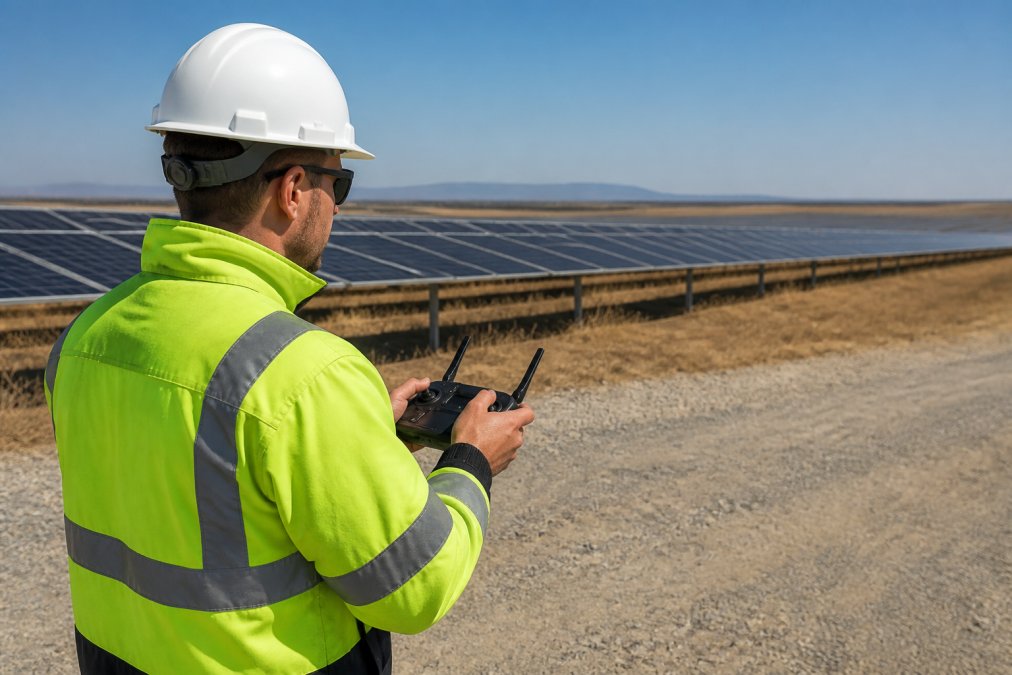
Accurate thermal data collection often reveals that performance degradation is caused by surface debris rather than hardware failure, necessitating a structured approach to solar panel cleaning to maintain optimal energy yields.
| Stage | Typical Duration | Key Output |
|---|---|---|
| Pre-flight planning | 1-2 hours | Flight plan and risk assessment |
| Irradiance confirmation | 15-30 minutes | Signed-off solar loading reading |
| Automated capture | 2-4 hours | Raw radiometric thermal dataset |
| Thermal processing | 4-8 hours | Annotated anomaly map |
| Fault reporting | 1-2 days | Prioritised maintenance schedule |
Pre-Flight Planning and Irradiance Checks
Capture only when panels are dry and irradiance holds above 600 W/m². Moisture, dew, and low solar loading distort thermal signatures, and Coptrz’s solar inspection guidance notes that readings taken in suboptimal conditions yield inaccurate data. Plan flights for the middle of the day, avoid the two hours after sunrise, and confirm dew has cleared before launch.
Thermal Imaging Solar Panel Fault Analysis: Reading the Data
Thermal imaging solar panel fault analysis identifies faults by comparing module temperatures against baseline expectations, and the pattern of heat tells you what has failed. A hot cell usually signals a short circuit or PID degradation. A uniformly warm module often points to a bypass diode failure or shading. Cooler-than-expected modules frequently indicate open circuits or disconnected strings.
According to ScienceDirect’s 2024 analysis of UAV thermal imaging for solar farms, the technique is promising but demands specific environmental conditions for accuracy. Thin-film modules complicate this further: Sitemark’s research on thin-film thermography shows their lower emissivity requires adapted workflows and different temperature thresholds than crystalline silicon.
Every anomaly needs a temperature delta, a location, and a severity rating before it reaches a maintenance schedule. A thermal image without a delta figure is a picture, not a diagnosis.
Inspection Frequency and Timing: When to Fly
Inspect utility-scale sites at least once a year, and commercial rooftop arrays twice. Industry best practice, per Sitemark’s 2026 solar inspection research, is annual drone thermography as a minimum, with additional flights triggered by performance data. If string-level monitoring shows a sustained yield drop, fly within the quarter rather than waiting for the calendar.
Timing within the day matters as much as frequency. The window between 11am and 3pm in summer, and a narrower midday band in winter, delivers the solar loading needed for valid readings. Early fault detection through thermal inspection can recover 2-5% of annual energy losses, so the cost of an extra flight rarely outweighs the generation it protects.
Common Mistakes That Ruin Thermal Solar Inspection Data
Flying in the wrong conditions is the mistake that ruins most datasets, and it tops the list of thermal solar farm inspection best practices to follow. Dew on panels, cloud passing mid-flight, or a launch before irradiance stabilises will produce anomalies that do not exist and miss faults that do. The second most common error is processing thermal data without emissivity correction, which skews every temperature reading on the report.
Three further mistakes recur across commercial projects:
- No string map overlay: anomalies cannot be assigned to a maintenance task without one
- Single-pass capture at low resolution: small hotspots vanish below the sensor’s spatial resolution
- Treating every anomaly as urgent: severity ranking prevents maintenance teams chasing false positives
Run a short calibration flight over two known-good modules before the main survey. Comparing their readings against your reference target confirms the camera settings are correct before you commit hours of flight time.
Frequently Asked Questions
What are the CAA regulations for drone solar inspections?
Commercial drone operations in the UK require a CAA Operational Authorisation, and pilots must hold a General Visual Line of Sight Certificate (GVC). Solar farm inspections often fall under specific category rules depending on site location and proximity to buildings or infrastructure. Operators must also carry appropriate commercial liability insurance. Impact Aerial holds CAA GVC certification and £5m commercial liability insurance, ensuring every thermal solar inspection meets current regulatory requirements.
How often should thermal solar farm inspections be conducted?
Industry best practice for utility-scale solar sites is a minimum of one drone thermography inspection per year, according to Sitemark (2026). Additional inspections are recommended based on site-specific performance data or after severe weather events. Early fault detection can significantly recover annual energy losses, so more frequent checks often justify the cost on larger arrays.
What equipment is required for professional solar thermal surveys?
A professional thermal solar inspection requires an enterprise-grade drone platform compatible with thermal sensors, such as the DJI Matrice 350 RTK paired with a Zenmuse H20T camera. RTK positioning provides centimetre-level accuracy for repeatable flight paths. Analysis software handles anomaly detection and reporting. The drone solar inspection workflow also needs a qualified pilot, appropriate CAA permissions and pre-flight irradiance monitoring equipment.
How does weather affect the accuracy of solar thermal inspections?
Thermal readings are highly sensitive to moisture, dew and solar loading. Inspections performed when panels are wet or under variable cloud cover yield inaccurate data (Coptrz, 2026). Industry best practice aligned with IEC 62446-3 requires a minimum irradiance of 600 W/m² during the inspection (Averroes.ai, 2026). Panels must be completely dry before flight operations begin. Scheduling flights during stable, clear conditions with consistent irradiance is essential for reliable thermal imaging solar panel fault analysis.
Thermal inspection only pays off when the data is valid, the pilot is authorised, and the report drives real maintenance decisions. Impact Aerial provides CAA GVC-certified pilots, a fleet of 4K HDR DJI Enterprise drones, £5m commercial liability insurance, and full post-production reporting for solar O&M teams. Get started with Impact Aerial and turn your next array survey into an actionable fault schedule rather than a folder of images.
 2 Norton Drive, Wythall, Birmingham, B47 6HH Company registration number: 11138586. VAT Number: 366 9068 55


