Did you know that digital spaces featuring immersive walkthroughs receive 87% more views on average than static galleries? For UK curators and heritage managers, providing a professional virtual tour for art galleries and museums is no longer just a digital trend; it’s a vital tool for institutional survival. You’ve likely experienced the frustration of low footfall during the winter months or the difficulty of making historic, multi-level buildings fully accessible to every visitor. It’s equally challenging to see a temporary exhibition, which took months to curate, disappear forever once the physical installation is dismantled.
We recognize that your priority is to protect your collection while expanding its reach. This guide promises to demonstrate how cutting-edge 3D mapping and aerial technology can transform your gallery into a global educational resource. We’ll explore the technical requirements for high-fidelity archival preservation, the benefits of 4K HDR drone perspectives for architectural context, and the safety protocols necessary when operating in sensitive environments. By the end of this article, you’ll understand how to create a permanent digital legacy that serves schools, researchers, and art lovers across the world.
Key Takeaways
- Learn how to select the optimal technology, ranging from 3D mapping to 4K aerial perspectives, to accurately reflect your institution’s architectural scale and collection detail.
- Discover how a bespoke virtual tour for art galleries and museums can bypass physical accessibility barriers while creating a permanent digital archive of temporary exhibitions.
- Understand the strategic role of immersive digital assets in driving revenue through virtual ticketing and enhanced private event hire marketing.
- Identify the essential safety protocols and CAA GVC certification requirements necessary for deploying advanced drone technology within sensitive heritage environments.
- Gain a clear, step-by-step framework for curatorial and technical preparation to ensure a seamless and high-fidelity digital transition.
The Evolution of Digital Engagement in Museums and Galleries
The landscape of cultural engagement has shifted from passive viewing to active immersion. Static photo galleries, once the gold standard for online presence, no longer satisfy a public accustomed to high-definition interactivity. Modern curators are now adopting a virtual tour for art galleries and museums to provide a spatial context that flat images simply cannot replicate. By creating a digital twin of a physical space, institutions can offer a comprehensive what is a virtual museum experience that serves as both a marketing tool and a scholarly resource.
Accessibility remains a significant hurdle for many UK heritage sites housed in listed buildings. Structural constraints often make physical modifications for disabled access difficult or impossible. Virtual experiences provide a solution by meeting WCAG (Web Content Accessibility Guidelines) standards; they allow visitors with limited mobility or neurodivergent needs to explore collections at their own pace from a secure environment.
There is a common misconception that digital access discourages physical attendance. In reality, the “Billboard Effect” suggests the opposite. Data indicates that immersive previews actually drive physical footfall by building confidence in the visitor’s mind. When a potential guest can navigate a 3D space online, they’re more likely to commit to a physical visit, knowing exactly what to expect from the venue’s layout and facilities.
Meeting Modern Visitor Expectations
Digital-native audiences demand “anytime, anywhere” access without compromising on visual fidelity. Using 4K HDR photography and video ensures that fine textures in oil paintings or the intricate details of sculptures are preserved. Integrating interactive metadata and educational hotspots allows visitors to click on an object to reveal its history; this creates a layered engagement that goes beyond a simple walkthrough. This level of detail satisfies the high expectations of global researchers and casual enthusiasts alike.
Digital Preservation and Archiving
Temporary exhibitions represent months of curatorial effort, yet they are often lost once the physical loan period ends. A professional virtual tour for art galleries and museums acts as a vital archival tool, creating a permanent, navigable record of time-limited displays. This high-resolution data collection is also essential for conservation. It provides a baseline for monitoring physical changes or environmental damage to fragile artifacts over time, ensuring that the institutional record remains intact even if the physical items are relocated or returned to lenders. This same ethos of preservation extends to personal histories; to discover how to archive family narratives, visit Lumenairi.
Comparing Technologies: 3D Mapping, 360 Tours, and Aerial Perspectives
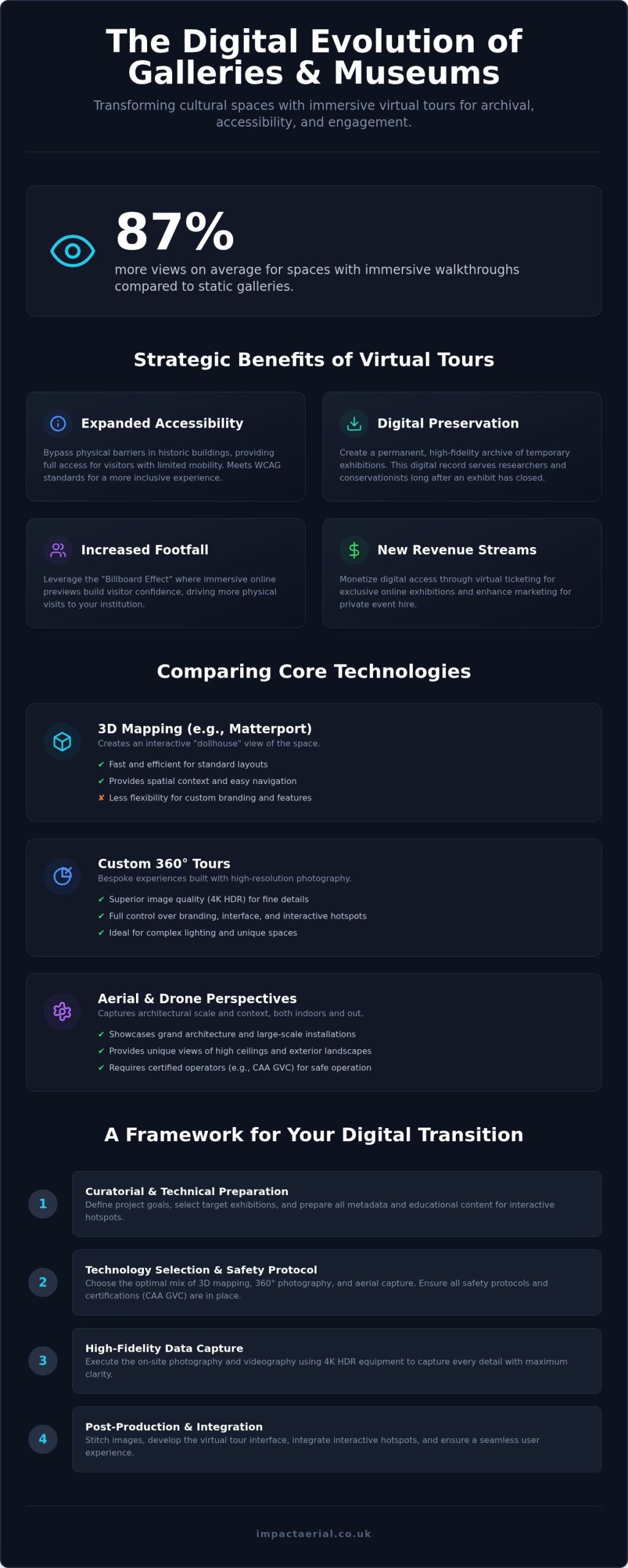
Selecting the right platform is critical for a successful virtual tour for art galleries and museums. While Matterport offers an efficient “dollhouse” view ideal for standard layouts, custom 360 tours provide greater flexibility for bespoke branding and higher resolution. Institutions like the National Park Service virtual exhibits demonstrate how tailored digital experiences can bridge the gap between physical distance and cultural education. For grand UK estates or modern galleries with complex lighting, a custom approach often yields superior results in capturing the nuance of the space without the limitations of automated hosting platforms.
Technological advancements now allow for photogrammetry, where hundreds of high-resolution photos are stitched together to create interactive 3D digital objects. This allows a visitor to rotate a fragile Roman bust or a contemporary sculpture, viewing it from angles that would be physically impossible in a gallery setting. A hybrid strategy that combines these ground-level details with aerial data offers the most comprehensive visitor experience, effectively guiding the user from the external landscape into the heart of the collection.
The Power of Aerial Videography Indoors
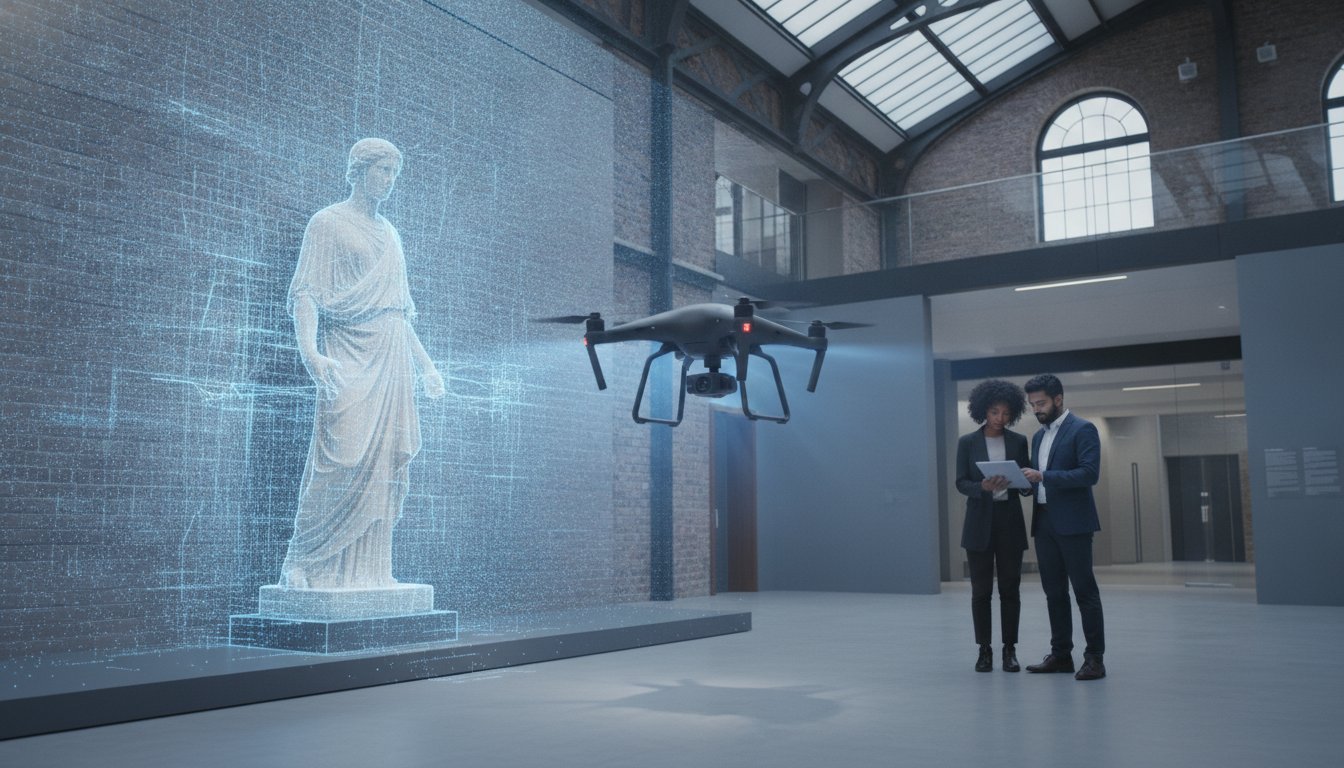
Grand museum architecture often features cathedral-height ceilings that are difficult to appreciate from eye level. Using specialized indoor drones, we can capture the scale of these grand halls from perspectives previously reserved for maintenance crews. Filming large-scale installations from above provides a sense of proportion that ground-level photography lacks. Safety is our primary concern. Operating in sensitive environments requires meticulous planning and adherence to CAA standards. Our pilots are CAA GVC certified and operate under £5m commercial liability insurance, ensuring total risk mitigation when flying near high-value assets or historic plasterwork. We use 4K HDR commercial-grade drones to ensure the output meets the highest professional standards.
Ground-Level Immersion and Detail
While aerial views provide context, ground-level immersion delivers the intimacy required for fine art. We utilize 4K HDR technology to capture the exact textures of oil paintings and the subtle patina of bronze works. The navigational flow must feel intuitive, mirroring a natural walkthrough that guides the user through the curatorial narrative. Achieving this level of cohesion requires integrating these elements with professional drone services to create a unified visual strategy. If you’re looking to elevate your institution’s digital presence, you can consult with our technical team to discuss a bespoke capture plan that respects the integrity of your collection.
Strategic Benefits: Why Museums are Investing in Virtual Tours
Institutional leaders are moving beyond viewing digital assets as mere novelties. A professional virtual tour for art galleries and museums is now a strategic requirement for maintaining relevance in a competitive cultural landscape. By providing 24/7 access, museums can engage international researchers and tourists who might never have the opportunity to visit the UK in person. This global reach extends the institution’s influence far beyond its physical walls, turning a local collection into a worldwide educational resource.
Sponsorship and funding opportunities often depend on an institution’s ability to demonstrate innovation. Grant bodies and private donors are increasingly looking for projects that future-proof collections and expand public engagement. Implementing sophisticated 3D and aerial capture shows a commitment to technological leadership. The best virtual museum and art gallery tours globally have proven that these investments pay dividends in institutional prestige and long-term donor confidence.
Accessibility and Inclusivity
Accessibility involves more than just physical ramps; it includes psychological comfort. Virtual tours provide a risk-free “pre-visit” environment for neurodivergent visitors, allowing them to familiarise themselves with the layout, lighting, and soundscapes before they arrive. This reduces anxiety and makes the physical museum more welcoming. For historic UK buildings where lift access is structurally impossible, digital twins provide an uncompromising way for visitors with limited mobility to explore upper floors or restricted areas. Virtual tours democratise art access in the 2026 digital landscape by providing an equitable platform where cultural engagement is determined by interest rather than physical or financial mobility.
Commercial and Marketing ROI
The commercial benefits of immersive media are measurable and significant. For institutions that rely on private event hire or film location scouting, a high-fidelity virtual tour shortens the sales cycle by allowing clients to conduct initial site inspections remotely. This saves time for the curatorial team and reduces the need for repeated physical walkthroughs. From a marketing perspective, these assets improve SEO performance by increasing “dwell time” on your website. Statistics show that properties featuring virtual tours receive 87% more views on average. These 3D environments also provide a wealth of content for social media and immersive advertising, allowing you to extract 4K stills and video clips for multi-channel campaigns without the cost of additional shoots.
Planning Your Virtual Exhibition: A Step-by-Step Guide
Executing a high-fidelity virtual tour for art galleries and museums requires a meticulous blend of curatorial precision and technical expertise. Before the capture phase begins, the curatorial team must finalise sightlines and ensure all object labels are correctly positioned for high-resolution legibility. A technical site survey is equally vital; this involves assessing Wi-Fi signal strength for interactive elements and mapping out safe drone flight paths through grand halls or stairwells. Every commercial operation must strictly adhere to current CAA regulations and the specific requirements of a UK drone license to ensure legal and safe deployment within public spaces.
Post-production is where the raw data becomes a functional institutional asset. This stage includes the integration of interactive hotspots, audio guides, and multilingual support to serve a global audience. These digital layers allow researchers to access deep-dive metadata that might not be physically present on a gallery wall, effectively turning a visual walkthrough into a comprehensive educational database.
Safety Protocols in High-Value Environments
Operating technical hardware in proximity to priceless artefacts demands a specialist approach to risk mitigation. It’s essential that your service provider is CAA GVC certified for indoor commercial work. This certification demonstrates a pilot’s competence in managing the unique aerodynamic challenges of enclosed heritage spaces. To provide institutional peace of mind, we carry £5m commercial liability insurance, which is a standard requirement for working in high-value UK environments. Our safety protocols include the use of propeller guards and obstacle-avoidance sensors to ensure drones never make physical contact with delicate structures or artwork.
Optimising Lighting and Visual Quality
Lighting for digital capture must be balanced against the preservation needs of the collection. We work closely with conservation teams to manage natural light levels and respect existing UV filters, preventing any risk of light-induced damage during the shoot. Achieving 4K HDR quality is a priority; this ensures strict colour accuracy and detail retention for digital art historians and conservators. By coordinating with aerial filming drone experts, we can create cinematic transitions that provide a seamless sense of movement through the exhibition space. If you’re ready to plan your institution’s digital transition, contact Impact Aerial for a detailed technical consultation.
Why Impact Aerial is the Trusted Partner for UK Institutions
Impact Aerial provides a specialized service that bridges the gap between traditional photography and advanced spatial data. We deliver a comprehensive virtual tour for art galleries and museums by integrating ground-level 360-degree immersion with sophisticated aerial perspectives. This dual approach ensures that every aspect of your institution, from the macro scale of its architecture to the micro details of its artifacts, is captured with precision. Our team manages the entire workflow, allowing curators to focus on their collections while we handle the technical complexities of digital twin creation.
We recognize that museums are high-stakes environments where safety is the primary concern. Our operations are built on a foundation of technical expertise and strict adherence to professional standards. By utilizing the latest 4K HDR DJI Enterprise drones, we provide the stability and visual fidelity required for high-end institutional output. This technology allows us to document spaces with a level of detail that satisfies both casual visitors and professional researchers.
Authority and Reliability in Drone Services
Reliability in high-value cultural environments is built on rigorous safety protocols. We are fully CAA GVC certified, which ensures our pilots are trained to the highest national standards for commercial drone operations in the UK. Our £5m commercial liability insurance provides essential risk mitigation for institutions managing priceless collections and historic property. While our expertise spans the property, construction, and advertising sectors, we apply a bespoke methodology to the arts. We work directly alongside your curatorial and conservation teams to ensure our flight paths and capture methods protect the integrity of the exhibition space. This meticulousness has made us a trusted specialist for organizations that value external validation and industry-leading standards.
Get Started with Your Virtual Transformation
Every institution has unique goals, whether it’s increasing global accessibility or creating a permanent digital record of a temporary show. Our consultation process begins with an in-depth understanding of these institutional objectives. We don’t offer a generic solution; instead, we customize the virtual tour for art galleries and museums to meet the specific needs of your target audience. This might include adding multilingual support for international tourists or integrating educational hotspots for remote school groups.
The transition from a physical gallery to a digital asset is managed entirely by our technical team. We handle everything from the initial site survey to final post-production editing and hosting. This end-to-end service ensures a cohesive visual narrative that reflects your institution’s brand and curatorial standards. If you’re ready to explore how immersive technology can benefit your collection, the next step is to request a bespoke quote tailored to your venue’s specific layout. You can contact our team today to speak with a technical consultant about your project.
Elevate Your Institutional Reach with Immersive Technology
The transition toward immersive digital engagement is a fundamental shift in how cultural heritage is preserved and shared. By implementing a high-fidelity virtual tour for art galleries and museums, your institution can bypass physical accessibility barriers while creating a permanent, high-resolution archive of temporary exhibitions. We’ve explored how the integration of 4K HDR ground-level detail and sophisticated aerial perspectives provides a sense of scale that traditional photography lacks.
Success in this space requires a partner that understands the unique risks associated with high-value environments. Impact Aerial brings technical precision and meticulous safety standards to every project; ensuring your collection is both protected and promoted. Our team of CAA GVC certified pilots operates with £5m commercial liability insurance. This provides the reassurance necessary for technical operations within historic UK buildings.
Ready to transform your visitor experience? You can Request a bespoke virtual tour quote from Impact Aerial to begin your digital transition. We look forward to helping you share your collection with a global audience.
Frequently Asked Questions
Can you safely use drones inside an art gallery or museum?
Yes, drones can be operated safely within sensitive indoor environments when managed by CAA GVC certified pilots. We utilize commercial-grade DJI Enterprise drones equipped with 360-degree obstacle avoidance sensors and propeller guards to prevent any contact with artifacts or historic structures. Every flight is preceded by a meticulous site survey to map out safe paths. This technical approach ensures that high-value collections remain protected while capturing cinematic perspectives that traditional ground-level cameras cannot achieve.
How long does it take to film a professional virtual tour?
The timeline for filming a professional virtual tour for art galleries and museums typically ranges from one to three days for the on-site capture phase. This duration depends on the total square footage and the complexity of the lighting. Smaller galleries might be completed in a single morning; whereas larger institutions with multiple wings require more extensive data collection. Following the shoot, our post-production team spends approximately two weeks editing the 4K HDR content and integrating interactive features.
What is the difference between a 360 tour and a 3D virtual tour?
A 360 tour consists of flat, panoramic images stitched together to show a view from a fixed point. In contrast, a 3D virtual tour uses spatial data to create a “digital twin” of the venue. This allows visitors to move freely through the space rather than just jumping between set locations. We use 3D mapping technology to provide a more immersive experience; which is essential for capturing the architectural scale of grand museum halls and complex exhibition layouts.
Do virtual tours work on mobile devices and VR headsets?
Yes, our virtual tours are fully optimized for cross-platform use, including smartphones, tablets, and desktop computers. They’re also compatible with major VR headsets like the Meta Quest or Apple Vision Pro for a truly immersive experience. We ensure that the 4K HDR visual quality remains consistent across all devices. This accessibility allows your institution to reach a global audience; providing a high-fidelity experience regardless of the hardware the visitor is using to access the collection.
How often should a museum update its virtual tour?
We recommend updating your tour whenever a major temporary exhibition is installed or if the permanent gallery layout undergoes significant changes. For institutions with static collections, a refresh every two to three years is advisable to take advantage of advancements in browser technology and visual fidelity. Regular updates ensure that your digital presence remains an accurate reflection of the physical site; maintaining its value as both a marketing tool and a reliable archival record for researchers.
Will a virtual tour decrease our physical visitor numbers?
Evidence suggests that a virtual tour for art galleries and museums doesn’t decrease physical footfall; it actually enhance it by acting as a digital billboard. Many visitors use the tour as a “pre-visit” tool to familiarize themselves with the building’s facilities and layout. This is particularly beneficial for international tourists and neurodivergent visitors who feel more confident visiting a site they’ve explored online. By showcasing the beauty of your collection, you’re more likely to convert online interest into a physical visit.
What insurance coverage is required for filming in a gallery?
Professional drone operators must carry specialized commercial liability insurance to work within UK cultural institutions. Impact Aerial maintains £5m in commercial liability insurance; which is the standard requirement for high-value museum environments. This coverage is essential for mitigating risks associated with operating technical hardware near priceless artifacts or listed architectural features. Always verify that your provider’s insurance specifically covers indoor drone operations and adheres to current CAA regulations before allowing any filming to commence on your site.
Can we add audio guides and interactive links to the tour?
Yes, our post-production services allow for the seamless integration of audio guides, video clips, and interactive hotspots. You can link specific artifacts directly to your collection management system or online gift shop. These features transform a simple visual walkthrough into a multi-layered educational resource. Visitors can click on a painting to hear a curator’s commentary or view high-resolution metadata; providing a level of engagement that rivals a physical guided tour while serving a global digital audience.
 2 Norton Drive, Wythall, Birmingham, B47 6HH Company registration number: 11138586. VAT Number: 366 9068 55