
By 2026, the global commercial drone market has reached a value of $28.87 billion, yet many UK boards still dismiss these precision instruments as nothing more than high-tech toys. This disconnect makes convincing management to adopt drone technology feel like an uphill struggle against outdated perceptions and valid fears of CAA non-compliance. You already know that manual inspections and traditional site monitoring are often inefficient, but you need a way to translate that technical intuition into a language the board respects. That language is risk mitigation and bottom-line impact.
It’s frustrating when the clear safety benefits of aerial data are overshadowed by concerns about legal repercussions or hidden costs. This article promises to help you build an undeniable business case by shifting the conversation from “buying a drone” to “acquiring precision data.” You’ll learn how to present a structured framework that highlights the 13.9% annual growth in commercial drone adoption while providing the “peace of mind” that comes with professional GVC certification. We will preview the exact evidence of time savings and safety improvements you need to secure approval in this niche but increasingly diverse market.
Key Takeaways
- Shift the internal dialogue from hardware to high-quality results by anchoring your proposal on the three core pillars of cost efficiency, improved site safety, and superior data quality.
- Mitigate legal concerns by demonstrating a firm grasp of the UK regulatory landscape, including the critical distinction between CAA GVC certifications and the necessity of commercial liability insurance.
- Simplify the ROI conversation by comparing the high overheads and learning curves of internal programs against the immediate value of professional services when convincing management to adopt drone technology.
- Utilize a structured five-step pitch to identify specific operational bottlenecks, such as slow roof surveys or manual inspections, and present drone-assisted workflows as the logical solution.
- Gain added peace of mind by positioning an expert drone partner as a technical consultant who ensures total compliance while delivering top-quality aerial insights across the UK.
Building the Business Case for Drone Technology in 2026
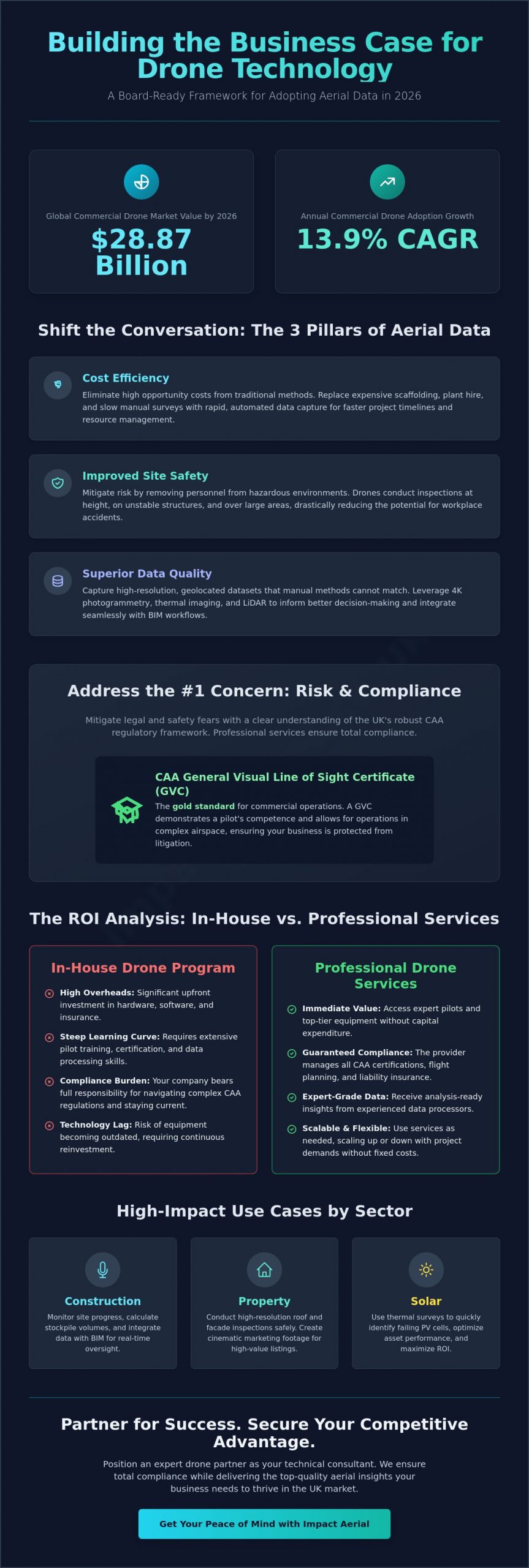
The year 2026 marks a definitive tipping point for the UK industry. With the global commercial drone market now valued at $28.87 billion, the transition toward digital-first site management is no longer a futuristic concept; it’s a present-day requirement. When convincing management to adopt drone technology, you must frame the conversation around three non-negotiable pillars: cost efficiency, operational safety, and data precision. Moving away from manual methods isn’t just about innovation. It’s about eliminating the high opportunity cost of traditional surveying, where slow data turnaround and elevated risk profiles can stall project momentum.
A successful business case highlights how professional aerial services provide a level of oversight that manual inspections simply can’t match. By leveraging a vast range of commercial drone applications, businesses can capture high-resolution datasets that inform better decision-making across every department. Whether it’s through thermal imaging or 4K photogrammetry, the goal is to provide the board with a reliable, scalable alternative to expensive scaffolding or hazardous manual roof climbs.
To better understand the strategic value of these services, watch this helpful video regarding the “Drones as a Service” model:
The Shift from ‘Nice-to-Have’ to Industry Standard
In the current market, your competitors are likely already utilizing drone survey technology to refine their bids and provide more accurate timelines. This shift is driven by the integration of aerial data into Building Information Modelling (BIM) workflows, allowing for a seamless flow of information from the site to the office. Sticking to manual methods creates a data silo that slows down collaboration. Drone adoption serves as a critical competitive advantage for UK construction firms by enabling real-time site oversight and reducing project timelines through automated data capture.
Identifying High-Impact Use Cases for Your Sector
Focusing on specific, high-impact applications helps in convincing management to adopt drone technology by showing immediate utility. Different sectors derive value in unique ways:
- Construction: Use drones for consistent site monitoring and precise stockpile volume calculations to manage resources effectively.
- Property: Deploy high-resolution inspections to identify structural issues without the need for plant hire; use cinematic footage for high-end marketing.
- Solar: Conduct PV solar farm thermal surveys to identify failing cells and optimize the ROI of renewable assets.
By identifying these specific needs, you present a case built on tangible evidence rather than abstract technical potential. This methodical approach ensures the board sees drones as the professional tools they’ve become.
Addressing Management’s #1 Concern: Risk and Compliance
Management’s hesitation often stems from a fear of the unknown, specifically regarding legal liability and site safety. When convincing management to adopt drone technology, you must address these concerns with concrete facts about the UK regulatory framework. The Civil Aviation Authority (CAA) has moved beyond the old PfCO system to a more robust structure involving the General Visual Line of Sight Certificate (GVC) and the A2 Certificate of Competency (A2 CofC). For commercial operations in congested areas or complex airspace, a GVC is the gold standard. It demonstrates a pilot’s ability to operate under strict safety cases that protect your business from litigation.
Operating without these credentials isn’t just a minor oversight; it’s a significant legal risk. In February 2026, international regulatory bodies updated enforcement policies, with civil penalties for unauthorized operations reaching up to $75,000 per violation. While these specific figures stem from FAA drone regulations in the US, they signal a global trend toward stricter enforcement that the UK’s CAA mirrors. Professional drone services provide added peace of mind by carrying £5m in commercial liability insurance, ensuring your business is protected against any unforeseen incidents. If you’re looking for a compliant partner, a professional aerial consultation can help clarify your specific site requirements.
Data privacy is another critical factor that boards prioritize. Every flight must be legally sound and GDPR compliant. A professional partner ensures that all data collection, from photogrammetry to thermal imaging, respects privacy laws and site-specific restrictions. This methodical approach to compliance turns a perceived risk into a controlled, professional workflow.
Why CAA GVC Certification is Non-Negotiable
There’s a vast difference between a hobbyist and a professional drone license holder. Certified pilots are legal requirements for commercial work, not just a preference. These experts are trained to manage complex UK airspace, including Beyond Visual Line of Sight (BVLOS) operations and flights in congested urban environments like Birmingham. This technical proficiency ensures every mission is executed with precision while adhering to the latest safety protocols.
Reducing On-Site Accidents through Aerial Surveys
Safety is the most compelling argument for drone adoption. Manual roof inspections often require scaffolding, cherry pickers, or ladders, all of which increase the risk of falls from height. Drones replace these hazardous methods with high-resolution aerial sensors. By integrating drones into construction site monitoring, firms can eliminate 100% of the initial physical risk associated with height-based assessments. This proactive approach significantly improves safety protocols and reduces the likelihood of on-site accidents.
The ROI Analysis: Make vs. Buy (Professional Services)
Deciding between building an in-house flight department or outsourcing to a specialist is a critical crossroads in convincing management to adopt drone technology. While the idea of owning hardware is appealing, the financial reality of an internal program often involves significant hidden costs that can erode your projected ROI. Business leaders who successfully integrate this technology understand that the value lies in the data gathered, not the ownership of the aircraft. When focusing on the final deliverable, many firms find a more positive ROI from drones by partnering with established experts rather than managing the logistical burden of a private fleet.
The speed of delivery is another factor where professional services consistently outperform internal teams. A specialized provider arrives on-site with a refined workflow, whereas an internal pilot must balance drone operations with their primary job roles. This internal learning curve can delay critical site insights by weeks or even months. By contrast, a professional service offers a fixed-cost model with guaranteed post-production results, ensuring that the board sees high-quality data without the unpredictability of an experimental in-house project.
Hidden Costs of an Internal Drone Department
Initial capital expenditure (CAPEX) for commercial-grade hardware is substantial. In 2026, a high-spec inspection drone can cost between $10,000 and $90,000, and that doesn’t include specialized sensors like LiDAR or thermal cameras, which can add another $30,000 to the bill. Beyond the hardware, your business must account for:
- Annual CAA GVC certification and pilot currency training.
- Specialized commercial insurance and public liability coverage.
- Software licenses for photogrammetry and data analysis.
- The 35.53% CAGR of the market, which risks making your hardware obsolete within 24 months.
The Benefits of Outsourcing to Professional Drone Services
Hiring established Drone Services provides immediate access to high-end 4K HDR sensors and thermal imaging without the upfront CAPEX. You gain the flexibility to scale operations across multiple sites simultaneously, a task that would require a massive internal team to replicate. Hiring a professional service provider allows a firm to bypass the £90,000 capital investment required for top-tier inspection drones while ensuring immediate access to GVC-certified expertise. This “Drone-as-a-Service” model ensures that your business stays at the cutting edge of a niche but increasingly diverse market without the risk of equipment depreciation or regulatory non-compliance.
How to Build Your Pitch: 5 Steps to Convince Leadership
Securing board-level buy-in requires a shift from technical enthusiasm to strategic problem-solving. When convincing management to adopt drone technology, your pitch must be rooted in operational reality. You aren’t just asking for a new tool; you’re proposing a more efficient way to manage assets and mitigate risk. By following a structured five-step framework, you can transform a “niche” request into a critical business objective that aligns with the board’s focus on safety and ROI.
- Identify a Specific Bottleneck: Pinpoint a recurring delay, such as the three days typically required to coordinate scaffolding for a roof survey.
- Contrast the Workflows: Present a direct comparison showing how traditional manual methods take 48 hours of labor while a drone-assisted survey takes two hours.
- Lead with Compliance: Open the risk discussion by highlighting the “peace of mind” provided by CAA GVC certified pilots and £5m commercial liability insurance.
- Showcase High-Quality Visuals: Use 4K HDR examples to demonstrate how superior data leads to faster, more accurate maintenance decisions.
- Propose a Low-Risk Pilot: Suggest a single-site trial to prove the concept with minimal initial capital commitment.
Gathering Your Evidence
Success depends on the quality of your data. Start by auditing your current safety logs for near-misses related to working at height. These statistics provide a powerful emotional and financial hook. You should also look at marketing potential; using an aerial filming drone can produce breath-taking cinematic video that elevates your brand’s market position. This dual-purpose utility makes the investment even more attractive to stakeholders who prioritize both operations and growth.
Handling Common Management Objections
Expect pushback on cost and legality. Address “It’s too expensive” by showing that the cost of a professional service is significantly lower than the £90,000 required for top-tier hardware and internal training. If they ask “Is it legal?”, provide clear CAA documentation and explain how outsourcing to a technical consultant removes the regulatory burden from your firm. This methodical approach demonstrates that you’ve considered every angle of the operation. To get started with your pilot project data, you can book a professional drone consultation today.
Partnering for Success: Integrating Impact Aerial
Successfully convincing management to adopt drone technology often rests on the strength of your chosen implementation partner. Impact Aerial doesn’t just offer pilots; we act as technical consultants who integrate seamlessly into your existing workflows. Based in Birmingham and the West Midlands, our central location allows for rapid, UK-wide deployment to construction sites and commercial properties. This accessibility ensures that your firm can respond to site requirements with the agility that modern site management demands. We provide the expertise needed to navigate the niche but increasingly diverse market of aerial data collection.
Our approach centers on providing a “peace of mind” guarantee. This means every flight is conducted by a CAA GVC Certified professional who understands the nuances of the 2026 regulatory environment. We handle the complexities of risk assessments and airspace authorizations so your team can focus on the results. By choosing a specialist partner, you eliminate the need for the £90,000 capital investment in hardware and the ongoing burden of internal pilot training. We provide the latest 4K High Dynamic Range (HDR) DJI Enterprise commercial drones to ensure your data is of the highest possible quality.
From Raw Data to Actionable Insights
Management needs more than just raw video files; they require data that informs their next board report or engineering decision. We specialize in transforming raw aerial captures into actionable insights through professional post-production services. Whether you require precise photogrammetry for volume calculations or high-resolution imagery for Building Services inspections, our output is tailored to your specific software environment. We ensure drone data integrates directly into your existing project management tools, providing a unified view for both marketing teams and engineering departments. This methodical data-gathering process ensures that every stakeholder receives the specific information they need to advance the project.
Why Impact Aerial is the Trusted Choice
Our track record with UK property developers and construction leaders is built on a foundation of meticulous compliance and technical proficiency. We understand that reliability is a primary requirement for any board-level decision. By maintaining a fleet of top-quality drones and providing comprehensive data analysis, we eliminate the technical barriers that often stall drone adoption. Our commitment to industry standards is reinforced by our active affiliations with organizations like ARPAS and the Drone Safe Register, providing an external layer of validation for your business case. Contact Impact Aerial to start your pilot project today and see how professional aerial services can transform your operational efficiency.
Securing a Competitive Advantage Through Aerial Intelligence
The transition from manual site inspections to digital-first oversight is no longer a luxury for UK firms. By 2026, the global commercial drone market’s valuation of $28.87 billion proves that industry leaders have already embraced this shift. Convincing management to adopt drone technology requires a clear focus on the safety benefits of eliminating working-at-height risks and the financial logic of the “Drone-as-a-Service” model. You’ve seen how professional data collection reduces project timelines and removes the $90,000 capital expenditure barrier associated with top-tier hardware.
Partnering with a specialist provides the technical precision and regulatory compliance your board demands. Impact Aerial delivers added peace of mind through our CAA GVC Certified pilots and £5m commercial liability insurance. Our fleet of the latest DJI Enterprise 4K HDR drones ensures that your data is accurate, actionable, and legally sound. Take the first step toward transforming your operational efficiency by choosing a partner that prioritizes safety and quality.
Request a Professional Drone Service Quote from Impact Aerial Today and lead your firm into a more efficient, data-driven future.
Frequently Asked Questions
Is convincing management to adopt drone technology actually cost-effective?
Yes, adopting drone technology is highly cost-effective when you consider the reduction in manual labor and equipment hire. By utilizing a “Drone-as-a-Service” model, your firm avoids the significant capital investment required for high-end sensors and specialized training. This shift allows for more frequent site oversight without the recurring costs of scaffolding or heavy machinery, which often results in a faster project completion rate.
What are the biggest risks management worries about with drones?
The primary concerns for leadership are usually legal liability and operational safety. Management often fears the repercussions of unauthorized flights, especially following the February 2026 updates to global enforcement policies that increased penalties for non-compliance. Partnering with a certified specialist mitigates these risks by ensuring every operation follows strict CAA safety protocols and is backed by robust commercial insurance.
Do we need our own drone license if we hire a professional service?
No, your business doesn’t need an internal license when you hire a professional provider. The drone service company holds the necessary CAA GVC or A2 CofC certifications and takes full responsibility for the flight planning and legal compliance. This arrangement simplifies the process of convincing management to adopt drone technology because it removes the regulatory burden from your internal team.
How much liability insurance should a drone company have in the UK?
A professional drone operator in the UK should carry at least £5 million in commercial liability insurance. This level of coverage is the industry standard for commercial property and construction sites; it provides the necessary peace of mind for your board of directors. It ensures that your firm is fully protected against any unforeseen incidents during data-gathering missions.
Can drones really replace traditional surveying methods?
Drones don’t necessarily replace surveyors; instead, they act as a force multiplier for traditional teams. Aerial photogrammetry and LiDAR sensors can capture site data up to 50% faster than ground-based manual methods. This speed allows surveyors to focus on data analysis and decision-making rather than spending days on physical measurements in hazardous environments.
What kind of ROI can we expect from professional aerial filming?
Professional aerial filming delivers a measurable boost to marketing engagement and brand authority. Industry data from early 2026 suggests that high-quality cinematic video can increase click-through rates on commercial property listings by up to 30%. This visual impact helps secure investors and tenants more quickly, directly contributing to the project’s overall profitability.
How do we ensure drone data is GDPR compliant?
Professional operators ensure GDPR compliance by following strict data protection workflows during and after the flight. This includes blurring identifiable faces or vehicle registration marks in the post-production phase and storing all high-resolution files on secure, encrypted servers. These meticulous data-handling procedures ensure that your aerial surveys meet all UK privacy regulations.
What happens if the weather is bad on the day of the shoot?
Safety is the non-negotiable priority, so flights are postponed if wind speeds or precipitation exceed safe operating limits. Most professional service agreements include a “weather day” clause that allows for rescheduling at no additional cost to the client. This methodical approach ensures that the final 4K HDR deliverables aren’t compromised by poor environmental conditions.
 2 Norton Drive, Wythall, Birmingham, B47 6HH Company registration number: 11138586. VAT Number: 366 9068 55