
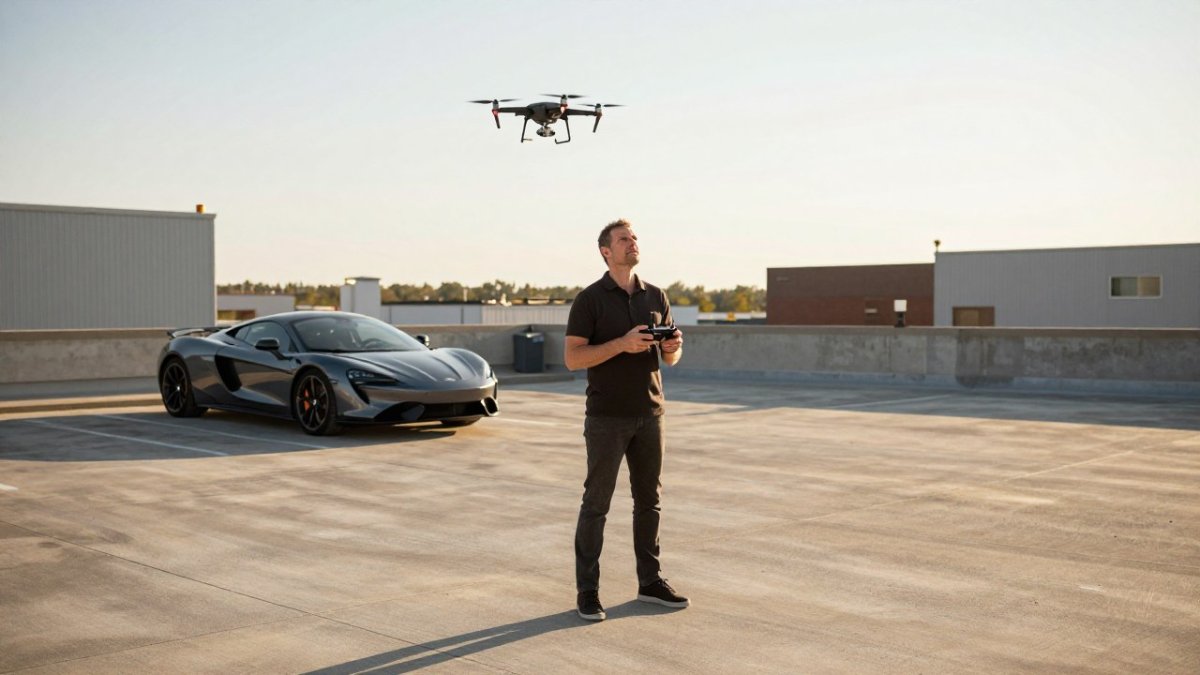
Quick Summary
Strong aerial video ideas for product launches include a slow pull-back reveal that rises from a detail to the full setting, and placing the product within the real environment it serves. Shots such as establishing, orbit, descending and tracking each suit a different job, and pairing them with ground footage creates a unified launch film.
- Start tight on a setting detail, then rise and pull back to reveal the product.
- Show the product in the environment it is designed for, answering where it fits.
- Plan three or four core shot types and use them consistently across the campaign.
- Match movement across cuts, linking drone shots with related ground-level gestures.
- Confirm the operator holds CAA authorisations and insurance before booking any shoot.
Table of Contents
Why Aerial Footage Works for Product Launches
Aerial footage gives a product launch a sense of scale and place that ground-level video struggles to match, and well-chosen aerial video ideas make that effect far easier to achieve. A drone can rise over a showroom, a factory floor or a city site and show the product within its real setting, which is exactly the context buyers want before they commit. Impact Aerial works with clients in construction, property and advertising, and the approach below reflects that practical experience.
Many launch teams treat drone footage as a decorative extra. That usually undersells it. Used with intent, aerial shots establish where the product lives, who it serves and why the location matters. The challenge is choosing the right ideas and planning them properly, which is where most of this guide focuses.
Aerial Video Ideas for Product Reveals
A strong product reveal depends on the first few seconds. The camera needs to earn attention before the product appears, and aerial movement is well suited to building that tension. The ideas below are practical options for reveal-led campaigns.
The Slow Pull-Back Reveal
Start tight on a detail of the setting, then rise and pull back until the product and its environment come into frame. The movement creates anticipation because the viewer does not yet know what the shot is building towards. Keep the ascent slow and steady, and hold the final frame long enough for the product to register.
Product in Its Environment
Place the product within the place it is designed for. A logistics device can sit against a working warehouse yard, while a consumer product can be shown against a city skyline or a coastal backdrop. The aim is to answer the buyer’s unspoken question about where and how the product fits into their world.
Drone Videography for Marketing: Shot Types That Earn Attention
Not every aerial shot does the same job. Choosing the right shot type for each part of the launch film keeps the footage purposeful. A sensible approach is to plan three or four core shot types and use them consistently across the campaign, rather than mixing styles at random.
Establishing shots set the scene and work well as opening frames. Orbit shots circle the product or site and suit close-up reveals. Descending shots move from wide context to a specific point of interest, which helps guide attention to a feature. Tracking shots follow movement along a route and add energy to social cuts. Each one should have a clear role in the edit.
Integrating Aerial and Ground Footage
Aerial footage rarely works alone. The strongest launch films cut between high-altitude shots and ground-level material, such as hands using the product, close-up detail and interview segments. The transition is where the story often lands. That shift from aerial scale to intimate detail can carry through to the launch space itself, where Themagicalmirrorluxe can help make a photo booth feel part of the same visual story.
Match the movement across the cut where you can. If a drone shot ends with a rising motion, begin the ground shot with a related upward gesture. Keep colour grading consistent between the two so the sequence feels unified. Plan these transitions during pre-production, not in the edit, because the shot list determines how well they will work.
Commercial Drone Filming Regulations UK: What You Must Have in Place
Commercial drone work in the UK is governed by the Civil Aviation Authority (CAA), and operators must hold the correct authorisations before flying for a client (Drones). Businesses commissioning aerial footage should confirm that the operator is appropriately qualified and insured before any shoot is booked.
The CAA publishes the full rules for operating unmanned aircraft, including requirements around flight restrictions, pilot competency and operating near people and property (Drones). Reviewing these at the planning stage avoids the delays and fines that can follow a shoot that was not properly prepared. Impact Aerial’s team operates with CAA GVC-certified pilots and holds £5m commercial liability insurance.
Budgeting for Aerial Production: What Drives Drone Video Production Costs
Aerial production costs vary considerably, and the drivers are rarely obvious to a first-time buyer. Pricing depends on the scope of the shoot, the number of locations, the complexity of the flight plan, the time needed for post-production and the level of permissions the site requires. Pricing depends on the scope of each brief, so fixed figures are not given here.
For an accurate picture, we recommend sharing your shot list, locations and delivery requirements. That gives you a quote tied to the work you actually need rather than a generic rate. For current prices or a quote, visit the Impact Aerial website.
Weather and Site Contingency Planning for Your Launch Shoot
Weather is the most common reason aerial shoots slip. Wind, rain and low cloud can all prevent safe flying, and a launch date does not move easily. Build a contingency window into the schedule, ideally with a second planned day, so a weather delay does not put the whole campaign at risk.
Site access also needs planning. Confirm landing and launch areas, identify any restricted zones and agree arrangements with site managers in advance. A short site survey before the shoot is one of the most effective ways to avoid problems on the day.
Briefing Your Next Aerial Shoot With Impact Aerial
A clear brief produces better footage and a smoother shoot. Include the purpose of the film, the audience, the key shots you want, the locations, the deadline and any brand guidelines the footage must follow. The more specific the brief, the more accurately the crew can plan the flights and the edit.
If you are planning a product launch and want aerial footage that does real work for your campaign, contact the Impact Aerial team to discuss your brief and get a quote tailored to your project.
Last Updated: November 9, 2026
Frequently Asked Questions
How can drone footage improve a product launch video?
Aerial footage establishes scale and context that ground cameras cannot match. A wide, high-angle opening shot can show a product in its real setting, such as a factory floor, a development site or a city street, which helps viewers understand where it fits. Drone sequences also work well as attention-grabbing openers for social channels, and they give editors a clear visual contrast with close-up product shots. The strongest results come from pairing aerial wide shots with detailed ground-level footage so the audience moves from the big picture to the product itself.
What are the legal requirements for commercial drone filming in the UK?
Commercial drone work in the UK is regulated by the Civil Aviation Authority. Operators need the appropriate CAA authorisation for the type of flying involved, and the pilots must hold the relevant qualifications, such as the General Visual Line of Sight Certificate (GVC) certification where applicable. Flights must follow the rules on distance from people, property and congested areas, and site-specific risk assessments are expected. Clients should ask any provider to confirm their authorisation, pilot qualifications and insurance before booking, rather than assuming compliance.
What is the difference between drone photography and videography for marketing?
Drone photography captures single high-resolution stills, which suit listings, brochures and websites where one striking image needs to carry the message. Drone videography captures motion, which shows movement, pacing and reveals that stills cannot convey. For a product launch, video is usually the better choice for the main film and social cut-downs, while stills are useful for press kits and printed materials. Many campaigns commission both during the same shoot to reduce repeat call-out costs.
How do I choose a CAA-authorised drone operator for my product launch?
Check that the operator holds current CAA authorisation for commercial work and that their pilots hold the relevant qualifications. Ask for examples of previous work in a similar sector, a clear explanation of how they plan and risk-assess each site, and proof of commercial liability insurance. A good operator will also discuss your creative brief, timing and weather contingencies before quoting, which is a sign they understand both the filming and the regulatory side of the job.

 2 Norton Drive, Wythall, Birmingham, B47 6HH Company registration number: 11138586. VAT Number: 366 9068 55


