
Bad data can turn a preventable mistake into repeated work, delays and added project costs. Rework is work that must be corrected or repeated because information, coordination or execution did not meet project requirements.
It is easy to focus on visible costs such as replacement materials and labour. But missing information, unclear instructions and outdated drawings can also waste time, disrupt sequencing and affect work beyond the original error.
This article explains what construction rework is, how poor communication and incomplete or inaccurate information add to its cost, and why data fidelity matters across project deliverables. It also explores how reliable site information can support clearer decisions and closer monitoring as work progresses.
Key Takeaways
- Understand why rework costs extend beyond repeating the task, affecting labour, materials, coordination and schedules.
- Recognise how unclear instructions and missing information can create avoidable mistakes between project teams.
- Learn how accurate, current project records help teams make decisions using dependable information.
- See how consistent site monitoring can give teams clearer visibility of construction progress.
How Much Does Bad Construction Data Cost the Industry?
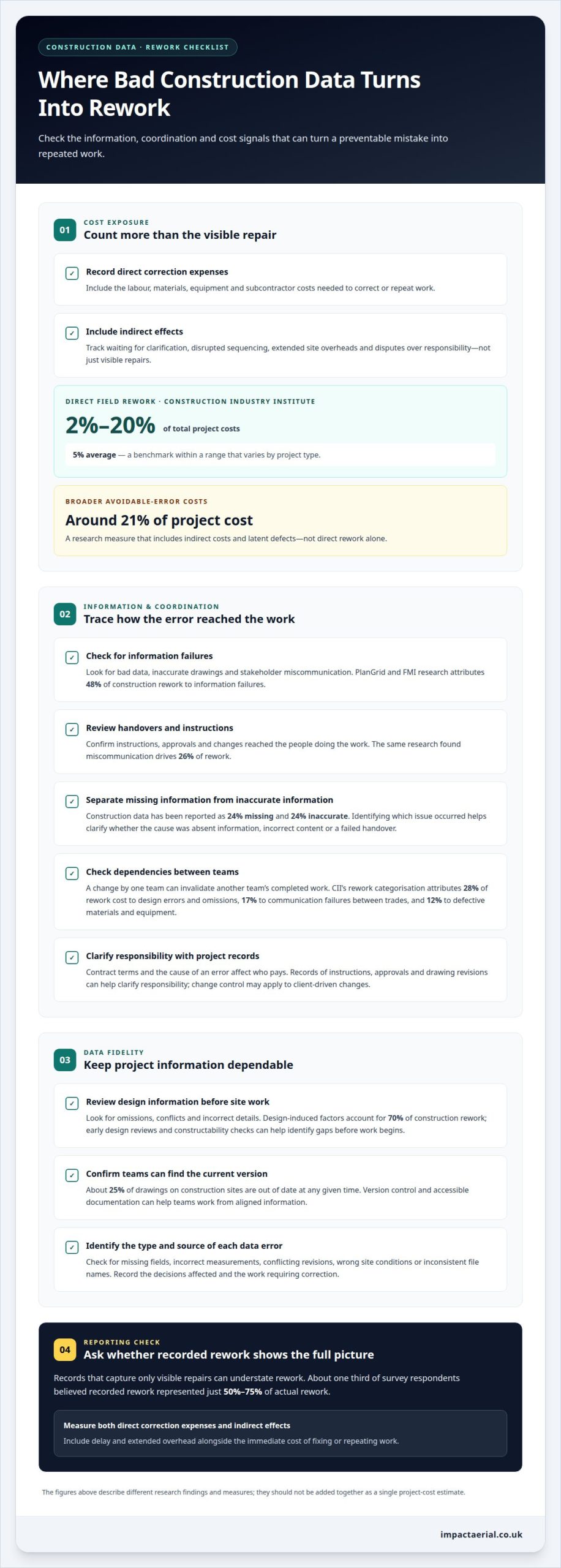
The cost of construction rework due to bad data varies with project type, size and when errors are found. The Construction Industry Institute estimates direct field rework ranges from 2% to 20% of total project costs, averaging 5%.
Direct Rework Expenses
Direct rework expenses include the labour, materials, equipment and subcontractor costs needed to correct or repeat work. The Construction Industry Institute’s average offers a benchmark, while its wide range reflects how exposure varies by project type. For example, a drawing error may mean removing and reinstalling completed work, not merely spending extra time on installation. That difference matters when forecasting total project cost.
Collaboration and Data Problem Costs
Collaboration and data costs arise when teams work from incomplete, inaccurate or inconsistent project information. PlanGrid and FMI research attributes 48% of construction rework to information failures, including bad data, inaccurate drawings and stakeholder miscommunication. Indirect costs can include waiting for clarification, disrupted sequencing, extended site overheads and disputes over responsibility. A late decision may delay subsequent trades, multiplying the impact of the original error.
Contractual Responsibility for Rework
Contract terms and the cause of an error affect who pays for its correction. Under a fixed-price arrangement, a contractor may absorb costs caused by its own performance, while client-driven changes may be handled through agreed change control. Under cost-plus terms, allowable costs may be passed to the client, subject to the contract. Records of instructions, approvals and drawing revisions can help clarify responsibility.
Measuring and Reporting Rework Costs
Measuring rework means recording direct correction expenses and indirect effects, including delay and extended overhead. Its 2015/16 research placed total avoidable-error costs around 21% of project cost when indirect costs and latent defects are included. The cost of construction rework due to bad data can be understated when records capture only visible repairs: about one third of survey respondents believed recorded rework represented just 50% to 75% of actual rework.
Rework caused by poor communication and missing information
On construction projects, information gaps become costly when teams act on different instructions or incomplete records. PlanGrid and FMI research found miscommunication drives 26% of rework, showing how coordination failures can become physical errors.
Communication and Information Gaps
Communication and information gaps arise when instructions, approvals or changes do not reach the people doing the work. A crew may then follow an outdated decision and have to undo completed work. For example, a late change to an installation location can affect setting out, materials and subsequent trades. Clear approval responsibilities and recorded decisions help keep instructions consistent across teams.
Project Data and Miscommunication
Poor project data means records are missing, inaccurate, outdated or difficult to interpret; miscommunication happens when teams misunderstand or don’t receive that information. Either can prompt work based on the wrong dimensions, specification or sequence. Construction data has been reported as 24% missing and 24% inaccurate. Separating these error types helps identify whether the cause was absent information, incorrect content or a failed handover.
Collaboration Failures and Rework Causes
Collaboration failures arise when designers, contractors and trades don’t coordinate decisions or dependencies before work proceeds. They matter because one team’s change can invalidate another team’s completed work. The Construction Industry Institute’s rework categorisation attributes 17% of rework cost to communication failures between trades, 28% to design errors and omissions, and 12% to defective materials and equipment. These causes can overlap when unresolved design information reaches site.
Types of Data Errors
Data errors can include missing fields, incorrect measurements, conflicting revisions and records that describe the wrong site condition. Each may require a different response, from seeking clarification to replacing installed work. Inconsistent file names or approval records can also lead teams to use superseded information. A useful review identifies the error type, its source, the decisions it affected and the work requiring correction, then addresses the underlying communication or data process.
Maintaining data fidelity across project deliverables
Data fidelity means keeping project information accurate, current and consistent as it moves between design, site work and handover. BIM and common data environments can support coordination by giving teams access to current models, drawings and records.
Design Errors and Incomplete Information
Design errors and incomplete information are omissions, conflicts or incorrect details that make project documents unreliable. They matter because a drawing gap can lead to incorrect installation, later changes and delays for dependent trades. Design-induced factors account for 70% of construction rework. Early design reviews and constructability checks help teams identify gaps before site work, while coordinated models can expose clashes before they become physical corrections.
Inaccurate or Inaccessible Project Information
Project information is inaccurate when it misrepresents requirements or site conditions, and inaccessible when teams can’t readily find or use it. Both conditions can reduce productivity: a team may act on an outdated drawing, or lose time reconciling conflicting records. About 25% of drawings on construction sites are out of date at any given time. A common data environment can provide version control and accessible documentation, helping participants work from aligned information.
Preventing Rework and Potential Savings
Preventing rework means identifying errors before they trigger removal, replacement or disrupted sequencing. BIM and virtual prototyping can help teams detect clashes in digital models before construction, while a common data environment supports consistent revisions across project phases. These approaches can reduce error pathways, but the savings depend on project conditions and how well teams maintain and use the information. The Get It Right Initiative estimates each pound spent on construction error prevention returns roughly 5 to 10 times its cost in avoided rework.
Global financial impact of poor construction data
Poor construction data can affect more than an individual project: it may contribute to rework, delays and lost productivity across the market. The financial impact depends on what is counted, from direct corrections to wider inefficiencies.
UK construction rework estimates are not directly comparable with global figures because studies use different definitions. Global estimates place rework at 3% to 11% of total project costs, while some UK estimates reach 30%; the gap highlights the importance of distinguishing direct rework from broader error costs.
Worldwide, bad data was estimated to cause 14% of avoidable construction rework. That share represents more than site repairs: inaccurate or inaccessible information can disrupt decisions, delay progress and reduce productivity across several project phases. The effect can spread as stakeholders pass incomplete or outdated records between design, procurement and construction teams.
Data quality also affects whether project teams can identify the source of recurring errors. In one reported survey, 30% of construction professionals said more than half their project data was bad and offered no valuable insights; a further 21% of construction data was described as wrong. These figures point to separate issues: information may be unusable, or it may misrepresent the worksite.
To implement better controls, teams can define consistent records, track revisions and capture site conditions in formats that support decisions. Real-time data initiatives were associated with a 31% decrease in cost overruns in a jobsite management study. That finding shows why timely information matters, though the specific effect depends on how teams use it and the project’s processes.
For clearer visibility of site progress, consider construction site monitoring as part of your project oversight.
Impact Aerial: Construction Site Monitoring
Impact Aerial provides Construction Site Monitoring, capturing aerial views of site progress for project teams. These visual records can help stakeholders review visible changes over time, discuss progress and identify areas needing closer attention. They complement, rather than replace, drawings, inspections or project records.
Construction Site Monitoring is relevant when a team needs a broader view of site activity to inform coordination and reporting. Visual context can help teams discuss site conditions alongside other project information, particularly when progress must be communicated between office and field teams.
If aerial monitoring could support your project oversight, contact Impact Aerial to discuss your requirements.
Make Clear Project Visibility Part of Your Next Step
Reducing the cost of construction rework due to bad data starts with sound decisions based on dependable project information. When planning upcoming work, consider where an additional visual perspective could help teams review site conditions, document progress or communicate what is happening on the ground. Aerial information can support those discussions alongside existing drawings, records and inspections.
Impact Aerial offers Aerial Filming and Photography, PV Solar Farm Thermal Surveys and Drone Commercial Property Surveys. Each serves a different purpose, from visual documentation to surveying. The right fit depends on the information your project needs.
For a practical discussion about aerial services and your project requirements, contact Impact Aerial to discuss your project. A considered approach to project visibility can help your team move forward with greater clarity.
Frequently Asked Questions
What is Rework In Construction?
Construction rework is work that must be corrected, removed or completed again because it does not meet project requirements. For example, a team may need to reposition an installed component after discovering that its location conflicts with the approved design. Unlike planned work, rework consumes resources without achieving the intended result first time and can affect subsequent activities.
How Big Is the Problem?
Rework is a significant cost and delivery risk for construction projects, but its scale depends on project type and how costs are counted. Direct correction work is only part of the impact: sequencing disruptions, extended site activity and disputes can add indirect effects. Tracking causes and consequences helps project teams see whether recurring errors stem from design, information or coordination.
Where Does Rework Actually Come From?
Rework can stem from design omissions, inaccurate or outdated information, communication failures, defective materials, changes or execution errors. To distinguish causes, trace a correction through the relevant instruction, drawing revision, approval and site record. For example, an installation that conflicts with a newer drawing may indicate a revision handover failure rather than a workmanship issue.
What percentage of construction project costs is caused by rework?
Estimates vary by project type and according to whether they include only direct work or also indirect effects. The Construction Industry Institute’s direct field rework estimate offers a benchmark, while broader studies may include design costs, delays and other consequences. When comparing percentages, check that they use the same denominator, such as total project cost or construction value, and count the same cost categories.
How much construction rework is directly linked to inaccurate or incomplete data?
FMI found that inaccurate or inaccessible information causes 22% of construction rework. This category can include missing project details, incorrect records or information that teams cannot access when decisions are made. The figure helps identify data quality as a distinct contributor, but it doesn’t mean every project experiences the same share. The specific causes depend on information flows and project controls.
What are the average costs of construction rework per project in the UK?
There isn’t one fixed UK cash average that applies across projects of different sizes and types. A useful benchmark is the Construction Industry Institute’s estimate that direct field rework averages 5% of total construction project costs. To interpret that for a particular project, apply the proportion to its own project value, then account separately for indirect effects such as disruption and extended site activity.
 2 Norton Drive, Wythall, Birmingham, B47 6HH Company registration number: 11138586. VAT Number: 366 9068 55


