What if the “affordable” drone operator you hired for your 2026 site survey costs your firm a £50,000 Civil Aviation Authority (CAA) fine before the first battery is even charged? It is a sobering thought for any UK project manager, yet many still struggle to distinguish between a hobbyist with a gadget and a fully qualified professional. You probably already recognise that high-quality aerial data is essential for modern construction and property management. But with 2026 regulations becoming increasingly stringent, the risk of site accidents or insurance gaps is higher than ever.
We understand that you need absolute certainty when commissioning aerial services. This article provides a comprehensive hiring a drone pilot checklist designed to navigate the complexities of GVC certifications and £5 million commercial liability requirements. You will learn exactly how to vet an operator’s technical credentials and safety protocols to ensure peace of mind. We’ll guide you through a clear “yes/no” vetting process to guarantee your project receives professional 4K or thermal data without any legal compromises.
Key Takeaways
- Understand why the GVC has replaced the PfCO as the essential CAA qualification for professional aerial operations in the UK.
- Identify the specific commercial drone insurance requirements needed to protect your organisation from vicarious liability and ensure total peace of mind.
- Utilise our definitive 2026 hiring a drone pilot checklist to vet operators based on safety standards, technical accuracy, and data-gathering capabilities.
- Learn how to match advanced drone hardware to your project’s specific needs, from high-resolution inspections to complex photogrammetry.
- Master the five non-negotiable pillars of drone procurement to ensure every aerial project is delivered with professional precision and full regulatory compliance.
Table of Contents
- The 2026 Hiring a Drone Pilot Checklist: Quick Reference
- Verifying CAA Compliance and Professional Qualifications
- Assessing Insurance and Operational Safety Standards
- Technical Capabilities: Equipment, Portfolios, and Data
- Why Impact Aerial Ticks Every Box for Your UK Project
The 2026 Hiring a Drone Pilot Checklist: Quick Reference
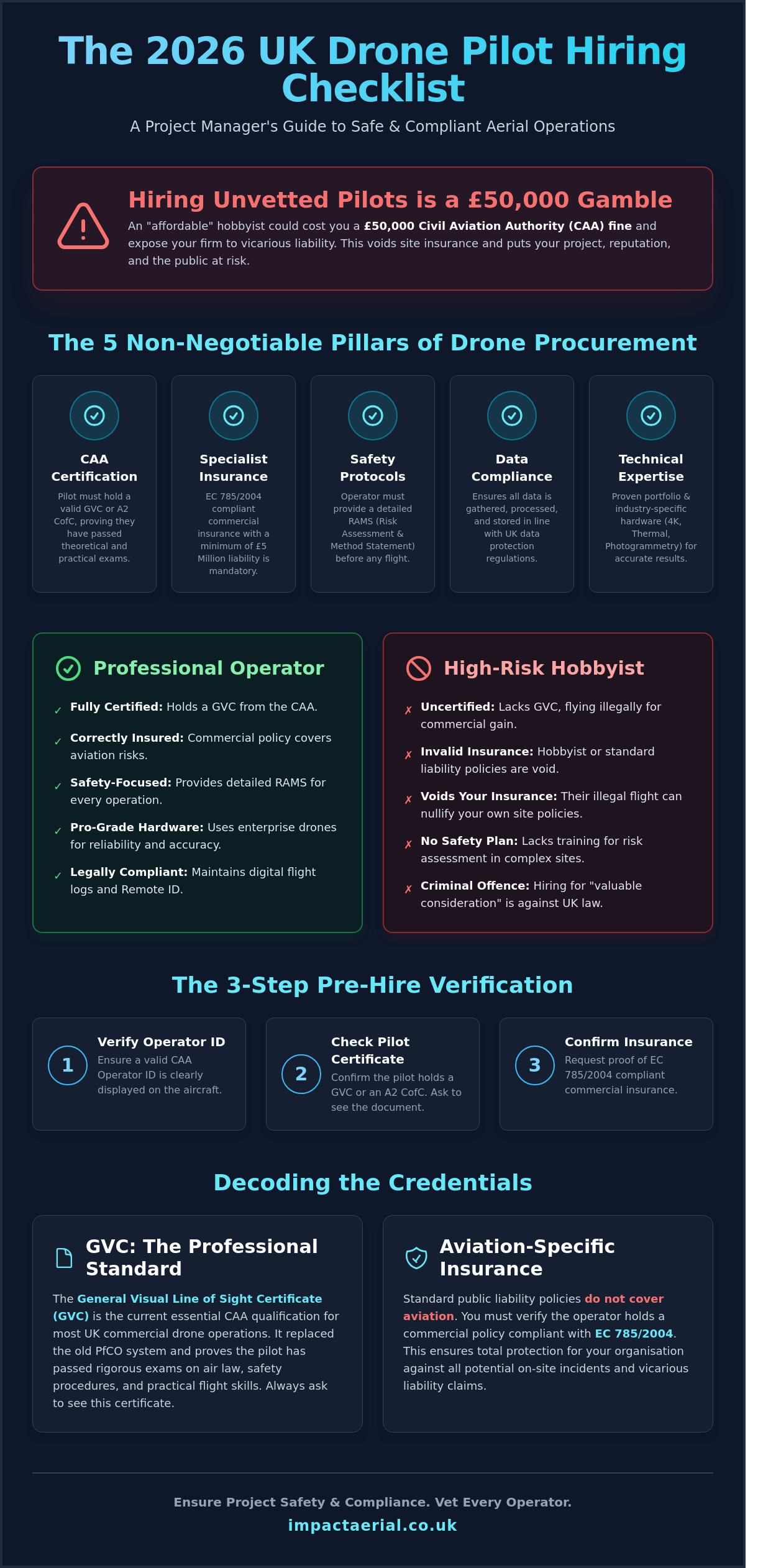
Professional drone procurement in 2026 requires more than a cursory glance at a creative portfolio. You need a robust hiring a drone pilot checklist to filter out high-risk hobbyists and identify technical experts. The five non-negotiable pillars of procurement include valid Civil Aviation Authority (CAA) certification, specialist commercial insurance, rigorous risk assessment protocols, data protection compliance, and industry-specific technical expertise. These pillars ensure that your project remains legal and your brand reputation stays intact.
Using an unvetted pilot exposes your organisation to vicarious liability. Under the 1982 Civil Aviation Act and updated 2021 safety frameworks, the hiring entity can be held legally accountable for damages if they fail to perform due diligence. You aren’t just commissioning a photographer; you’re managing a flight operation. A formalised vetting process provides the necessary paper trail to prove you’ve met your legal obligations as a responsible contractor.
To better understand the risks involved in this process, watch this helpful video:
There’s a sharp distinction between a visual artist and a commercial drone operator. An artist focuses solely on the aesthetic quality of a shot. A commercial operator prioritises the safety of the 2.8 million people living in the West Midlands while delivering high-accuracy data. In 2026, the CAA enforces strict digitised flight logs and Remote ID requirements. Professional operators use these tools to maintain transparency, whereas hobbyists often bypass these essential safety layers.
The 5-Minute Pre-Hire Verification
Before signing any contract, perform three essential checks. First, ensure the aircraft displays a valid CAA Operator ID. Second, verify the pilot holds a General Visual Line of Sight Certificate (GVC) or an A2 Certificate of Competency (A2 CofC). These certifications are the bedrock of current UK drone regulations and prove the pilot has passed theoretical and practical exams. Finally, confirm the presence of EC 785/2004 compliant commercial insurance. Standard public liability policies don’t cover aviation-specific risks.
Why “Hobbyist” Pilots Pose a Corporate Risk
Hiring a hobbyist for “valuable consideration” is a criminal offence under UK law. Valuable consideration includes any form of payment, even if it’s just a gift or a promise of future work. If an uncertified pilot flies for your firm, it’ll likely void your existing site or business insurance policies. This creates a massive financial vulnerability for your company.
The hiring a drone pilot checklist becomes even more vital in complex urban environments like Birmingham city centre. Flying near the Bullring or the West Midlands Metro requires specific permissions and advanced safety systems like flight terminators. Professional operators use DJI Enterprise hardware and specialised software to ensure every flight stays within the law. Hobbyists lack the training to manage these high-pressure environments, putting your project and the public at risk. For added peace of mind, always demand a detailed RAMS (Risk Assessment and Method Statement) before any rotors start spinning.
Verifying CAA Compliance and Professional Qualifications
The UK drone regulatory framework underwent its most significant transformation on 31 December 2020. This shift replaced the old PfCO (Permission for Commercial Operations) with a risk-based system aligned with European standards. Understanding these layers is a vital component of any hiring a drone pilot checklist. Operations now fall into the “Open” or “Specific” categories based on the level of risk and proximity to uninvolved people. Most standard photography falls under the Open category, while complex industrial work requires the Specific category.
You should always verify a pilot’s credentials before they arrive on site. The Civil Aviation Authority (CAA) drone rules mandate that all commercial operators hold valid insurance and the correct competency certificates. You can request their Operational Authorisation document, which is a PDF issued by the CAA. This document lists the specific conditions the pilot must follow. If a pilot cannot produce this for “Specific” category work, they’re operating illegally. Checking these documents is the only way to ensure your project doesn’t fall foul of the law.
GVC vs. A2 CofC: Which Does Your Project Need?
The A2 Certificate of Competency (A2 CofC) allows pilots to fly “C2” rated drones or “legacy” drones under 2kg in more populated areas. It’s suitable for residential real estate or basic marketing shots. For high-stakes environments, the General Visual Line of Sight Certificate (GVC) is required. This involves a rigorous flight test and a detailed Operations Manual. The GVC is the gold standard for industrial site monitoring. It provides the legal basis for flying heavier aircraft or operating closer to people in congested areas. If your project involves construction sites or busy urban centres, the GVC is non-negotiable.
The Operator ID vs. Flyer ID Distinction
Every professional setup requires two distinct registrations. The Operator ID belongs to the business or individual responsible for the drone’s maintenance and management. This ID must be physically labelled on the aircraft body, usually in a visible position or within the battery compartment. In contrast, the Flyer ID is the individual pilot’s licence, earned by passing the CAA theory test. Both must be current for any flight to be legal. Your hiring a drone pilot checklist should include a physical inspection of the drone to ensure the Operator ID matches the paperwork provided.
The UK drone industry faces a major milestone in early 2026. This is when the first wave of original five-year GVC and A2 CofC certificates will hit their renewal dates. Always check the expiry dates on the certificates provided to you. A pilot flying on an expired licence voids their insurance immediately, leaving your business exposed to massive financial risk. Professional operators will have these documents ready for inspection as part of their standard onboarding process.
For added peace of mind, ensure the operator is listed on the CAA’s list of authorised commercial pilots. This level of due diligence ensures your project remains compliant and safe. Choosing a professional aerial service that prioritises these legal standards protects your business from liability and ensures top-quality data collection.
Assessing Insurance and Operational Safety Standards
Safety isn’t a buzzword in the drone industry; it’s a legal mandate. When you’re ticking boxes on your hiring a drone pilot checklist, insurance and safety protocols must sit at the top. UK law is uncompromising on this. Under Regulation (EC) 785/2004, any pilot flying for “valuable consideration” must possess commercial-grade insurance. Standard public liability policies held by general contractors or photographers often specifically exclude aviation risks. If a drone causes property damage or personal injury without a specialist UAV policy in place, the financial and legal liability could fall directly on your business.
Before any propellers spin, you must verify that your pilot understands the current CAA requirements for commercial drone operations. This includes holding a valid Flyer ID and Operator ID, alongside the relevant competency certificates like the A2 CofC or the GVC. A professional operator won’t hesitate to provide these documents. They treat safety as the foundation of their service, not an administrative hurdle.
Why £5m Commercial Liability is the Industry Standard
While some hobbyist-turned-pro pilots carry the minimum £1m cover, this is frequently inadequate for commercial environments. Consider a drone incident on a heritage restoration project or a live construction site. A minor collision with a Grade II* listed facade or a high-voltage asset can result in repair costs and business interruption claims exceeding £100,000 in hours. Impact Aerial maintains a £5m commercial liability policy to provide our clients with absolute peace of mind. We utilise specialist providers like Moonrock and Coverdrone because they offer bespoke UAV cover that includes “fly-away” scenarios and cyber-hijacking, which generic insurers don’t address.
Pre-Flight Surveys and Risk Assessments (RAMS)
Professionalism is visible long before the drone leaves the ground. A vetted pilot will always produce a Site Survey and a Risk Assessment Method Statement (RAMS) tailored to your specific location. These documents aren’t generic templates. They should detail specific local hazards such as magnetic interference from steel structures, overhead power lines, or public rights of way. For operations in the West Midlands, this must include a NOTAM (Notice to Airmen) check. This ensures the flight doesn’t conflict with low-flying emergency helicopters or the restricted airspace around Birmingham International Airport.
Managing “Meters from People” rules is another hallmark of an expert. In congested urban centres like Birmingham or Coventry, a pilot must demonstrate how they will maintain legal separation distances. They might use the “1:1 rule,” where the drone’s distance from uninvolved people is always equal to or greater than its altitude. You can spot a high-quality operator by their proactive approach to ground safety, including the use of:
- Marshals and Spotters: To manage public access during take-off and landing.
- Signage and Cordons: Clearly defining the operational area to prevent unauthorised entry.
- Anemometers: Handheld devices to verify that wind speeds are within the aircraft’s safe 12m/s limits.
By scrutinising these safety standards, you ensure that hiring a drone pilot checklist items protect your brand reputation as much as your physical assets. A pilot who prioritises these technical details is one who will deliver high-quality data without compromising site integrity.
Technical Capabilities: Equipment, Portfolios, and Data
The hardware a pilot brings to your site determines the quality and accuracy of your final deliverable. You shouldn’t expect a consumer-grade hobbyist drone to provide the same precision as a professional platform. For UK commercial surveys, DJI Enterprise drones like the Matrice 350 RTK or the Mavic 3 Enterprise are the industry gold standard. These aircraft integrate Real-Time Kinematic (RTK) positioning, which offers centimetre-level accuracy that standard GPS drones simply cannot achieve. When you are reviewing your hiring a drone pilot checklist, ensure the equipment matches the complexity of your project. A pilot’s portfolio should demonstrate more than just “pretty” cinematic shots. Look for technical clarity, sharp edges in high-contrast environments, and evidence of successful data-gathering in challenging weather conditions.
Filming vs. Surveying: Different Tools for Different Jobs
Project requirements dictate the sensor type. A high-end cinematic drone focusing on 10-bit colour depth won’t help if you need to detect heat loss on a commercial roof. Your pilot must own or have access to the specific technology required for your sector. Use these specific criteria to vet their technical readiness:
- Cinematic Filming: Demand 4K HDR at 60fps, 10-bit colour profiles (like D-Log) for post-production flexibility, and 3-axis gimbal stability for fluid movement.
- Property Surveys: Require 20MP to 45MP high-resolution stills, orthomosaic capability for detailed site maps, and the ability to generate 3D point clouds.
- Solar Farm Inspections: Ensure the pilot uses thermal imaging sensors with radiometric data capabilities, such as the FLIR Tau 2 or DJI Zenmuse H20T, to identify specific cell failures.
Post-Production and Delivery Formats
Data is useless if you can’t open the files or if they don’t integrate with your existing software. Professional operators provide more than just an SD card full of images. They should offer a structured workflow for data delivery. Ask if they provide raw files for your internal team or if they handle the full post-production process, including colour grading or photogrammetry processing. For property developers, virtual tours and interactive 360-degree panoramas are now standard requirements for marketing 2026 developments.
Data security is equally vital. UK drone operators must comply with the Data Protection Act 2018 and UK GDPR when capturing imagery that includes identifiable individuals or private property. A professional pilot will have a clear policy on how they store, process, and delete your sensitive site data. They should use encrypted storage and secure transfer methods like WeTransfer Pro or private cloud servers. This level of detail provides the professional assurance necessary for high-stakes commercial projects. For added peace of mind, ensure your pilot can explain their data retention policy before the first flight begins.
Selecting a pilot with the right technical credentials ensures your project is completed safely and accurately. If you need a team that uses the latest DJI Enterprise technology to deliver high-quality results, you can book a professional drone survey with our CAA GVC certified operators today.
Why Impact Aerial Ticks Every Box for Your UK Project
Choosing the right operator shouldn’t be a gamble. Impact Aerial provides a safety-first approach to aerial filming and photography that spans Birmingham and the wider UK. We don’t just fly; we deliver data-driven results using a fleet of DJI Enterprise drones. By integrating this high-end technology with our CAA GVC-certified pilots, we ensure every flight meets the highest regulatory standards. This is the final and most critical step in your hiring a drone pilot checklist, ensuring your project moves from a concept to a high-quality reality without legal or safety risks.
We manage the entire project lifecycle to save you time. Our team handles everything from the initial consultation and risk assessment to the final post-production edit. You won’t need to worry about the complexities of airspace permissions or technical data processing. We’ve built our reputation on being a meticulous, compliant, and technologically adept partner for businesses that require precision and reliability.
Expertise Across the West Midlands and the UK
Our team brings deep-sector knowledge to every mission. In the construction industry, we provide detailed site progress reports for projects valued up to £50 million. For the renewable energy sector, our thermal imaging capabilities allow for efficient PV solar farm inspections, identifying cell defects that would otherwise remain hidden from ground-level view. We’ve refined our processes across property, infrastructure, and environmental sectors to ensure we deliver exactly what your stakeholders need.
Our local knowledge of Birmingham airspace is a significant asset. We understand the specific restrictions around Birmingham Airport and the city’s complex flight zones. This expertise often reduces project lead times by 15% to 20% compared to operators unfamiliar with the region’s specific requirements. For added peace of mind, every operation is backed by £5 million in commercial liability insurance and full CAA compliance. We handle the complex paperwork and flight permissions so your project stays on schedule.
Request Your Personalised Drone Service Quote
Transparency is the foundation of our pricing. We provide bespoke quotes based on your specific risk profile and data requirements rather than using a rigid model. Our process starts with an initial consultation to define your specific goals. From there, we take the necessary steps to ensure your project is legal, safe, and breathtaking. We use the latest 4K, High Dynamic Range (HDR) DJI Enterprise commercial drones to capture every detail with absolute clarity.
Your project deserves a partner that values precision as much as you do. We follow a strict operational manual to ensure every frame is captured safely. Whether you need high-resolution photogrammetry for a 10-acre development or cinematic footage for a commercial property launch, we have the technical proficiency to deliver results that exceed expectations. It’s the most reliable way to complete your hiring a drone pilot checklist with total confidence.
Ready to elevate your next project with a professional aerial partner? Contact Impact Aerial to discuss your aerial project today and receive a comprehensive, transparent quote tailored to your specific needs.
Future-Proof Your Aerial Projects for 2026
Securing high-quality aerial data in the UK requires more than just a pilot; it demands a technical partner who prioritises safety and regulatory precision. Using this hiring a drone pilot checklist ensures your project remains fully compliant with the latest CAA standards while delivering the breath-taking results your stakeholders expect. Impact Aerial removes the guesswork by providing CAA GVC Certified pilots and an advanced fleet of 4K HDR DJI Enterprise drones. We back every operation with £5m commercial liability insurance to give you total peace of mind on every site. Our team focuses on meticulous data-gathering and professional photogrammetry to support your specific industry needs; we’ve designed our services to meet the rigorous demands of commercial property developers and building inspectors alike. Don’t compromise on quality or safety when professional expertise is readily available. We’re ready to help you capture never-before-seen perspectives with absolute confidence and technical accuracy.
Download our Full Compliance Checklist or Contact Impact Aerial for a Quote
Frequently Asked Questions
Is it illegal to hire a drone pilot without a CAA licence in the UK?
It’s illegal to hire a drone pilot for commercial work if they don’t hold the required Civil Aviation Authority (CAA) permissions. Under the Air Navigation Order 2016, any “valuable consideration” given for a flight classifies it as commercial. You risk a fine of up to £5,000 and the invalidation of any insurance if you hire an unlicensed operator for your project.
What is the difference between a GVC and an A2 CofC certificate?
The General Visual Line of Sight Certificate (GVC) is the professional standard for complex operations in the Specific Category, whereas the A2 Certificate of Competency (A2 CofC) is for lower-risk flights with smaller drones. A GVC allows pilots to operate drones up to 25kg and is required for an Operational Authorisation from the CAA. The A2 CofC limits pilots to Open Category flights, typically using drones under 2kg in more restricted environments.
How much insurance should a professional drone pilot have?
A professional drone pilot must hold a minimum of £1 million in commercial public liability insurance that is compliant with EC 785/2004 regulations. For high-risk sites or industrial surveys, many clients require £5 million or even £10 million in coverage. Standard hobbyist insurance is void for commercial tasks; for added peace of mind, always verify the policy specifically covers commercial UAS operations.
Do I need landowner permission for a drone to fly over my property?
You must grant permission for the pilot to take off and land on your property, as this is a legal requirement under UK law. While the drone can technically fly through the airspace above, the pilot must still comply with the Information Commissioner’s Office (ICO) data protection rules and the CCTV Code of Practice. Professional pilots include these access requirements in their hiring a drone pilot checklist to ensure the operation remains fully compliant.
Can drones fly in the rain or high winds during a scheduled shoot?
Most commercial drones can’t fly in rain unless they have an IP43 or higher weatherproofing rating, such as the DJI Matrice 300 RTK. Safe flight usually ceases when wind speeds exceed 22mph or gusts reach the manufacturer’s specified limits. Pilots use apps like UAV Forecast to monitor real-time data and will postpone a shoot if conditions threaten the safety of the aircraft or the public.
How do I verify if a drone pilot is actually insured for commercial work?
You should request a copy of the pilot’s insurance schedule and check that it explicitly mentions “Commercial Drone Operations” and “EC 785/2004 compliance.” Verify their status by asking for their CAA Operator ID and checking it against the Drone Safe Register or similar vetted databases. Valid commercial insurance is only active if the pilot also holds a valid GVC or A2 CofC and follows their approved Operations Manual.
What happens if a drone crashes on my site during a survey?
The pilot’s commercial liability insurance covers damages to third-party property or injury to persons, provided they followed all safety protocols. If a serious incident occurs, the pilot is legally required to report it to the Air Accidents Investigation Branch (AAIB) and the CAA via the ECCAIRS 2 portal. For added peace of mind, professional operators conduct a pre-flight site survey to identify hazards and mitigate risks before the rotors start turning.
Why are some drone hire prices so much lower than others?
Lower prices often indicate a lack of commercial insurance, missing CAA certifications, or the use of consumer-grade equipment rather than enterprise-level sensors. Professional rates reflect the £1,000 annual cost of insurance, regulatory fees, and the use of high-end 4K HDR technology. When using a hiring a drone pilot checklist, remember that cheap operators often skip the essential risk assessments that protect your business from legal liability in this niche but increasingly diverse market.
 2 Norton Drive, Wythall, Birmingham, B47 6HH Company registration number: 11138586. VAT Number: 366 9068 55