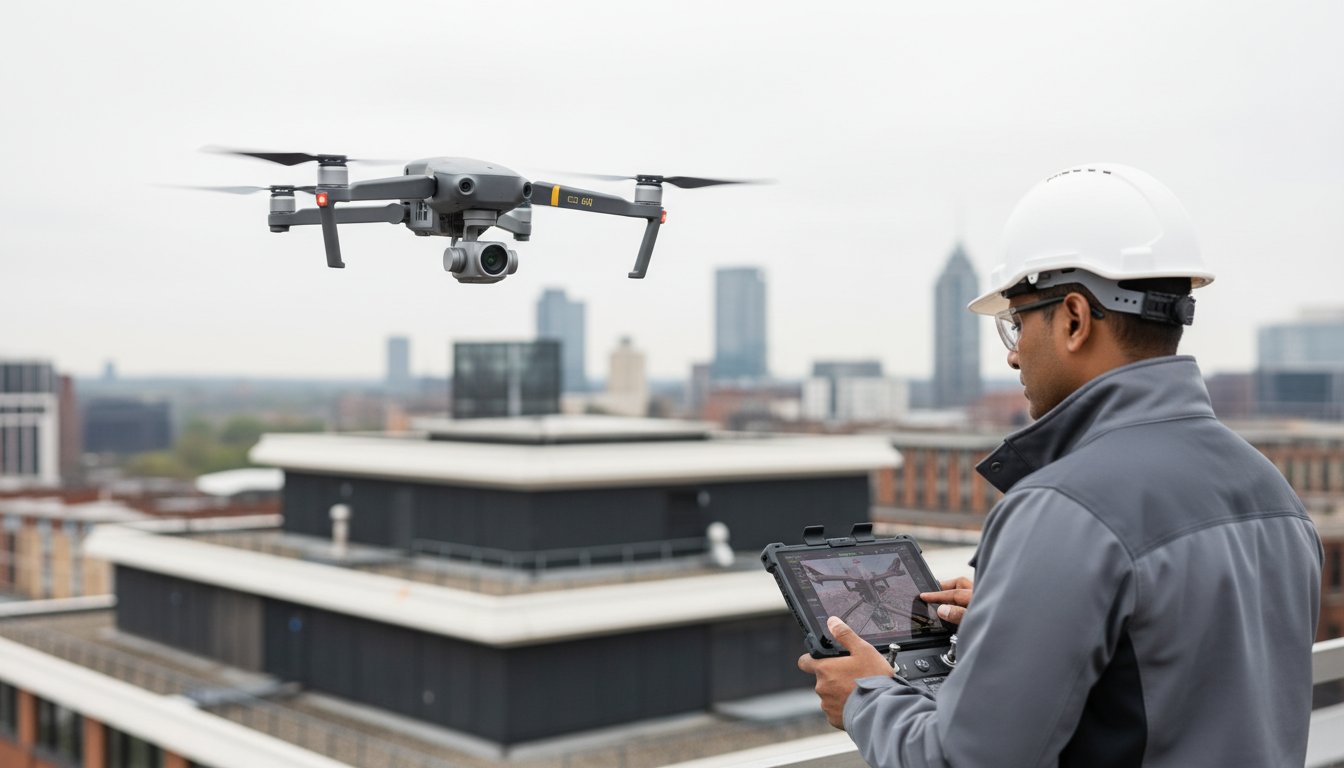
The spiralling costs, significant operational disruption, and inherent dangers of working at height make traditional roof inspections a major challenge for property managers and surveyors across the UK. Erecting scaffolding is not only a slow and expensive process, but it also introduces considerable Health and Safety Executive (HSE) compliance burdens. For many, finding a way to conduct a safe roof inspection without scaffolding has become a critical priority for both budget management and operational safety, moving beyond logistical headaches to a fundamental requirement for modern asset management.
Fortunately, a transformative, fully-compliant solution exists. In this article, we provide a comprehensive guide to how modern, CAA-certified drone technology delivers a superior alternative. You will discover how professional aerial survey services can eliminate the need for costly scaffolding, drastically reduce project timelines, and provide you with high-resolution, actionable data for precise maintenance planning. We will demonstrate how you can achieve a more thorough inspection with minimal disruption to your tenants or business operations, all while ensuring full compliance and providing complete peace of mind.
Key Takeaways
- Understand why traditional methods like scaffolding introduce unnecessary project risks, delays, and significant costs compared to modern drone technology.
- A safe roof inspection without scaffolding delivers high-resolution, actionable data to inform critical maintenance decisions, often in a fraction of the time.
- Learn the structured, professional process behind a drone-based roof survey, from initial planning and risk assessment to on-site data capture and analysis.
- Discover the essential CAA regulations and criteria for selecting a qualified and insured drone operator in the UK to ensure your project is both legally compliant and safe.
The Problem with Scaffolding: Why Traditional Roof Inspections Are Risky and Inefficient
Proactive roof maintenance is a non-negotiable aspect of protecting any commercial or residential property’s value. For decades, the standard approach involved manual surveys conducted from ladders or extensive scaffolding structures. While necessary, these traditional methods are fraught with risks, high costs, and logistical complexities. Today, modern technology offers a far superior alternative, establishing a safe roof inspection without scaffolding as the new industry benchmark for efficiency and data quality.
To see how this modern approach works in practice, consider this simple example of a drone-based check:
Unpacking the Safety Risks of Working at Height
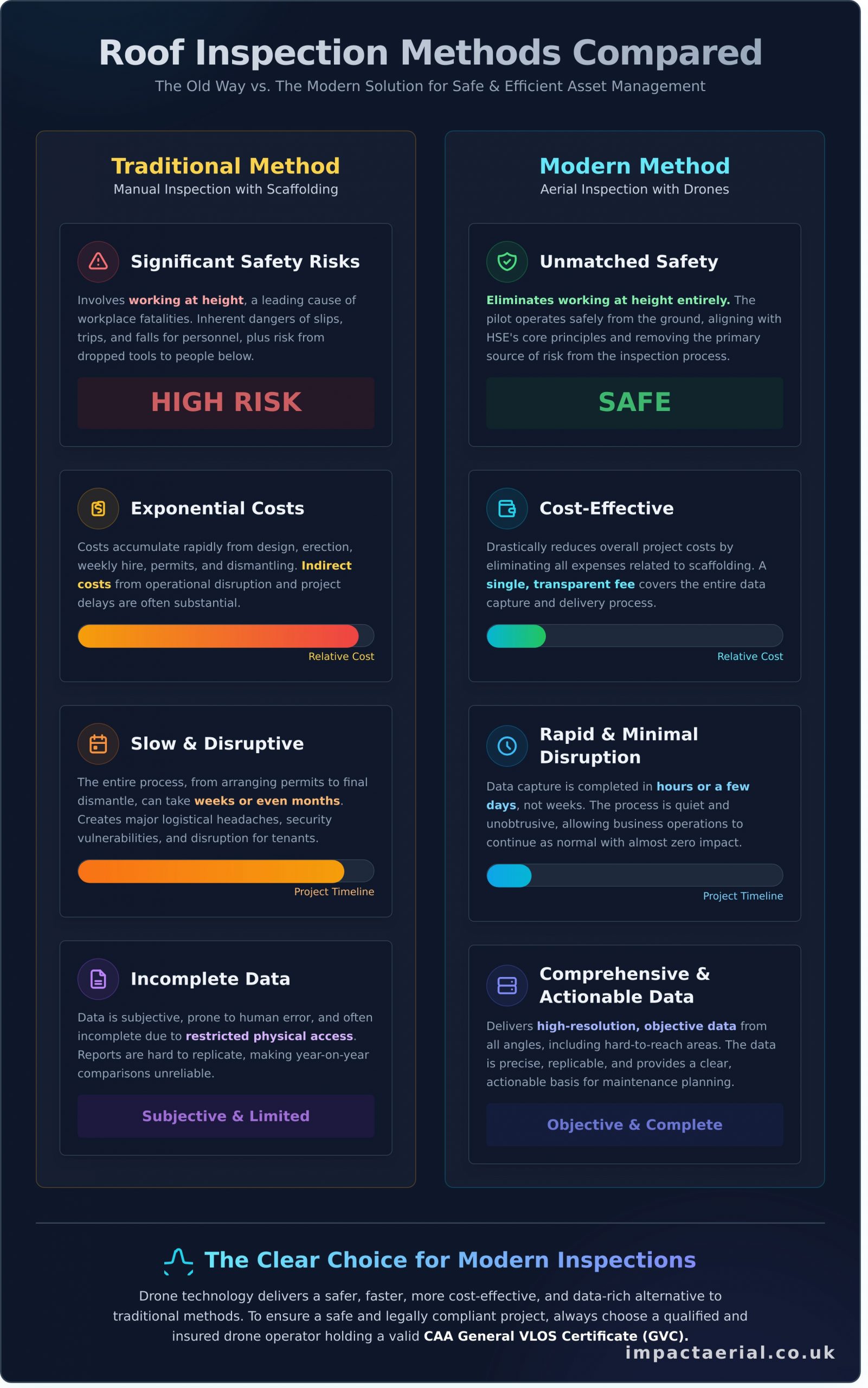
Working at height remains one of the leading causes of workplace fatalities and major injuries. In the UK, the Health and Safety Executive (HSE) enforces the Work at Height Regulations 2005 to mitigate these dangers, but the inherent risks of slips, trips, and falls from scaffolding or ladders can never be eliminated. Furthermore, there is a constant danger of dropped tools or materials posing a significant threat to people and property below. An accident not only has devastating human consequences but also leads to severe liability issues and drastically increased insurance premiums.
The True Cost of Scaffolding: More Than Just Metal Poles
The financial outlay for scaffolding goes far beyond the daily hire rate. The true cost is an accumulation of direct and indirect expenses that can quickly escalate. These include:
- Direct Costs: The fees for scaffold design, erection, dismantling, and weekly hire, plus the cost of any required council permits.
- Indirect Costs: Significant operational disruption for businesses, project delays waiting for assembly, and potential lost revenue.
- Damage and Complexity: Scaffolding can cause cosmetic damage to a building’s facade, pathways, or landscaping. For properties with complex roof shapes or listed status, these costs increase exponentially.
Logistical Headaches and Incomplete Data
Arranging scaffolding is a time-consuming process that creates numerous logistical challenges, including site security vulnerabilities from the new, unauthorised access points it creates. Critically, the data gathered from a manual inspection can be incomplete. Human error, combined with restricted access to hard-to-reach areas, often results in missed defects. This contrasts sharply with the comprehensive data-gathering seen in modern drone inspection applications. Manual reports are also subjective and difficult to replicate, making accurate year-on-year condition comparisons almost impossible.
Drone Technology: The Modern Solution for Scaffold-Free Roof Inspections
In the pursuit of a truly safe roof inspection without scaffolding, Unmanned Aerial Vehicles (UAVs), or drones, have emerged as the definitive modern solution. These are not consumer toys; commercial-grade drones are sophisticated data-gathering tools equipped with high-specification sensors and built-in safety features. Their deployment by a certified pilot revolutionises the inspection process, delivering unparalleled benefits across three key areas: safety, efficiency, and data quality. However, it is crucial to remember that the technology is only as effective as the CAA GVC Certified professional operating it.
Eliminating Working at Height for Unmatched Safety
The foremost advantage of using drones is the complete removal of personnel from dangerous heights. The pilot operates the UAV from the safety of the ground, mitigating the primary risk associated with traditional inspections. This method aligns perfectly with the HSE’s core principle of avoiding work at height wherever possible. Drones can access structurally-sensitive areas, such as fragile skylights or steep, unstable pitches, without any physical contact, providing comprehensive data without endangering a surveyor. This ground-based approach is a significant step towards eliminating workplace fatalities associated with falls, while also reducing liability and insurance premiums for building owners.
Drastic Reductions in Time and Cost
The efficiency gains offered by drone inspections are substantial. Where erecting scaffolding can take several days and cause significant disruption, a comprehensive drone survey is often completed in just a few hours. For example, a large commercial warehouse roof that would traditionally require a week of costly preparation can be thoroughly documented in a single morning. This minimal disruption is invaluable for active businesses and tenanted properties. Consequently, the financial savings are significant, with clients often seeing a cost reduction of 50-70% compared to the combined expense of scaffolding hire, labour, and permits.
Superior Data Quality with High-Resolution and Thermal Imaging
Drone technology provides a level of detail that is often impossible to achieve from scaffolding. The data captured is not only safer to acquire but is also demonstrably superior. Key data-gathering capabilities include:
- High-Resolution Visuals: 4K cameras capture crystal-clear imagery, allowing for the identification of even minor defects like cracked tiles, degraded sealant, or blocked gutters.
- Thermal Imaging: An infrared camera payload can detect anomalies invisible to the naked eye, such as trapped moisture beneath a flat roof membrane or areas of significant heat loss, pinpointing insulation failures.
- Measurable Models: Using a technique called photogrammetry, the collected images can be processed to create dimensionally accurate 2D maps and 3D models of the entire roof structure for precise analysis and record-keeping.
Furthermore, pre-planned flight paths can be repeated with centimetre-level accuracy, enabling reliable condition monitoring and tracking of deterioration over time.
The Drone Roof Inspection Process: What to Expect from Start to Finish
Understanding the process behind a professional drone survey demystifies the service and highlights its value as a structured, data-driven project. Far from simply flying a drone over a building, a commercial aerial survey is a meticulous operation designed to deliver a safe roof inspection without scaffolding, providing actionable insights for facility managers and property owners. This structured approach is part of how modern aerial technologies revolutionize building inspections, transforming a complex task into a manageable, data-driven project. The process is typically broken down into three distinct phases.
Phase 1: Pre-Flight Planning and Risk Assessment
This foundational stage ensures all operations are safe, compliant, and tailored to your specific objectives. It is the most critical part of delivering a successful and safe roof inspection without scaffolding.
- Initial Consultation: We begin by discussing your project goals, the specifics of the site, and the key data you need, whether it’s identifying water ingress, checking for damaged tiles, or assessing HVAC unit conditions.
- Desktop Survey: Our team conducts a detailed off-site review, checking UK airspace regulations (using tools like Drone Assist), identifying potential ground hazards, and assessing the surrounding environment.
- Flight Plan & RAMS: A comprehensive flight plan is created, alongside a detailed Risk Assessment and Method Statement (RAMS). This document outlines all procedures and safety protocols for client approval.
- Scheduling: A suitable date is scheduled, taking into account weather forecasts, site access, and any operational requirements of your facility to minimise disruption.
Phase 2: On-Site Operations and Data Capture
With planning complete, the on-site phase is executed with precision and a primary focus on safety. A CAA-certified pilot arrives and conducts a series of pre-flight checks on the equipment and the immediate environment. A secure take-off and landing zone is established, and all relevant on-site personnel are briefed. The pilot then executes the pre-programmed automated flight paths to ensure comprehensive, overlapping coverage, supplemented by manual flights to capture specific areas of interest in high detail. Depending on the brief, this will include capturing both high-resolution visual (RGB) imagery and thermal data to identify hidden issues like moisture retention or heat loss.
Phase 3: Data Processing and Reporting
Once the flight is complete, the captured raw data is securely transferred and backed up. This data is then processed using specialised photogrammetry software to create detailed, measurable outputs such as high-resolution orthomosaic maps and 3D models of your roof. Our experts analyse these outputs to pinpoint defects, anomalies, and potential maintenance issues. The final deliverable is a comprehensive inspection report, complete with annotated images, clear descriptions of findings, and actionable recommendations, presented in an easy-to-understand format for your maintenance teams and stakeholders.
Beyond a Simple PDF: Actionable Data Deliverables from a Drone Survey
The true value of a professional drone survey lies not in a simple folder of photographs, but in the quality and usability of the data captured. A modern, safe roof inspection without scaffolding delivers a suite of actionable intelligence that transforms reactive repairs into proactive asset management. This detailed data provides a complete, verifiable record of your roof’s condition, empowering you to make informed, budget-conscious maintenance decisions with confidence.
High-Resolution Orthomosaic Maps
An orthomosaic map is a single, geometrically-corrected, high-resolution image stitched together from hundreds or thousands of individual photographs. It provides a complete, top-down, map-like view of your entire roof structure. This powerful tool allows for precise measurements of lengths and areas, and enables us to pinpoint the exact location of every defect, from cracked tiles to pooling water, forming the foundation of a comprehensive, annotated report.
Interactive 3D Models
Using a process called photogrammetry, we create a detailed and accurate 3D model of your entire building. This isn’t just a visual gimmick; it’s a powerful diagnostic tool. Clients can digitally navigate, zoom, and rotate the model on their own computer, inspecting complex geometry like chimneys, parapet walls, and skylights from any conceivable angle. This level of detail is invaluable for planning complex repairs or new installations, such as solar panels or HVAC units.
Annotated Reports and Thermal Maps
The culmination of our data-gathering is a clear, concise, and actionable report. We deliver more than just raw data; we provide analysis. Key findings are presented in a comprehensive PDF document where:
- Defects are clearly annotated on high-resolution images, with descriptions and precise locations noted.
- Thermal maps (where applicable) highlight temperature anomalies, clearly indicating potential water ingress, saturated insulation, or heat loss invisible to the naked eye.
- Recommendations are provided, giving your maintenance teams or contractors a clear brief to work from.
This final document transforms a complex survey into a straightforward plan of action. To understand the level of detail we provide, you can see examples of our detailed reports. Contact Impact Aerial for a demonstration.
How to Choose a Compliant and Professional Drone Operator in the UK
Choosing a drone service provider is more than just finding someone with a drone; it’s about entrusting the safety and security of your property to a qualified professional. The UK’s commercial drone industry is highly regulated by the Civil Aviation Authority (CAA) to ensure public safety. Hiring a non-compliant operator not only exposes you to significant legal and financial risk but also compromises the quality and reliability of the inspection data. To ensure you commission a truly safe roof inspection without scaffolding, every potential operator must meet the following non-negotiable criteria.
Verify CAA Certification and Permissions
The Civil Aviation Authority (CAA) is the UK’s aviation regulator, and all commercial drone operations fall under its jurisdiction. A professional operator must hold a General Visual Line of Sight Certificate (GVC) and be able to present their official CAA Operational Authorisation document. This is not just a piece of paper; it is proof that the pilot is trained, competent, and legally permitted to fly commercially. Engaging an uncertified operator is a serious liability.
Confirm Adequate Commercial Insurance
Standard public liability insurance does not cover commercial drone flights. Your chosen operator must hold specialist aviation insurance that is compliant with regulation EC785/2004. For added peace of mind, we recommend a minimum public liability coverage of £5 million. This protects you, your property, and the public in the unlikely event of an incident. Always ask to see a current insurance certificate before any work commences.
Review Their Experience and Equipment
A proven track record is essential. Ask to see a portfolio of previous roof inspection projects, particularly in commercial or industrial settings similar to your own. A professional operator will use enterprise-grade equipment, including advanced drones specifically designed for commercial applications, which offer superior reliability and high-resolution imaging capabilities. Furthermore, they will have robust pre-flight safety procedures, risk assessments, and backup equipment to ensure the mission is completed safely and efficiently.
At Impact Aerial, we consider these standards the baseline for professional service. By prioritising compliance, insurance, and experience, you ensure your project is not only effective but also conducted with the highest degree of safety and professionalism.
The Future of Roof Inspections: Safe, Swift, and Scaffold-Free
The era of relying on costly, disruptive, and high-risk scaffolding for roof assessments is drawing to a close. As we’ve explored, drone technology provides a vastly superior alternative, delivering comprehensive, high-resolution data quickly and without putting personnel at risk. The key to unlocking these benefits lies in partnering with a qualified professional who understands the technical and regulatory landscape. Ultimately, a safe roof inspection without scaffolding is not just possible-it’s the new professional standard for proactive property management.
When you’re ready to embrace this modern approach, ensure you choose a partner with proven expertise. At Impact Aerial, we provide professional services backed by decades of commercial surveying experience. For your complete peace of mind, our operators are fully CAA GVC Certified and insured, utilising professional DJI Enterprise drones for top-quality data gathering. Don’t leave your asset’s integrity to chance.
Discover how our meticulous, compliant, and technologically advanced services can benefit your project. Request a professional quote for your scaffold-free roof inspection today and take the first step towards a more efficient and secure approach to your building maintenance.
Frequently Asked Questions
Is a drone roof inspection legally compliant in the UK?
Absolutely. A professional drone roof inspection is fully compliant with UK law, provided it is conducted by a commercially licensed operator holding a valid CAA GVC (General Visual Line of Sight Certificate). This certification ensures the pilot operates to the highest safety standards and possesses the required knowledge of UK airspace regulations. For added peace of mind, always verify your provider’s credentials and commercial liability insurance before commencing any work, ensuring a legally sound and secure operation.
What happens if the weather is bad on the scheduled inspection day?
Safety is our paramount concern. Commercial drones cannot be operated safely in adverse weather conditions such as high winds or heavy rain. If the weather is unsuitable on the scheduled day, we will proactively contact you to reschedule the inspection for the next available date with a suitable forecast. This is a standard professional practice, and there is no additional charge for weather-related postponements. Our priority is to gather high-quality data without compromising safety or asset integrity.
How accurate are the measurements taken from a drone survey?
Drone survey measurements are exceptionally accurate, often achieving precision to within 2-5 centimetres. By utilising advanced data-gathering techniques like photogrammetry, we create detailed 3D models and orthomosaic maps of your roof. These digital assets allow for precise measurements of lengths, areas, and volumes, providing engineers and surveyors with reliable data for assessments and planning. This level of accuracy is critical for detailed condition reports and accurate cost estimations for repairs.
Can a drone inspect every part of a complex roof?
Drones offer unparalleled access to complex roof structures, including intricate gables, steep pitches, and difficult-to-reach valleys that are hazardous for manual inspection. Our high-resolution cameras and manoeuvrable aircraft can capture detailed imagery of almost every external surface. While extremely confined spaces or internal voids may require alternative methods, a drone provides a far more comprehensive overview than can be achieved from the ground, making it an ideal solution for a safe roof inspection without scaffolding.
How much does a professional drone roof inspection cost compared to scaffolding?
A professional drone inspection offers substantial cost savings. While erecting scaffolding for a typical commercial building can cost several thousand pounds (£2,000 – £10,000+) and take days to assemble, a comprehensive drone survey is often completed in hours for a fraction of that price, typically starting from a few hundred pounds. This makes a drone-based inspection not only faster and less disruptive but also a significantly more cost-effective solution for routine maintenance and initial damage assessment.
Are drone inspections noisy or disruptive for building occupants?
Drone inspections are designed to be minimally disruptive. The commercial drones we operate produce a low level of noise, comparable to a household appliance, and are typically flying at a height where they are barely noticeable from inside the building. The entire data-gathering process is usually completed within a few hours, a stark contrast to the prolonged noise, visual intrusion, and access restrictions associated with erecting and dismantling scaffolding, ensuring business operations can continue as normal.
 2 Norton Drive, Wythall, Birmingham, B47 6HH Company registration number: 11138586. VAT Number: 366 9068 55