
While drone mapping can achieve a vertical accuracy of 3 to 5 cm with proper RTK technology, that precision is often lost during a fragmented post-production process. You’ve likely experienced the frustration of handling massive point clouds or orthomosaics that stall your existing CAD or BIM software. It’s a common challenge to feel overwhelmed by file sizes or uncertain about whether your digital twins meet the strict legal standards required for high-stakes construction and energy projects.
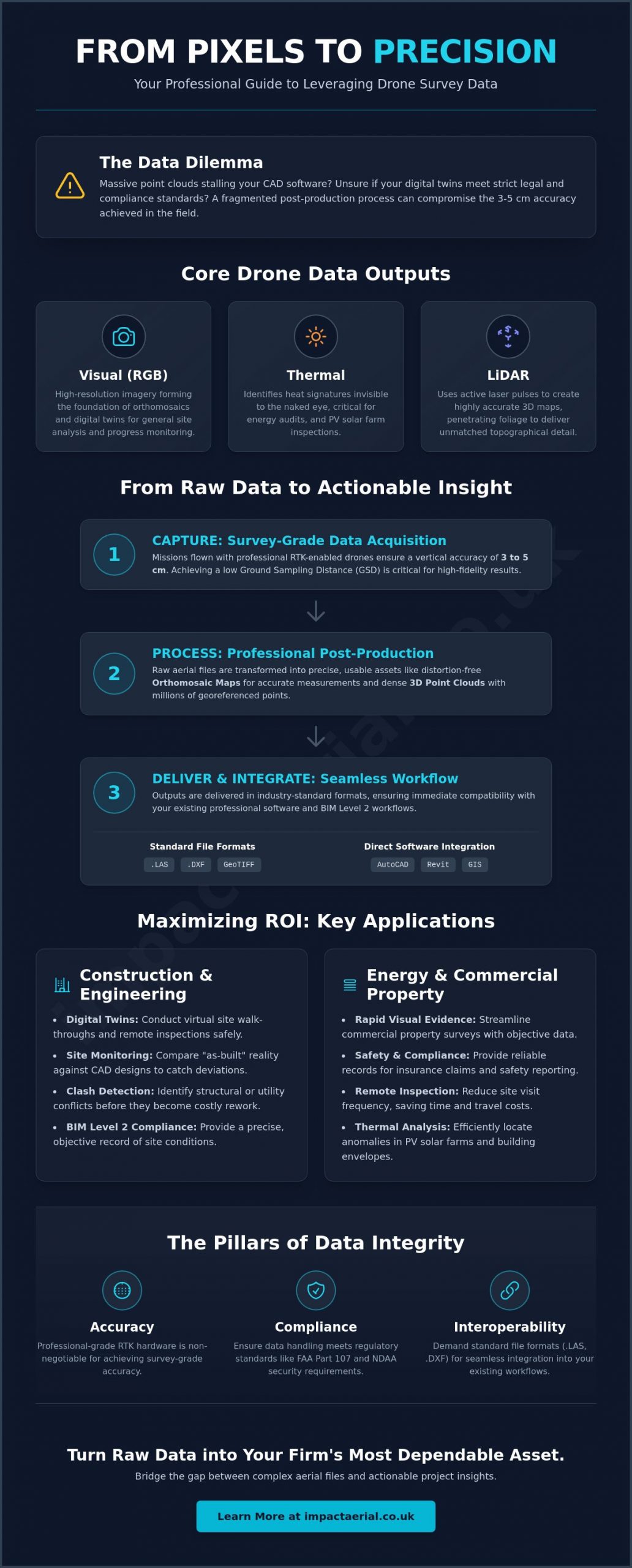
This professional guide explains how to use drone survey data effectively to transform raw aerial captures into precise, actionable insights. You’ll learn how to integrate these digital assets seamlessly into AutoCAD or Revit to reduce site visit frequency and improve safety reporting with objective visual evidence. We’ll also cover the technical requirements for maintaining compliance with 2026 FAA Part 107 rules and NDAA security standards, ensuring your data is as reliable as it is detailed. By the end of this guide, you’ll have a clear roadmap for turning complex aerial data into a dependable asset for your firm’s decision-making framework.
Key Takeaways
- Master the distinction between RGB, thermal, and LiDAR outputs to ensure your aerial data aligns with your specific engineering or inspection requirements.
- Discover how to use drone survey data effectively by mastering the export of .DXF and .LAS files for seamless integration into professional CAD and BIM Level 2 workflows.
- Maximise ROI by implementing digital twins for construction site monitoring and rapid, objective visual evidence in commercial property surveys.
- Ensure data integrity and regulatory compliance by understanding why professional-grade hardware and RTK positioning are essential for survey-grade accuracy.
- Streamline your decision-making process with a clear implementation roadmap that bridges the gap between raw aerial files and actionable project insights.
What is Drone Survey Data? Understanding the Core Outputs
Drone survey data isn’t simply a collection of aerial photographs. It’s a precise, georeferenced digital representation of a physical asset or landscape. To understand how to use drone survey data effectively, you must first distinguish between the three primary sensor outputs: visual (RGB), thermal, and LiDAR. RGB sensors provide the high-resolution imagery needed for general site analysis, whereas thermal sensors identify heat signatures during PV solar farm thermal surveys. LiDAR is distinct because it uses active laser pulses to map terrain even through dense foliage, providing a level of topographical detail that traditional cameras can’t match.
Raw data captured during a flight is essentially a massive collection of unstructured files. It’s through professional unmanned aerial photogrammetric survey techniques and dedicated post-production services that these files become useful. A critical metric in this process is Ground Sampling Distance (GSD). GSD represents the actual distance on the ground between the centers of two consecutive pixels. If your GSD is 2 cm, each pixel in your map represents 2 cm of real-world space. Achieving a low GSD is essential for the high-tier quality required in professional engineering and property surveys.
To visualize how these technical components come together during a professional mission, watch this deep dive:
Orthomosaic Mapping: The Foundation of Site Analysis
Orthomosaics are the foundation of modern site analysis. This process involves stitching together hundreds of overlapping aerial images into a single, distortion-free map. Unlike a standard photograph, an orthomosaic is geometrically corrected for camera tilt and topographic relief. This allows project managers to perform centimetre-accurate distance and area measurements directly from their screens. These maps are invaluable for construction site monitoring, as they provide a clear historical record of site progress. They allow for rapid, objective comparisons against original design plans to catch errors before they become costly.
3D Point Clouds and Digital Twins
When aerial data is processed, it creates a 3D point cloud. This is a collection of millions of individual data points, each assigned an X, Y, and Z coordinate. These point clouds can be converted into textured 3D meshes to create immersive digital twins. Using digital twins allows stakeholders to conduct virtual site walk-throughs and remote inspections without the safety risks or travel costs associated with physical visits. It’s a meticulous way to document a property’s condition, providing a reliable record for insurance and compliance purposes.
Integrating Data into Professional Workflows (CAD, BIM, and GIS)
Capturing high-resolution aerial imagery is only the first step in a professional survey. The true value of these digital assets is realized when they are integrated into your existing technical workflows. To understand how to use drone survey data effectively, you must prioritize interoperability. Professional surveyors deliver georeferenced data in industry-standard formats such as .DXF for vector files, .LAS for point clouds, and GeoTIFFs for orthomosaics. These formats ensure that your aerial captures are immediately compatible with the software your team uses every day.
In the UK, drone data is a vital component of BIM Level 2 compliance. By providing a precise “as-built” record, aerial surveys allow project managers to overlay current site conditions directly against original design CAD files. This objective comparison identifies structural deviations or utility clashes early, preventing the expensive rework that often delays large-scale construction and energy projects. This digital bridge also streamlines collaboration, allowing remote stakeholders to review site progress within a Common Data Environment (CDE) without needing to be physically present. If your team requires assistance with these complex deliverables, our post-production services ensure your raw data is refined into CAD-ready assets.
Using Drone Data in AutoCAD and Revit
For Scan-to-BIM projects, importing 3D point clouds into Revit allows architects to build models based on reality rather than outdated paper plans. This workflow eliminates the manual measurement errors that often occur with traditional ground-based methods. Engineers can also generate precise topographic contours from aerial data to inform site planning or use high-resolution overlays to verify the placement of structural steel and foundations. It’s a meticulous approach that ensures every element of the build aligns with the digital blueprint.
GIS Integration for Large-Scale Land Management
For environmental analysis and estate management, importing orthomosaics into ArcGIS or QGIS provides a level of detail that satellite imagery cannot match. You can combine drone-captured layers with existing Ordnance Survey maps to gain a comprehensive perspective of land assets. By managing multi-temporal data sets, organizations can track land changes over months or years. This is particularly effective for monitoring coastal erosion, managing large-scale vegetation, or documenting the impact of infrastructure developments on the surrounding environment.
Industry-Specific Applications: Maximising ROI in Construction and Energy
Understanding how to use drone survey data effectively involves moving beyond the digital map and into the balance sheet. For high-stakes industries, the return on investment isn’t just found in the speed of data collection, it’s found in the mitigation of risk and the prevention of project delays. By applying aerial insights to specific operational challenges, firms can transform a technical output into a significant cost-saving tool. Whether you are managing a multi-million pound infrastructure project or a sprawling energy estate, the goal is to replace manual, high-risk inspections with objective, repeatable data.
In the commercial property sector, rapid roof assessments have become a primary application. Traditional scaffolding or cherry picker access can take days to coordinate and execute, often with significant health and safety implications. A professional drone survey captures high-resolution imagery of entire roofing systems in a fraction of the time, allowing surveyors to identify defects, standing water, or structural compromises from the safety of the ground. This speed allows for more frequent inspections, ensuring that minor issues don’t escalate into major structural failures.
Construction Site Monitoring and Safety
Weekly drone flights provide a comprehensive visual record that ground-based photography simply cannot match. Project managers use these captures to identify potential health and safety hazards remotely, such as improper material storage or unsecured perimeters. Beyond safety, aerial data provides a reliable way to calculate stockpile volumes. By using 3D point clouds, software can determine the volume of earth or materials in seconds, a task that would take a manual survey team hours to complete. For a deeper look at these processes, see our guide on construction site monitoring to see how these workflows improve site transparency.
PV Solar Farm Thermal Surveys
For energy providers, the effectiveness of drone data is most apparent in thermal inspections. Solar farms often suffer from “hot spots” or defective cells that are completely invisible to the naked eye but significantly reduce power yield. By using radiometric thermal sensors, we identify these anomalies with precision. The real value comes from integrating this thermal data directly into your maintenance schedules. Instead of checking every panel, your team can go directly to the defective units identified in the survey. This targeted maintenance prevents power loss and quantifies the ROI through improved energy output and reduced technician hours.
Ensuring Data Integrity: Accuracy, Compliance, and Insurance
Data is only as valuable as its reliability. To understand how to use drone survey data effectively, you must first ensure that the foundation of your digital twin is technically sound and legally defensible. Many firms ask if they can simply use internal consumer drones for site mapping. While a hobbyist drone might capture a clear image, it lacks the Real-Time Kinematic (RTK) positioning required for survey-grade results. Standard consumer GPS has a margin of error that can reach several metres, whereas professional DJI Enterprise hardware achieves horizontal accuracy of 2 to 3 cm. This precision is the difference between a visual reference and a tool that can be used for high-stakes engineering decisions.
The legal weight of your data is equally important. In 2026, mandatory Remote ID systems and stricter data security protocols mean that commercial operations must be meticulously documented. Data captured by a non-certified pilot often lacks the necessary metadata and safety logs to stand up in a legal or insurance dispute. By using a CAA-certified pilot, you ensure that every flight follows a structured risk assessment process, providing you with objective visual evidence that carries professional authority. If you are ready to implement these standards on your next project, you can request a compliance-led survey from our expert team.
Why CAA GVC Certification Matters for Your Data
The General Visual Line of Sight Certificate (GVC) is more than just a permit to fly; it’s a guarantee of operational safety. This certification ensures that pilots have undergone rigorous training in airspace management and emergency protocols, which is vital when operating in congested areas or near critical infrastructure. Certified operations significantly mitigate risk for the client, ensuring that data collection doesn’t compromise site safety. For a detailed breakdown of these regulations, refer to our UK drone license guide to understand how these rules protect your project’s integrity.
Professional Liability and Data Security
High-value sites require more than just technical skill; they require financial protection. We maintain £5m commercial liability insurance, which is a fundamental prerequisite for any professional drone survey in 2026. This coverage provides peace of mind for stakeholders, ensuring that any unforeseen incidents are fully covered under a commercial policy. Beyond physical safety, we implement strict data handling protocols. Your survey data is stored on secure servers and delivered via protected links to prevent unauthorized access. Professional insurance and robust cybersecurity are no longer optional extras; they are the baseline for trustworthy commercial drone operations.
From Raw Files to Decisions: Your Implementation Roadmap
Transitioning from a successful flight to a data-driven decision requires a structured approach. Learning how to use drone survey data effectively is not just about the technology; it’s about the workflow that follows the capture. To ensure your project benefits from the high-tier precision of aerial data, follow this five-step implementation roadmap.
- Step 1: Define clear project objectives. Before the drone even leaves the ground, you must determine if you require survey-grade accuracy (RTK-driven) for engineering or high-resolution visual detail for property inspections. Defining these goals early prevents the collection of redundant data.
- Step 2: Choose the right output format. Ensure your internal software, whether it’s Revit, AutoCAD, or ArcGIS, is compatible with the deliverables. Requesting .DXF for vectors or .LAS for point clouds ensures a seamless transition into your existing technical environment.
- Step 3: Establish a collection cadence. Data is most valuable when it’s used for comparison. Establish a routine, such as weekly flights for construction site monitoring or biannual checks for solar farm health, to track changes over time.
- Step 4: Distribute insights via cloud platforms. Massive file sizes can hinder collaboration. Use cloud-based viewers to share digital twins and orthomosaics with remote stakeholders, allowing them to measure and annotate data without specialized hardware.
- Step 5: Partner with a specialist for analysis. Raw data is a liability if it isn’t processed correctly. Partnering with a professional for post-production services ensures that your outputs are accurate, compliant, and ready for immediate use.
Consultation and Project Planning
At Impact Aerial, we work closely with our clients to define the most efficient data capture strategy for their specific needs. Our meticulous pre-flight planning involves identifying site constraints, managing airspace permissions, and ensuring every mission adheres to the strictest safety protocols. We don’t just deliver files; we provide a customized deliverable that aligns with your industry requirements. This structured consultation phase ensures that the final data is a reliable asset rather than a technical burden for your team.
Ready to Elevate Your Project Data?
Professional drone services provide UK businesses with an objective, high-resolution perspective that traditional methods simply cannot match. From reducing site visit frequency to improving the accuracy of safety reporting, the benefits of digital twins are clear. Based in Birmingham, we provide nationwide coverage, bringing technical expertise and CAA-certified reliability to projects across the country. If you are ready to transform your site operations with high-tier aerial insights, contact us today to request a bespoke survey quote and discover how our professional standards can support your project goals.
Advancing Your Digital Site Strategy
The transition from raw aerial files to high-tier project intelligence requires a meticulous approach to software integration and regulatory compliance. You’ve seen that the true value of these digital assets lies in their ability to merge with existing CAD and BIM workflows, providing a reliable as-built record that reduces site visits and costly rework. Understanding how to use drone survey data effectively is ultimately about bridging the gap between sophisticated hardware and your firm’s decision-making framework. For teams looking to scale these digital insights through automation, you can learn more about Business With AI Strategist to discover strategic implementation services.
By prioritizing survey-grade accuracy and professional-grade outputs, you ensure that every digital twin is a defensible asset for your business. We provide the technical expertise needed to secure these results, supported by CAA GVC Certified Pilots and the latest DJI Enterprise Grade Hardware. Our operations are backed by £5m Commercial Liability Insurance, offering the reassurance and reliability required for complex infrastructure and energy projects.
If you’re ready to modernize your data collection process, request a professional drone survey quote from Impact Aerial today. We look forward to helping you transform your aerial perspectives into tangible project success.
Frequently Asked Questions
How accurate is drone survey data compared to traditional methods?
Drone surveys achieve horizontal accuracy of 2 to 3 cm and vertical accuracy of 3 to 5 cm when using RTK or PPK technology. This level of precision is comparable to traditional ground-based surveying for most construction and property applications. While traditional methods are meticulous for individual points, drones provide a much higher data density by capturing millions of points across the entire site in a fraction of the time.
What software do I need to view drone survey point clouds?
To view and manipulate 3D point clouds, you typically need professional CAD or BIM software such as Autodesk Revit, AutoCAD, or Civil 3D. For large-scale land management and environmental analysis, GIS platforms like ArcGIS or QGIS are the industry standard. These tools allow you to integrate aerial data into your existing technical workflows for precise measurements and structural analysis.
Can drone survey data be used for legal property boundary disputes?
Drone data provides objective visual evidence of physical encroachments and site conditions that can support legal cases. However, it must be captured by a CAA-certified pilot to ensure the metadata and safety logs are defensible. While it doesn’t replace official title deeds, it serves as a powerful supplement to a licensed surveyor’s report by providing an undeniable visual record of the land at a specific date.
How long does it take to process drone survey data after the flight?
A typical 50-acre drone survey can be completed, from flight to final deliverable, in approximately 4 to 8 hours. This rapid turnaround is a key reason why project managers prioritize how to use drone survey data effectively for tight construction schedules. More complex datasets, such as high-density LiDAR or multi-temporal thermal analysis, may require additional processing time in post-production to ensure high-tier quality.
What is the difference between LiDAR and Photogrammetry in drone surveys?
LiDAR uses active laser pulses to map the terrain and can penetrate dense vegetation to reach the ground surface. Photogrammetry relies on overlapping high-resolution images to reconstruct a 3D model through triangulation. While photogrammetry is excellent for visual site mapping and progress monitoring, LiDAR is the professional choice for topographical surveys in wooded areas or for mapping thin infrastructure like power lines.
Is a drone survey cheaper than a traditional land survey?
Drone surveys are frequently 50% to 75% less expensive than traditional ground-based surveys for large sites. This cost efficiency is driven by the significant reduction in field hours and the ability to cover vast areas without a large team of surveyors. By choosing aerial methods, firms can allocate their budgets more effectively while receiving a more comprehensive digital representation of their physical assets.
What weather conditions prevent a drone survey from being accurate?
High winds, heavy rain, and low-light conditions are the primary factors that compromise data integrity. Excessive wind can cause motion blur in photogrammetry, while rain interferes with laser sensors and camera lenses. Meticulous pilots monitor weather windows to ensure that every flight is conducted within the safe operational limits of their DJI Enterprise hardware, ensuring the final output meets professional standards.
Do I need to be on-site during the drone survey?
You don’t need to be physically present during the drone operation as long as the pilot has site access and a clear project brief. The captured data is processed and delivered via secure digital links, allowing you to review site conditions from any location. This remote capability is a major benefit for stakeholders managing multiple projects across the country, as it eliminates the need for frequent travel.
 2 Norton Drive, Wythall, Birmingham, B47 6HH Company registration number: 11138586. VAT Number: 366 9068 55