Navigating the world of UK drone regulations can often feel like deciphering a complex code. With acronyms like GVC, Open Category, and various subcategories, it’s easy to feel uncertain about what is legally required for a commercial drone operation. One of the most significant qualifications within this framework is the a2 cofc, or A2 Certificate of Competency. Understanding its place is fundamental for anyone looking to fly drones or hire a professional pilot for their project.
This simple guide is designed to provide clarity and professional assurance. We will break down exactly what the A2 CofC is, the specific operational advantages it grants a pilot, and how it differs from other Civil Aviation Authority (CAA) qualifications. By the end, you will be equipped with the knowledge to ensure any drone work you commission is not only high-quality but, most importantly, fully legal, insured, and conducted with the utmost safety.
What Exactly is the A2 CofC? A Plain English Explanation
Navigating the world of drone qualifications can seem complex, but understanding the key certifications is crucial for any professional or hobbyist pilot. At its core, the A2 CofC stands for the ‘A2 Certificate of Competency’. It is a key drone qualification issued by the UK’s Civil Aviation Authority (CAA) that sits a step above the mandatory, basic Drone and Model Aircraft Registration and Education Service (DMARES) requirements, which include the Flyer ID.
To provide a practical overview of what the qualification entails, this video offers an excellent first-hand account of the journey:
Holding an A2 CofC grants you greater operational freedom, specifically allowing you to fly closer to uninvolved people, albeit with strict limitations that we will cover later. This qualification operates within a specific regulatory framework known as the ‘Open Category’, which is designed to manage low-risk drone flights across the UK and Europe.
Understanding the UK’s ‘Open Category’ for Drones
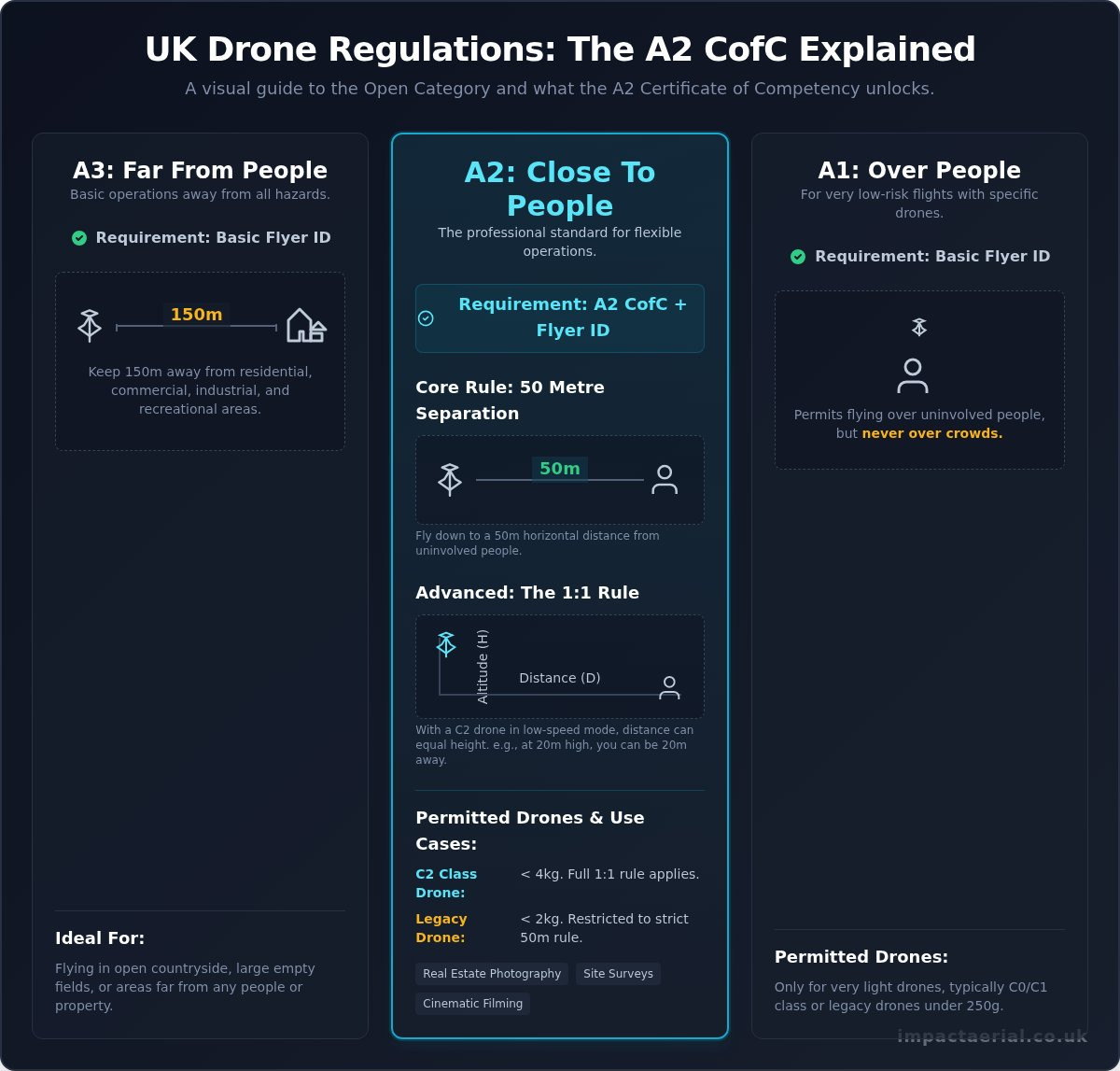
The Open Category is the foundation for most recreational and straightforward commercial drone operations. It is divided into three subcategories based on the level of risk involved. Think of it like driving licence categories, where different licences permit you to operate different types of vehicles. The overall framework is defined by comprehensive UK drone regulations, but the subcategories are:
- A1: Flying over people (only with very light, specific drones).
- A2: Flying close to people. This is the subcategory where the A2 CofC is required.
- A3: Flying far from people and built-up areas.
A2 CofC vs. Flyer ID: What’s the Difference?
It is essential to distinguish between the Flyer ID and the A2 CofC. The Flyer ID is a mandatory, foundational requirement for anyone flying a drone weighing 250g or more in the UK. It is obtained by passing a simple online theory test covering basic safety rules. In contrast, the a2 cofc is an additional, optional qualification. Achieving it requires passing a more rigorous, formal examination with a CAA-approved entity, demonstrating a much deeper understanding of meteorology, flight performance, and operational risk management. This higher level of knowledge is what unlocks the privilege of operating with more freedom in the A2 subcategory.
What Can You Actually Do with an A2 CofC?
Holding an A2 Certificate of Competency, often referred to as the a2 cofc, fundamentally changes where and how you can operate your drone in the UK. Its primary benefit is granting you the permission to fly closer to uninvolved people than is permitted in the A3 (Open) subcategory, unlocking a wider range of commercial and recreational opportunities. This qualification, as detailed by the Civil Aviation Authority, is a crucial step for any pilot looking to operate with greater flexibility while maintaining full compliance with UK regulations. It signifies a higher level of theoretical knowledge, particularly concerning meteorology, drone performance, and mitigating ground risk.
Flying Closer to People: The 50-Metre Rule Explained
The core advantage of the A2 CofC is the reduction in separation distances. With this certificate, you can fly down to a horizontal distance of 50 metres from uninvolved people. It is critical to understand that you must never intentionally fly directly over them. Furthermore, if your C2-class drone is in a designated low-speed mode, you can get even closer using the ‘1:1 rule’. This allows you to reduce the horizontal separation distance to be equal to the drone’s height. For example, if you are flying at 15 metres high, you only need to be 15 metres away horizontally. This is a significant operational advantage compared to the A3 subcategory, which requires staying 150 metres away from residential, commercial, and industrial areas.
Drone Classes and Your A2 CofC
The permissions granted by your A2 CofC are directly linked to the class of drone you are flying. This certificate primarily applies to operations with C2 class drones, which have a maximum take-off mass of under 4kg. Popular examples include the DJI Mavic 3 series and the DJI Air 3. For pilots operating older drones without a C-class marking (known as ‘legacy’ drones), transitional rules apply. An A2 CofC holder can fly a legacy drone weighing up to 2kg, but must maintain a strict 50-metre horizontal separation from uninvolved people at all times; the 1:1 rule does not apply in this case. Always verify your drone’s classification before any flight to ensure compliant operations.
Practical Scenarios for A2 CofC Operations
These enhanced permissions open up numerous professional applications in lower-risk environments where maintaining a 150-metre buffer is impractical. Common scenarios include:
- Real Estate Photography: Safely capturing high-quality images of a property in a suburban area, maintaining the required 50-metre distance from neighbouring houses and gardens.
- Commercial Site Surveys: Conducting detailed inspections or creating photogrammetry models of a small commercial building or industrial unit where staff or the public may be nearby, but not within the immediate operational area.
- Cinematic Filming: Flying in a park or on private land to capture establishing shots for a film or corporate video, where you can manage a 50-metre buffer from any members of the public.
The A2 CofC Exam and Training Process
Achieving your A2 Certificate of Competency is a structured and highly valuable process designed to elevate your drone piloting from a hobbyist level to a recognised standard of competence. The entire qualification, from training to examination, is delivered by Civil Aviation Authority (CAA) approved organisations known as Recognised Assessment Entities (RAEs). This ensures that every pilot holding an a2 cofc has met a consistent, high standard of theoretical knowledge and practical awareness.
The process is far more accessible than many assume and is broken down into two core components: a theoretical examination and a period of self-guided practical flight training. Upon successful completion, the certificate is valid for a period of five years, providing a long-term qualification for your operations.
What’s on the Theory Exam?
The theoretical exam is the cornerstone of the A2 CofC qualification. It is designed to ensure you have a robust understanding of the principles that govern safe flight, building upon the foundational knowledge outlined in The Drone and Model Aircraft Code. The exam is typically conducted online and consists of a minimum of 30 multiple-choice questions. Key syllabus topics include:
- Meteorology: Understanding how weather conditions like wind, visibility, and precipitation affect drone flight.
- UAS Flight Performance: A technical look at how a drone operates, including battery life, payload effects, and turning circles.
- Mitigating Ground Risk: Assessing and managing risks to people and property on the ground, a critical skill for flying closer to uninvolved persons.
Self-Certified Practical Flight Training
One of the most distinct features of the A2 CofC process is the absence of a formal, in-person flight test with an examiner. Instead, candidates undertake a period of self-certified practical flight training. This means you are responsible for completing a set amount of flying practice in conditions that are representative of how you will operate under the A2 CofC.
Once you have completed this practical element and are confident in your abilities, you simply make a formal declaration to your RAE. This approach is designed to build genuine piloting skill and confidence, ensuring you have the hands-on experience needed to operate safely and effectively before you begin to utilise the privileges of the certificate.
A2 CofC vs. GVC: Which Qualification is for Professionals?
While the A2 CofC is an excellent qualification for skilled hobbyists and those undertaking very simple commercial work, its operational limits are important to understand. For professional pilots conducting complex commercial operations in the UK, the next level of certification is the General VLOS Certificate (GVC). The GVC is the key that unlocks the ability to operate in the ‘Specific Category’, which is where the vast majority of professional drone services take place.
Key Differences in Flying Permissions
The fundamental distinction between the two qualifications lies in the permissions they grant. An A2 CofC authorises a pilot to fly strictly within the rules of the Open A2 subcategory. The GVC, however, does not grant permissions directly; instead, it demonstrates a level of pilot competency that allows the holder to apply to the Civil Aviation Authority (CAA) for an Operational Authorisation. This authorisation provides bespoke permissions for flights that fall outside the standard rules, such as flying closer to buildings or people for a detailed structural inspection in a built-up area.
When is an A2 CofC Not Enough?
The limitations of an A2 CofC quickly become apparent when planning more demanding commercial projects. A GVC and an Operational Authorisation become essential for any operation that involves:
- Flying in congested urban areas, like city centre roof surveys or construction site monitoring.
- Operating closer than 50 metres horizontally to uninvolved people, a common requirement for detailed asset inspection.
- Conducting specialised flights that require specific CAA permissions due to the nature of the task or the weight of the drone.
In these scenarios, relying solely on Open Category permissions would be both operationally restrictive and non-compliant.
Why Impact Aerial Operates with a GVC
At Impact Aerial, our pilots hold the GVC because it is the undisputed UK industry standard for professional drone services. This qualification is far more than a certificate; it demonstrates a deep, tested understanding of operational procedures, meticulous risk assessment, and robust safety protocols. It is the benchmark for competence and professionalism in the commercial drone sector.
For our clients, this provides complete peace of mind. It is an assurance that every operation is meticulously planned, fully compliant with CAA regulations, and backed by comprehensive commercial insurance. When precision, safety, and legality are paramount, there is no substitute for a GVC-qualified team. Trust our GVC-certified pilots for your project.
Hiring a Drone Pilot: Why Qualifications Matter
Understanding drone regulations is crucial not just for pilots, but also for clients commissioning aerial work. When you hire a drone service, you are also taking on a degree of responsibility for the operation. Pilot qualifications, from the foundational A2 CofC to the more advanced GVC, are not just certificates; they are your assurance of a pilot’s commitment to safety, legal compliance, and professionalism. Choosing a qualified operator is the single most important step in protecting your business and ensuring a high-quality result.
The Risks of Unqualified Operators
Engaging an unqualified or uninsured drone pilot exposes your business to significant and unnecessary risks. The potential cost savings are minuscule compared to the potential liabilities, which can include:
- Invalid Insurance: If an operator lacks the correct commercial insurance, any accident or damage becomes your liability. Standard business insurance policies will not cover illegal drone flights, leaving you financially exposed.
- Increased Accident Risk: A qualified pilot is trained in risk assessment and emergency procedures. An amateur is far more likely to cause property damage or, in the worst case, serious injury.
- CAA Fines and Penalties: The Civil Aviation Authority (CAA) can impose significant fines for illegal commercial drone operations, which can apply to the person who commissioned the flight as well as the pilot.
- Poor Quality Results: Professionalism goes beyond flying. It includes understanding client briefs, capturing high-quality data, and delivering a polished final product. An unqualified operator often lacks the experience to deliver on these fronts.
Checklist for Hiring a Drone Company
For your peace of mind, always verify a potential drone provider’s credentials before work begins. A professional company will expect these questions and have the answers ready. Here is a simple checklist to follow:
- Do they hold a CAA Operational Authorisation? While an A2 CofC is an important pilot competency, most commercial work requires the operator to hold a General VLOS Certificate (GVC) and operate under a company-wide Operational Authorisation from the CAA.
- Can they provide proof of insurance? Ask to see a current certificate of commercial drone insurance. This should show a minimum of £1 million in public liability coverage.
- Do they have a robust safety process? A professional will always conduct detailed pre-flight site surveys and produce a comprehensive risk assessment and method statement (RAMS) for the specific operation.
- Can they show a portfolio? Ask to see examples of their previous work to ensure their skills and quality align with your project’s requirements.
At Impact Aerial, we believe in complete transparency. We provide all our credentials upfront, ensuring every operation is safe, legal, and fully insured. To discuss your project with a fully qualified and CAA-authorised team, please contact us today.
Navigating Drone Qualifications: Your Path to Professional Results
Understanding the UK’s drone regulations is the first step towards safe and effective flight. As we’ve explored, the a2 cofc is an excellent qualification that grants greater flying freedom for hobbyists and some basic commercial work. However, the key takeaway is recognising the clear distinction between this certificate and the more comprehensive GVC, which is the standard for professional, high-risk commercial operations.
When your project demands precision, safety, and regulatory compliance, hiring a proven expert is non-negotiable. At Impact Aerial, our specialists in commercial drone surveys and filming provide exactly that. Our pilots hold the advanced CAA GVC certification, and for your complete peace of mind, every operation is covered by £5m in commercial liability insurance. We manage the complexities so you can focus on the outstanding data and visuals.
Ready to see the difference a qualified professional makes? Discuss your project with our fully-certified drone professionals.
Frequently Asked Questions About the A2 CofC
How much does an A2 CofC course cost in the UK?
The cost of an A2 CofC course in the UK typically ranges from £99 to £150. Prices vary between different CAA-approved Recognised Assessment Entities (RAEs), so it is advisable to compare providers. This fee generally covers access to online learning materials and the final theoretical examination. Always ensure the provider is officially recognised by the Civil Aviation Authority to guarantee your qualification is valid for professional and recreational drone operations within the UK.
How long is the A2 CofC certificate valid for?
An A2 Certificate of Competency (A2 CofC) is valid for a period of five years from the date of issue. This fixed duration ensures that pilots remain familiar with the latest aviation regulations and best practices for safe drone operation. Once the five-year period concludes, the pilot must undergo a renewal process to continue exercising the privileges granted by the certificate and maintain their legal status to fly in the A2 subcategory of the Open Category.
Can I fly commercially with just an A2 CofC?
Yes, you can conduct commercial drone operations with just an A2 CofC, provided your flights fall within the A2 subcategory of the Open Category. This allows for flights with C2-class drones closer to people than is permitted in the A3 subcategory. However, for more complex operations that require permissions beyond the scope of the Open Category, such as flying in restricted airspace, a General VLOS Certificate (GVC) and an Operational Authorisation from the CAA are required.
Do I need to renew my A2 CofC, and what does it involve?
Yes, renewal is mandatory every five years to keep your qualification current. The renewal process for your A2 CofC typically involves retaking the theoretical examination with a CAA-approved training provider. This ensures your knowledge of air law, meteorology, and operational procedures remains up-to-date with any regulatory changes. Some providers may offer a shorter refresher course before the exam, but passing the test is the essential component for successful recertification.
What happens if I fly a C2 drone without an A2 CofC?
Flying a C2-class drone in the A2 subcategory without a valid A2 Certificate of Competency is a serious breach of Civil Aviation Authority (CAA) regulations. The potential consequences are significant and can include substantial fines, criminal prosecution, and the seizure of your drone equipment. Furthermore, any commercial liability insurance you hold would likely be invalidated in the event of an incident, leaving you personally liable for any damages or injuries caused during the illegal flight.
Is the A2 CofC recognised outside of the UK?
The A2 CofC is issued by the UK Civil Aviation Authority (CAA) and is therefore fully valid for drone operations within the United Kingdom. While it is not a global qualification, it is currently recognised across all European Union Aviation Safety Agency (EASA) member states. This means you can use your UK-issued certificate to fly under the same A2 subcategory conditions in EU countries, Norway, Iceland, Liechtenstein, and Switzerland, providing valuable flexibility for cross-border operations.
 2 Norton Drive, Wythall, Birmingham, B47 6HH Company registration number: 11138586. VAT Number: 366 9068 55