Investing in high-quality video is a critical decision for any business, yet navigating the process can feel complex. From understanding the difference between videography and full-scale video production to concerns about project costs in the UK and the complexities of hiring, it’s easy to feel uncertain. That’s why a clear understanding of professional videography services is the essential first step toward achieving your business objectives. This complete guide is designed to provide clarity and confidence for your next project.
We will demystify the entire process, explaining exactly what professional services include and how to choose the right provider for your specific needs. You will learn how to vet a professional’s credentials, understand the crucial legal and insurance requirements-especially concerning CAA regulations for drone operations-and ultimately, feel assured in your investment. By the end, you’ll have the knowledge to commission a top-quality video that is delivered safely, legally, and professionally, ensuring it meets your goals and provides a tangible return.
Understanding the Scope: What Do Videography Services Truly Include?
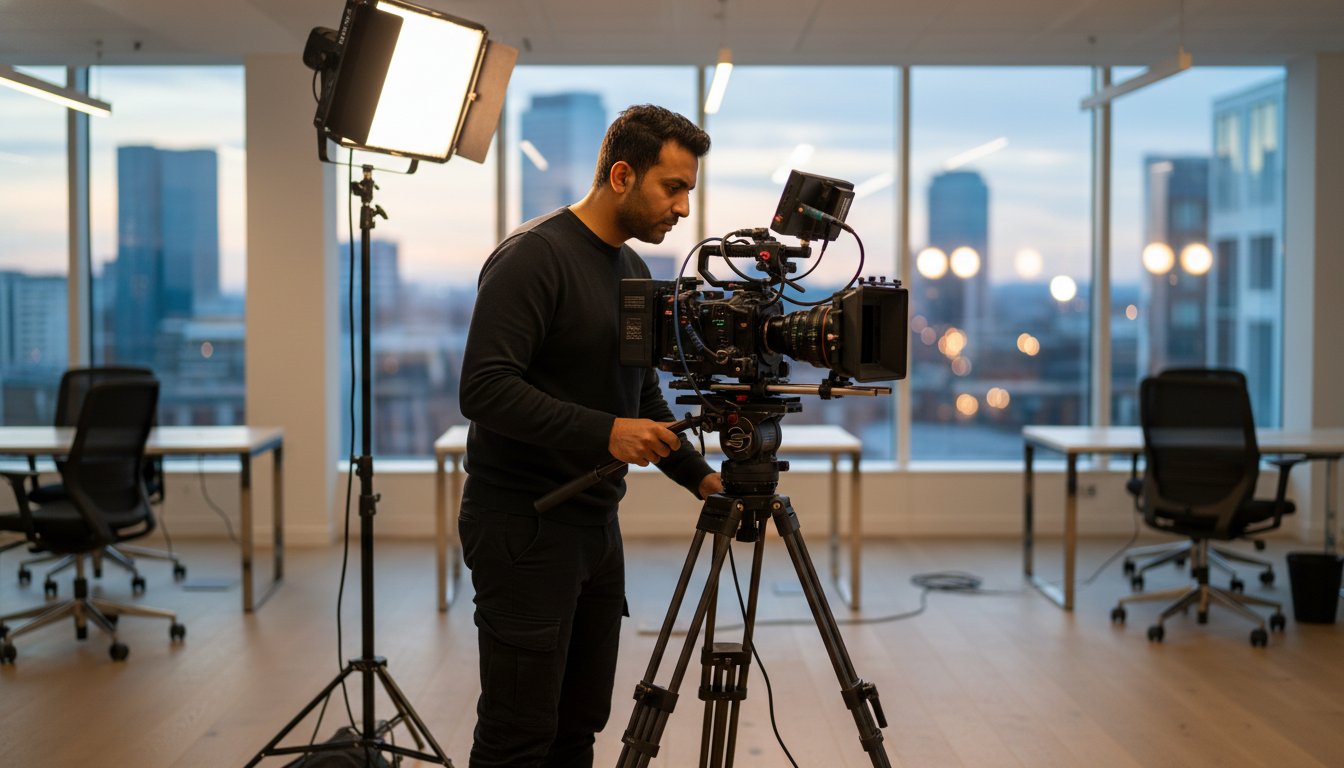
At its core, videography is the art and process of capturing moving images on electronic media. While the term is often used interchangeably with filmmaking, it specifically refers to the crucial on-location capture phase of a project. Understanding what videography services include is the first step for any business looking to commission high-quality visual content. It is where technical expertise with cameras, lighting, and sound transforms a concept into professionally shot footage, forming the foundation of the final product.
To better understand this concept, watch this helpful video:
Videography vs. Video Production: A Critical Distinction
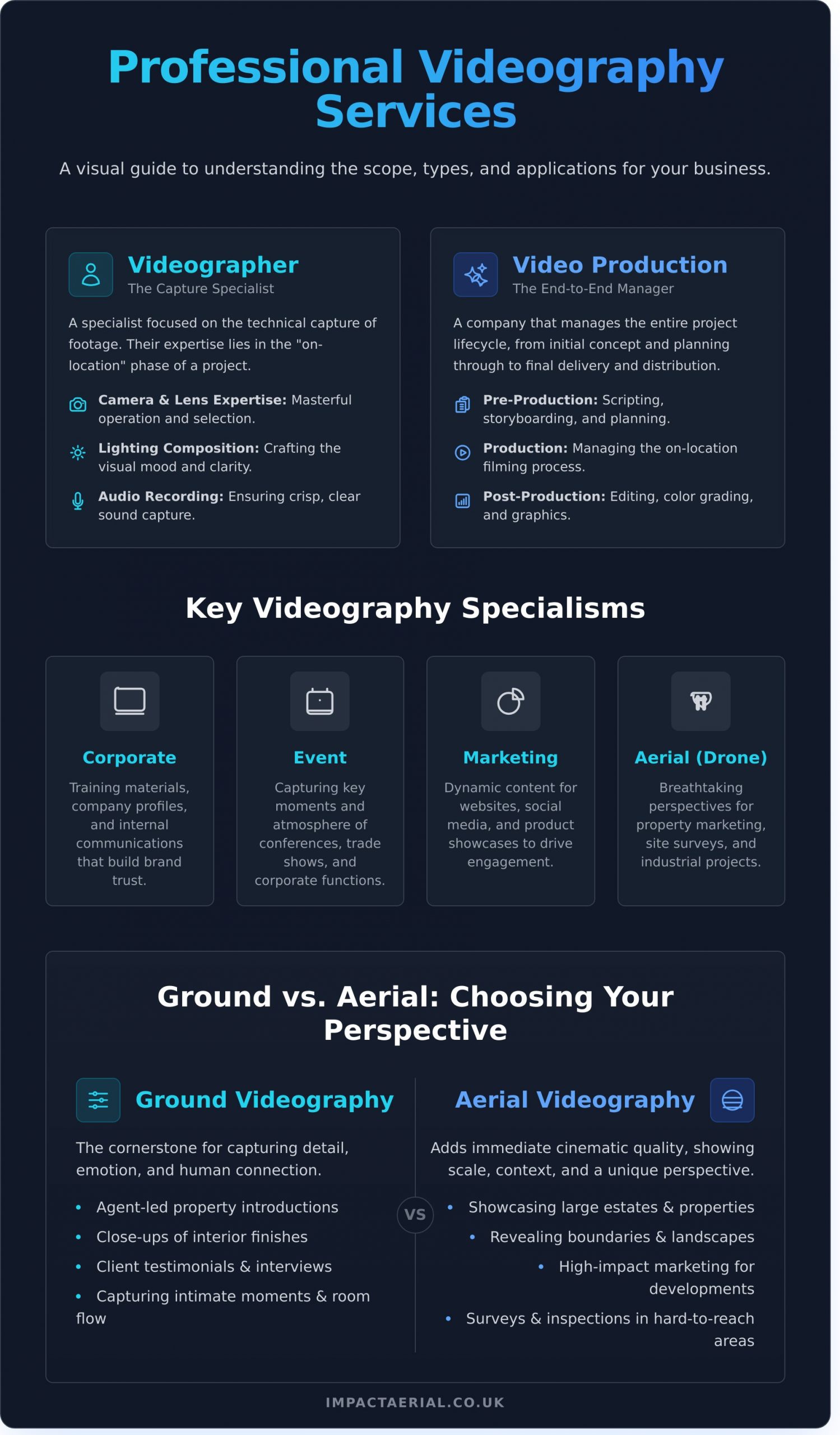
It is vital to distinguish between a videographer and a full video production company. A videographer is a specialist focused on the technical capture of footage. Their expertise lies in camera operation, lens selection, lighting composition, and clear audio recording. Conversely, a production company manages the entire project lifecycle, including pre-production (scripting, storyboarding, planning) and post-production (editing, colour grading, motion graphics). You might hire a videographer for direct-to-edit projects or to capture raw footage of an event, whereas a full production is necessary for complex marketing campaigns requiring end-to-end management.
Common Types of Videography Services for Business
Professional videography is tailored to meet specific business objectives. While the core skills are consistent, the application varies significantly across different sectors. Key specialisms include:
- Corporate Videography: Essential for creating internal training materials, company-wide communications, and professional company profiles that build brand trust.
- Event Videography: Focused on capturing the key moments, speaker sessions, and overall atmosphere of conferences, trade shows, and corporate functions for promotional use.
- Marketing & Promotional Videography: The creation of dynamic visual content specifically designed for websites, social media campaigns, and compelling product showcases.
- Aerial Videography: A powerful and highly specialised service using commercial drones to capture breath-taking perspectives, ideal for property marketing, site surveys, and large-scale industrial projects.
Ground vs. Air: Choosing the Right Videography for Your Project
In modern property marketing, professional videography is no longer a single-camera, fixed-perspective affair. The narrative you can build is defined by two primary viewpoints: traditional ground-level filming and dynamic aerial videography. The optimal choice is not a matter of one being superior to the other; it is entirely dependent on the project’s specific goals and the story you intend to tell. Selecting the right approach is a key part of the planning process, and understanding these differences is vital when you begin to research how to hire a professional videographer. Ultimately, the most compelling projects often leverage a strategic blend of both, creating a rich and comprehensive visual experience.
When to Use Traditional Ground Videography
Ground-level filming remains the cornerstone for capturing detail, emotion, and human connection. It is the ideal method for filming agent-led property introductions, client testimonials, and close-ups of high-end interior finishes. This perspective excels at conveying the texture of materials, the flow of a room, and intimate moments. For any content that requires clear dialogue or focuses on the human element of a space, traditional ground videography is essential.
The Unique Power of Aerial Videography
Utilising commercial drones operated by certified professionals provides a perspective that is simply unattainable from the ground. Aerial footage adds immediate cinematic quality, offering breathtaking establishing shots that reveal a property’s full scale, its boundaries, and its relationship to the surrounding landscape. This is perfect for showcasing large estates, commercial developments, or land parcels. Furthermore, our professional videography services use aerial platforms for dynamic tracking shots and for conducting essential surveys and inspections in hard-to-reach areas, ensuring comprehensive data gathering with maximum efficiency.
Industries That Benefit Most from Aerial Views
While many sectors can leverage aerial data, several industries see a transformative impact from high-quality aerial videography:
- Real Estate: Showcasing an entire property, its gardens, and proximity to local amenities in a single, sweeping shot.
- Construction: Providing stakeholders with clear progress monitoring, conducting site surveys, and creating high-impact marketing materials for finished projects.
- Tourism & Hospitality: Creating stunning promotional videos that capture the grandeur of resorts, golf courses, and scenic locations to attract visitors.
- Advertising: Adding a premium, cinematic feel to commercials that immediately captures audience attention and elevates brand perception.
How to Hire a Professional Videographer: A 5-Step Checklist
Selecting the right professional for your property marketing is a critical decision. High-quality videography services can transform your listings, but project success hinges on preparation and diligent vetting. This five-step checklist provides a structured approach to help you confidently hire the best provider, ensuring a smooth process from concept to completion.
Step 1: Define Your Project Goals & Brief
Before contacting any provider, define what success looks like. A detailed brief is the foundation of your project, ensuring the final video aligns with your business objectives. Understanding the core benefits of video marketing for business helps clarify your goals. Your brief should outline:
- Purpose: Is it to drive sales for a listing, build your brand, or train staff?
- Audience: Are you targeting first-time buyers or commercial investors?
- Desired Outcome: List key shots, the overall tone (e.g., luxurious, modern), and a call to action.
Step 2: Review Portfolios and Showreels
A portfolio is more than a collection of impressive shots; it’s a direct reflection of a provider’s capabilities. Look for specific experience in property or architectural videography. Assess the technical quality-is the footage stable, well-lit, and in focus? Most importantly, does their creative style align with your brand’s image and the tone you defined in your brief?
Step 3: Verify Credentials and Insurance
This step is non-negotiable. For any aerial footage in the UK, your videographer must hold a valid General Visual Line of Sight Certificate (GVC) from the Civil Aviation Authority (CAA). They must also carry adequate commercial liability insurance-a minimum of £5 million is standard. Verifying these credentials is essential for legality, safety, and your own protection. Impact Aerial’s pilots are fully certified for your peace of mind.
Step 4: Discuss Logistics and Request a Quote
Once you’ve shortlisted candidates, provide your brief and discuss their process and timelines. A professional will ask clarifying questions to fully understand your vision. Always request a formal, itemised quote that breaks down all costs, including filming, editing, and music licensing, to avoid unexpected expenses.
Step 5: Finalise the Contract and Pre-Production
Before committing, carefully review the service agreement. It should clearly outline the scope of work, deliverables, payment schedule, and content ownership. Once signed, work with your provider on a pre-production plan. This involves confirming shoot dates, locations, and risk assessments to ensure the filming day is efficient and productive.
Key Questions to Ask Before You Commit to a Service
Choosing the right partner for your property marketing is a critical decision. To ensure you receive the high-quality results your project deserves and to avoid any misunderstandings, it is essential to conduct thorough due diligence. A professional provider of 3D virtual tour and videography services will welcome detailed questions and provide clear, confident answers, demonstrating their expertise and commitment to your project’s success.
Arming yourself with the right questions helps establish a foundation of trust and clarity from the outset. Here are the key areas to cover before you commit.
Questions About Experience and Equipment
Understanding a provider’s technical capabilities and relevant experience is paramount. Their answers will reveal their suitability for the specific demands of property marketing.
- What specific cameras, lenses, and drone models do you use for a project of this nature?
- Can you provide examples of projects you have filmed in similar locations or challenging conditions (e.g., low light, complex architecture)?
- Could you share a portfolio piece or case study that had similar commercial goals to ours?
Questions About Process and Deliverables
A clearly defined process ensures a smooth collaboration and a final product that meets your specifications. It is vital to align on what will be delivered and who holds the rights to it.
- What is your creative process for planning a shoot, from initial brief to on-site execution?
- What are the specific deliverables? (e.g., raw footage, number of edited clips, file formats, resolution).
- Who owns the final copyright and usage rights for the footage once the project is complete?
Questions About Timeline and Cost
Transparency on cost and scheduling is non-negotiable. These questions will help you budget effectively and plan your marketing launch with confidence.
- How do you structure your pricing? Is it an hourly rate, a day rate, or a fixed project-based fee in GBP (£)?
- What is included in the quote, and what are potential extra costs we should be aware of (e.g., travel, specific licensing, revisions)?
- What is the estimated timeline from the shoot day to the final delivery of all assets?
A partner who can confidently address these points demonstrates the professionalism and meticulous planning necessary for outstanding results. At Impact Aerial, we pride ourselves on this level of transparency for added peace of mind.
Why Professional Videography is a Smart Business Investment
In today’s competitive property market, the conversation around visual marketing is shifting from cost to value. Investing in professional videography services is no longer a luxury but a strategic decision that delivers a tangible return on investment (ROI). High-quality video assets distinguish your brand, build trust with potential clients, and directly contribute to achieving your business objectives. It’s a clear signal to the market that you prioritise quality and attention to detail in every aspect of your operations.
Enhancing Brand Perception and Trust
Professionally produced video content immediately elevates your brand’s perception. Crisp visuals, smooth editing, and clear audio convey a level of competence and dedication that resonates with discerning clients. More than just showcasing a property, video allows you to tell a story, build an emotional connection, and demonstrate transparency. This commitment to high-quality presentation builds a foundation of trust before you’ve even met a potential buyer or partner.
Boosting Engagement and Conversions
The data consistently shows that video is a powerful tool for engagement. Social media platforms prioritise video content, leading to greater organic reach and visibility. Furthermore, when used on landing pages, video can be a conversion powerhouse. Industry studies have shown that including a video on a landing page can increase conversion rates by a significant margin, as it effectively communicates complex information and captures viewer attention far better than text alone. This translates directly into more enquiries, leads, and sales.
The Unmatched ROI of Aerial Videography
For a truly commanding presence, aerial videography offers a perspective that is simply unattainable from the ground. These breath-taking shots provide an immediate ‘wow factor’, capturing attention and making your marketing materials instantly more memorable. Aerial footage is unparalleled for conveying critical information such as the scale of a property, its proximity to local amenities, or the layout of a large commercial site. This unique viewpoint not only enriches your 3D virtual tours but also creates highly shareable content that amplifies your marketing reach. Discover how our aerial videography can elevate your next project.
Your Next Step Towards High-Impact Video Content
Choosing the right creative partner is a critical decision that directly impacts the quality and message of your final project. As we’ve outlined, the key to success lies in clearly defining your project’s scope, following a structured vetting process, and understanding that professional video is a powerful investment in your brand’s credibility. By asking the right questions and demanding a high standard of technical and regulatory compliance, you ensure your vision is not just met, but exceeded.
At Impact Aerial, we provide leading professional videography services designed to deliver breath-taking results with an unwavering commitment to safety. For your complete peace of mind, our pilots are fully CAA GVC Certified and insured, operating a fleet of high-end 4K HDR DJI Enterprise drones. Serving clients across the UK from our West Midlands base, we combine technical expertise with creative vision to capture stunning perspectives for your business.
Ready to transform your concept into a compelling visual reality? Get a professional quote for your videography project today.
Frequently Asked Questions
How much do videography services cost in the UK?
The cost of professional videography services in the UK is determined by project scope, duration, and equipment requirements. A standard half-day property shoot may start from £400-£600, while a full-day project with advanced editing and aerial footage can range from £800 to over £1,500. Factors such as multi-location filming, complex post-production, and the integration of 3D tour data will influence the final quotation. We provide a detailed proposal outlining all costs upfront for complete transparency.
What is the difference between a videographer and a cinematographer?
A videographer typically manages the entire video production process, from shooting to editing, often working as a sole operator on projects like corporate videos or events. A cinematographer, conversely, is a specialist focused purely on the art and science of capturing moving images. They are part of a larger crew and are responsible for the lighting, composition, camera choice, and overall visual narrative of a production, most commonly in filmmaking where artistic direction is paramount.
Do I get to keep the raw footage from the shoot?
As standard practice, we deliver the final, professionally edited video file, which represents the completed scope of work. Raw, unedited footage is not typically included in the project deliverables. This is because these files are often very large, require specialist software to process, and do not reflect the finished quality of our work. Should you require the raw files for a specific purpose, access can be discussed and arranged for an additional fee outlined in the project agreement.
How long does a typical videography project take from start to finish?
A typical property videography project is completed within 1-2 weeks from the date of the shoot. This timeline includes the on-site filming, followed by the post-production phase where our team handles editing, colour grading, audio mixing, and adding any required graphics or branding. The exact duration can vary depending on the project’s complexity and the number of client revisions. We always establish a clear delivery schedule during the initial project consultation to manage expectations effectively.
Why is CAA certification so important for a drone videographer?
CAA (Civil Aviation Authority) certification is a legal mandate for any commercial drone operation in the UK. This certification proves the operator has undergone rigorous training and assessment in air law, operational procedures, and safety protocols. Hiring a CAA-certified pilot ensures your project is conducted legally and safely, with comprehensive risk assessments and the necessary commercial liability insurance. Operating without this certification is illegal and poses significant risks to public safety and your business.
Can you provide videography services anywhere in the UK?
While we are based in the West Midlands, we provide our professional videography services to clients across the entire United Kingdom. Our teams are fully equipped and prepared to travel to your project location, whether it is in a major city or a remote rural area. For projects located outside our immediate service area, a transparent quotation will be provided that includes any necessary travel and accommodation expenses, ensuring there are no hidden costs for our national clients.
 2 Norton Drive, Wythall, Birmingham, B47 6HH Company registration number: 11138586. VAT Number: 366 9068 55