Navigating the world of UK drone regulations can feel like trying to decipher a complex code. The official CAA website, with its sea of acronyms like A2 CofC and GVC, can leave even the most enthusiastic pilot feeling overwhelmed and concerned about the risk of significant fines. If you’re asking “Do I need a drone license for my small drone?” or simply want to fly with complete confidence, you have come to the right place. This guide is designed to provide clarity and, for added peace of mind, a straightforward path to compliance.
In this simple guide, we will break down the UK’s drone registration and licensing requirements for 2025 in plain English. We’ll provide a clear checklist of what you need to fly legally, from the basic Flyer ID for hobbyists to the professional GVC qualification required for commercial operations. By the end, you will not only understand your own responsibilities but also know exactly what to look for when hiring a fully certified and insured drone service, ensuring every flight is both safe and lawful.
Key Takeaways
- Understand that the UK uses a two-part registration system (Flyer and Operator ID) rather than a single “drone license” for most pilots.
- Learn how the CAA’s risk-based flight categories directly impact where you can legally fly based on your drone’s weight.
- Discover which qualification, the A2 CofC or the GVC, is necessary to unlock more advanced operational permissions for your flights.
- For businesses, learn why verifying a pilot’s GVC qualification is a critical step for ensuring regulatory compliance and operational safety on your project.
The Foundation: Flyer ID and Operator ID Explained
For any professional operating in the UK, understanding the foundational layer of drone regulation is non-negotiable. While many aspiring commercial pilots search for a single UK ‘drone license’ similar to a driving license, the reality is a mandatory two-part registration system governed by the Civil Aviation Authority (CAA). This system ensures that both the pilot and the person responsible for the drone are accountable and aware of their legal obligations. These requirements are a core component of the modern regulatory framework, which has a complex and detailed UK drone regulations history, evolving to meet the demands of this growing industry.
To clarify the distinction between these foundational IDs and more advanced commercial qualifications, the following video provides a helpful overview:
What is a Flyer ID?
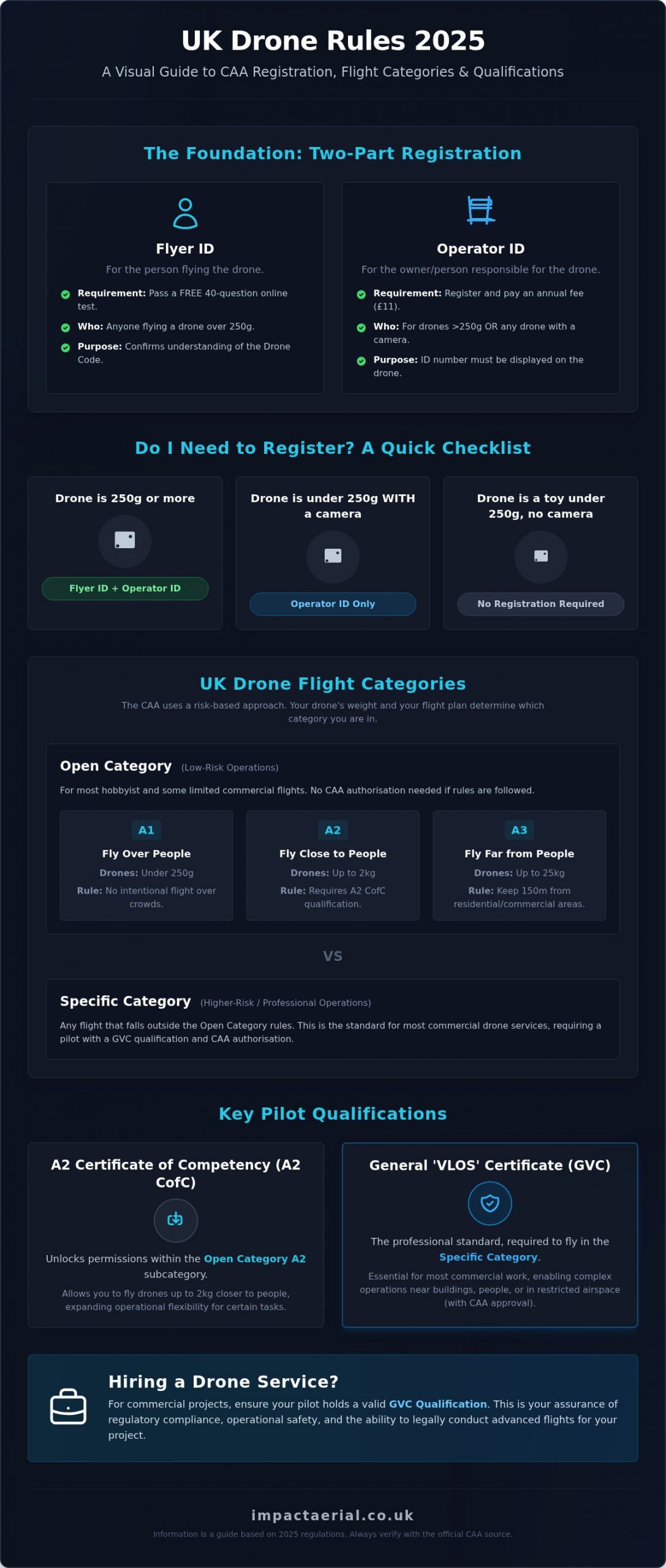
A Flyer ID is a personal qualification issued by the CAA to the individual who will be flying the drone. To obtain it, you must pass a free online theory test consisting of 40 multiple-choice questions. This test confirms that you have read and understood the essential safety rules outlined in the Drone and Model Aircraft Code. Anyone who flies a drone that requires registration must have their own Flyer ID. For individuals under 13, a parent or guardian must register them and supervise their flights.
What is an Operator ID?
The Operator ID is assigned to the person or organisation that owns or is responsible for the drone(s). This unique identification number must be clearly and legibly displayed on every aircraft you manage. It is a legal requirement for any drone weighing 250g or more, or for any drone under 250g that is fitted with a camera (which includes most commercial-grade sub-250g models). The Operator ID must be renewed annually, which currently involves a fee of £11, ensuring your details remain current on the CAA database.
Who Needs to Register? A Quick Checklist
Navigating the requirements can be simplified with this checklist. You must register if:
- You fly any drone or model aircraft weighing 250g or more: You need both a Flyer ID and an Operator ID.
- You fly a drone or model aircraft under 250g that is fitted with a camera: You only need an Operator ID. The person flying is still strongly encouraged to pass the Flyer ID test to ensure safe operation.
- You only fly a toy drone under 250g that does not have a camera: No registration is required.
Understanding UK Drone Flight Categories: Open vs. Specific
To operate a drone commercially in the United Kingdom, it is essential to understand the regulatory framework established by the Civil Aviation Authority (CAA). The CAA employs a risk-based approach, meaning the rules governing your flight are not one-size-fits-all. Instead, they are determined by the weight of your drone and the specific environment in which you plan to operate. This framework is divided into two primary classifications: the Open Category and the Specific Category, which directly influence the type of qualification or drone license you will require.
The Open Category: Flying in Low-Risk Areas
The Open Category is designed for low-risk drone operations and serves as the entry point for most flyers. It covers the majority of recreational flights and some highly restricted commercial activities. Operations in this category do not require prior authorisation from the CAA, but pilots must strictly adhere to its subcategory limitations:
- A1 (Fly Over People): For very light drones, typically those under 250g. This subcategory permits flight over uninvolved people, but never over crowds.
- A2 (Fly Close to People): For drones up to 2kg. This requires a greater separation distance from people and necessitates an additional qualification, the A2 Certificate of Competency (A2 CofC).
- A3 (Fly Far from People): For drones up to 25kg. These operations must be conducted in areas clear of people and at least 150 metres away from residential, commercial, or industrial sites.
The Specific Category: For Professional & Advanced Operations
For the vast majority of professional commercial drone services, the limitations of the Open Category are too restrictive. Any flight that falls outside its rules is classified under the Specific Category. This is the standard for higher-risk operations, such as flying in congested urban areas for property surveys, conducting inspections close to infrastructure, or operating nearer to people than the Open Category allows. To operate in this category, a commercial pilot must hold an appropriate drone license, such as the General Visual Line of Sight Certificate (GVC). Furthermore, the operator must obtain an Operational Authorisation from the Civil Aviation Authority (CAA) by submitting a detailed Operations Manual that proves the proposed flights can be conducted safely.
Key Qualifications: A2 CofC vs. GVC
When discussing commercial drone operations in the UK, it’s crucial to understand that there isn’t a single, mandatory ‘drone license’ that all pilots must hold. Instead, the Civil Aviation Authority (CAA) has established a framework of qualifications that grant pilots additional permissions and unlock more advanced operational capabilities. These certificates demonstrate a pilot’s competence and understanding of aviation safety, moving them beyond the basic rules of the Open category. The two primary qualifications for commercial work are the A2 Certificate of Competency (A2 CofC) and the General Visual Line of Sight Certificate (GVC).
The A2 Certificate of Competency (A2 CofC)
The A2 CofC is an entry-level qualification ideal for advanced hobbyists or those undertaking very simple commercial tasks. Its primary benefit is allowing pilots to operate in the A2 subcategory, which means flying closer to people who are not involved in the operation. This certificate significantly increases the freedom for operators using drones weighing between 250g and 2kg. Achieving the A2 CofC involves completing a theory-only examination with a CAA-approved Recognised Assessment Entity (RAE), with no practical flight test required.
- Best for: Low-risk commercial work, such as basic property photography with a lightweight drone.
- Permissions: Allows flight within the A2 subcategory (closer to uninvolved people).
- Process: Online training and a multiple-choice theory exam.
The General Visual Line of Sight Certificate (GVC)
For any serious professional, the GVC is the definitive qualification and the industry standard for commercial drone pilots in the UK. It is a more intensive course that requires passing both a comprehensive theory examination and a practical flight assessment with an RAE. Holding a GVC is a mandatory prerequisite for applying to the CAA for an Operational Authorisation, which allows for complex operations in congested areas or outside the standard rules of the Open category. The CAA’s official Commercial drone operations guidance outlines these requirements in detail. For professional services that demand the highest levels of safety and compliance, this qualification is non-negotiable. To provide our clients with complete peace of mind, every pilot at Impact Aerial is GVC certified.
Commercial Drone Operations: Why a GVC Matters for Clients
When commissioning aerial work, the focus is often on the final product-the stunning footage or critical survey data. However, the qualifications of the operator you hire are paramount, not just for quality, but for your own legal and financial protection. Choosing a pilot with a General VLOS Certificate (GVC) and an Operational Authorisation from the Civil Aviation Authority (CAA) is a non-negotiable aspect of due diligence for any business.
What an Operational Authorisation Allows
A GVC is the qualification a pilot needs to apply for an Operational Authorisation from the CAA. This authorisation is the key that unlocks operations in the ‘Specific Category,’ which is essential for most commercial projects. It permits a qualified operator to fly in ways that are otherwise not allowed under basic regulations, such as:
- Flying closer to buildings, people, and built-up areas.
- Operating specialist drones for complex tasks like inspections or 3D modelling.
- Conducting flights for commercial purposes like real estate marketing or construction progress monitoring in urban environments.
This authorisation proves the operator has developed and maintains a robust Operations Manual, detailing exhaustive safety procedures for every flight. Our CAA-approved status gives you complete peace of mind.
Insurance and Risk Mitigation
Perhaps the most critical reason to hire a certified professional is to mitigate risk. Hiring an uncertified or under-qualified pilot exposes your business to significant liability. Reputable insurers will not provide commercial drone insurance to an operator without CAA authorisation, meaning any flight they conduct is likely uninsured.
If an accident occurs-causing property damage or injury-the liability could fall directly on your business. An operator with a valid drone license and Operational Authorisation will hold valid commercial liability insurance. This protects your assets, your reputation, and your project. For added reassurance, Impact Aerial’s professional services are backed by £5 million in commercial liability insurance, ensuring every operation is fully covered.
The Drone and Model Aircraft Code: Rules for Every Pilot
Beyond the specific qualifications required for complex commercial tasks, the Civil Aviation Authority (CAA) has established a foundational set of rules that governs every drone flight in the UK. This is the Drone and Model Aircraft Code. Adherence to this code is non-negotiable and represents the bedrock of safe and responsible flying for every pilot, from hobbyists to seasoned professionals.
Understanding these principles is so critical that they form the entire basis of the theory test required to obtain your Flyer ID. This ID is the first step on the ladder for any pilot, and its principles remain relevant even after you have secured a professional drone license like the GVC. Following the code is your legal responsibility to protect people, property, and privacy on every flight.
Core Safety Rules
These principles are designed to prevent conflicts with manned aircraft and to ensure you always have full control of your drone. They are the absolute minimum safety requirements for any operation:
- Always keep the drone in your direct line of sight. This is known as Visual Line of Sight (VLOS). It means you must be able to see the aircraft with your own eyes at all times, not just through a screen or camera feed, to monitor its flight path and avoid collisions.
- Do not fly higher than 120 metres (400 feet) from the ground. This vertical limit is crucial for maintaining separation from most low-flying manned aircraft, such as helicopters and light aircraft, creating a safer airspace for everyone.
- Stay away from airports, airfields, and other aircraft. You must understand and respect Flight Restriction Zones (FRZs) around protected aerodromes. It is illegal to fly within these zones without explicit permission.
Respecting People and Privacy
As a remote pilot, your responsibilities extend beyond the technical aspects of flying. You must operate in a way that respects the safety and privacy of the public:
- Never fly over crowds or large groups of people. This is a strict rule to mitigate risk. An unexpected failure could cause serious harm if the drone were to fall into a congested area.
- Respect privacy laws when flying near homes or private property. If your drone is equipped with a camera, you are a data controller. You must be mindful of data protection regulations (GDPR) and avoid intrusive flights that could be perceived as surveillance.
- Ensure you are not endangering anyone. This is the overarching principle of responsibility. Before and during every flight, you must assess the risk to people and property below, ensuring your operation is safe at all times.
For commercial operators, these rules are just the starting point. Obtaining a GVC drone license and an Operational Authorisation from the CAA involves a much deeper understanding of risk assessment and safety procedures. For professional, fully-insured services that guarantee compliance and peace of mind, trust the experts at Impact Aerial.
Navigating UK Drone Regulations with Confidence
As we’ve explored, navigating the UK’s drone regulations in 2025 hinges on a clear understanding of the fundamentals. From securing your essential Flyer and Operator IDs to distinguishing between the Open and Specific flight categories, compliance is the cornerstone of every safe and legal flight. Understanding which qualification you need, such as the A2 CofC or the GVC, ensures you have the correct drone license for your specific operations.
For commercial projects where compliance and professionalism are non-negotiable, partnering with a fully certified operator provides complete peace of mind. The team at Impact Aerial brings this level of expertise to every job. Our pilots are CAA GVC Certified, backed by £5m in commercial liability insurance, and are a proud Drone Safe Registered Operator. This commitment to the highest industry standards ensures your project is not only visually stunning but also fully compliant.
Need a fully licensed and insured drone crew for your project? Contact Impact Aerial. Fly safe, fly legally, and unlock the incredible potential of aerial technology.
Frequently Asked Questions About UK Drone Regulations
How much does a UK drone license cost?
The term “drone license” typically refers to the qualifications needed for commercial work. The mandatory CAA Operator ID costs £11 per year. For more complex operations, you will need a General VLOS Certificate (GVC), with training courses costing between £500 and £1000. This GVC qualification, alongside a comprehensive Operations Manual, is required to apply to the CAA for an Operational Authorisation, which allows for more advanced commercial flights in the UK.
Do I need a license for a drone under 250g, like a DJI Mini?
For a sub-250g drone like a DJI Mini, you do not need to complete any formal training or examination. However, you are still legally required to register for an Operator ID if the drone belongs to you. While you don’t need a Flyer ID for a basic drone under 250g without a camera, models like the DJI Mini series do have cameras, so you must still pass the free online test and obtain a Flyer ID to fly it legally.
What is the difference between the old PfCO and the new GVC?
The PfCO (Permission for Commercial Operation) was the standard commercial permission issued by the CAA before regulations changed on 31st December 2020. It has now been replaced by the Operational Authorisation. The GVC (General VLOS Certificate) is the new remote pilot competency certificate required to apply for an Operational Authorisation. While existing PfCOs remain valid until they expire, all new applicants must now obtain a GVC to operate commercially.
Can I fly my drone in my garden or a local park?
Flying in your own garden is generally permitted, provided you respect your neighbours’ privacy and do not fly over their property without permission. Flying in public parks is more complex as many are subject to local council byelaws that may prohibit drone use. It is essential to check the specific rules for your local park, often found on the council’s website. Always prioritise safety and maintain visual line of sight with your drone.
Do I need specific drone insurance to fly in the UK?
Yes, for any commercial drone operations, you must have valid commercial liability insurance that is compliant with Regulation (EC) 785/2004. This is a legal requirement for anyone flying for business purposes. Even for recreational flying, particularly with drones weighing over 250g, having public liability insurance is highly recommended for your own peace of mind and to cover any potential accidents or damage to property.
How long are the Flyer ID and Operator ID valid for?
Your CAA Flyer ID, which confirms you have passed the online theory test, is valid for five years. Your Operator ID, which must be displayed on all your drones, is valid for one year. You must renew your Operator ID annually to remain compliant with UK regulations. The CAA will send a reminder when your renewal is due, and the current fee for renewal is £11.
Can I use a drone license from another country in the UK?
No, a drone license or qualification obtained from another country, including those within the EU, is not automatically recognised for commercial operations in the UK. To fly commercially, you must hold a UK-issued qualification, such as the GVC, and obtain an Operational Authorisation directly from the UK Civil Aviation Authority (CAA). Visiting pilots must comply fully with UK regulations and cannot operate under their home country’s permissions.
 2 Norton Drive, Wythall, Birmingham, B47 6HH Company registration number: 11138586. VAT Number: 366 9068 55